

Home > Blogs > ServiceNow > ServiceNow Performance Analytics Guide for ITSM Teams
February 27, 2026
ServiceNow Performance Analytics Guide for ITSM Teams
Table of Contents
In the current rapid digital environment, IT Service Management (ITSM) teams need more than simple reactive reporting; they require proactive, data-informed insights to enhance service delivery and operational effectiveness. This guide examines how ServiceNow Performance Analytics revolutionizes ITSM by surpassing conventional metrics to provide predictive intelligence and practical insights.
ServiceNow Performance Analytics (PA) is a sophisticated module on the ServiceNow platform intended to gather and assess historical data, recognize trends, foresee future results, and promote ongoing enhancement throughout IT operations. It transforms ITSM from a reactive approach to a proactive, strategic role, allowing teams to foresee problems before they affect services.
See the Impact of Performance Analytics in Action
What is ServiceNow Performance Analytics and Why is it Important in ITSM?
ServiceNow Performance Analytics is an effective tool that allows ITSM teams to obtain in-depth understanding of their service delivery performance, advancing from mere reporting to extensive data analysis. This change is essential for contemporary IT organizations seeking to move from reactive issue resolution to proactive service enhancement.
Performance Analytics revolutionizes decision-making in IT operations by offering insights into trends, pinpointing bottlenecks, and predicting future needs. Performance Analytics also strengthens governance and audit readiness by maintaining structured historical performance records. This enables IT leaders to demonstrate measurable service improvements over time, support compliance reporting, and align IT outcomes directly with enterprise KPIs.

Understanding ServiceNow Performance Analytics Core Components

ServiceNow Performance Analytics uses a systematic method for data gathering and analysis via its main elements: indicators, breakdowns, and scores.
Indicators
Key Performance Indicators (KPIs) that measure specific aspects of ITSM performance:
- Mean Time to Resolve (MTTR)
- SLA compliance
- Incident backlog growth
- Change success rates
Breakdowns
Dimensions used to segment indicators for granular insights:
- Assignment group
- Priority level
- Location
- Service category
Scores
Evaluated values of indicators captured at scheduled intervals, forming the basis of historical trend analysis and forecasting.
These factors collaborate to deliver a complete perspective on IT service performance. Unlike traditional reports that query live tables in real time, Performance Analytics captures scheduled data snapshots. This structured historical dataset enables predictive capabilities unavailable in standard reporting.
In addition to indicators, breakdowns, and scores, Performance Analytics supports targets and thresholds, allowing organizations to define acceptable performance ranges. Automated threshold-based alerts notify teams when performance deviates from expected baselines, enabling early corrective action.PA also supports automated data collectors and scripted data sources, enabling advanced metrics beyond standard ITSM tables — including integration with CMDB, asset data, and third-party monitoring tools.
The table below highlights the main distinctions between ServiceNow Performance Analytics and conventional ITSM reporting:
| Feature/Capability | Traditional ITSM Reporting | ServiceNow Performance Analytics |
| Data Collection Method | Real-time queries on live table data . | Scheduled historical snapshots (indicators) . |
| Historical Trending | Limited to current data views; manual historical comparison. | Automated, continuous data capture for trend analysis over time. |
| Predictive Capabilities | None; provides only current or past data snapshots. | Forecasting, anomaly detection, and predictive insights based on historical trends. |
| Real-time Visibility | High, reflects current operational state. | High, for operational views, but PA primarily focuses on trends rather than live counts . |
| Customization Effort | Relatively low for basic reports; higher for complex dashboards. | Requires specialized setup and training to avoid performance issues . |
| Automated Insights | Manual interpretation of reports. | Automated alerts, thresholds, and root-cause analysis tools. |
Setting Up Performance Analytics for ITSM Success

To maximize the value of ITSM, careful planning and configuration are essential when implementing ServiceNow Performance Analytics. Licensing for Performance Analytics is usually related to a portion of the total ServiceNow subscription or included with application solutions such as ITSM, instead of being based on per-user fees.
It is advisable to verify particular licensing information with your ServiceNow Account Executive or partner like Royal Cyber, since conditions can differ based on solution and deployment.
Essential configuration steps and recommended practices consist of:
- Establishing Specific Aims: Pinpoint distinct ITSM objectives that PA will assist in reaching, like decreasing Mean Time to Resolve (MTTR) or enhancing SLA adherence.
- Setup of Indicators and Breakdown: Establish essential ITSM metrics such as incident resolution duration, SLA adherence, and ticket quantity.
- Choosing Data Sources: Verify that data sources are precise and thorough for trustworthy insights.
- Non-Production Testing: Always conduct PA configuration tests in non-production settings to avoid destabilizing the instance.
Frequent setup mistakes involve misaligning expectations between PA snapshots and live reports, as well as employing high-cardinality breakdowns that may affect performance.
Essential ITSM Metrics to Track with Performance Analytics

To successfully enhance ITSM, teams need to concentrate on monitoring essential metrics that offer practical insights into service performance and effectiveness. Performance Analytics provides the ability to continuously track these KPIs.
Essential measures consist of:
- Mean Time to Resolve (MTTR): An essential metric for incident management, offering considerable improvement opportunities via focused objectives. Organizations utilizing AI-driven tools experience a 75% decrease in ticket resolution times.
- First-Call Resolution (FCR) Rate: Assesses the proportion of issues addressed in the first interaction, enhancing both customer satisfaction and operational efficiency.
- SLA Adherence: Monitors compliance with service level agreements, pinpointing areas where service delivery does not meet promises.
- Ticket Backlog Trends: Offers information on the increase or decrease of outstanding incidents and requests, signaling possible resource or process challenges.
- Change Success Rates: Tracks the rate of successful changes, aiding in evaluating the efficiency of change management procedures.
- Problem Recurrence: Determines the frequency of problem reappearance, emphasizing the success of root cause analysis and efforts to resolve issues.
Additional high-impact KPIs to consider include:
- Cost per Ticket
- Reassignment Rate
- Incident Reopen Rate
- Service Request Fulfillment Time
- Change Lead Time
Tracking metric interdependencies — such as correlating failed changes to incident spikes — provides deeper operational intelligence than isolated KPI monitoring.
Building Custom Dashboards for Stakeholder Visibility
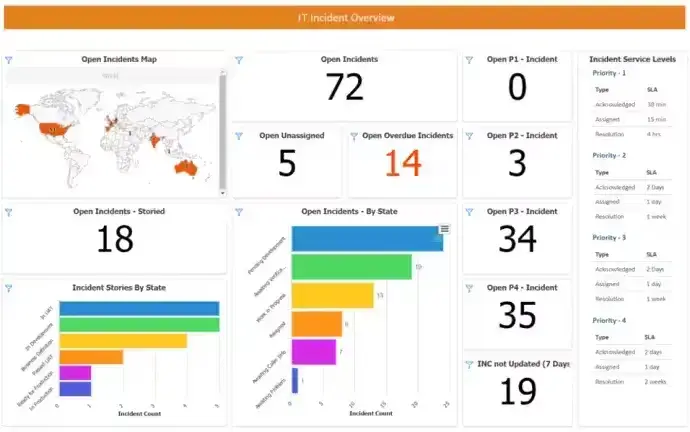
Custom dashboards in ServiceNow Performance Analytics are crucial for delivering personalized, role-specific insights into ITSM performance. These dashboards convert raw information into simple and understandable visual insights.
In dashboard design, it is essential to distinguish between executive views that emphasize high-level strategic KPIs and operational team views that offer detailed data for daily management. Dashboards need to be interactive, providing drill-down features to examine data more thoroughly.
Optimal methods involve restricting the number of widgets per tab (e.g., 5-10) and employing indicator scores instead of live reports to enhance performance. Access based on roles guarantees that every stakeholder views only the pertinent performance information, promoting accountability and informed decision-making.
Leveraging Predictive Intelligence for Proactive ITSM
ServiceNow’s Predictive Intelligence, closely aligned with Performance Analytics, allows ITSM teams to transition from reactive to proactive service management. This integrated AI component employs machine learning to predict trends and detect possible problems before they worsen.
Predictive Intelligence aids in anticipating incident volumes and resource requirements by examining past data and recognizing trends. It can identify patterns of performance decline that could result in SLA violations, enabling proactive measures. Automated notifications for anomaly detection guarantee that IT teams are promptly informed of atypical actions or variances from standard performance metrics.
The platform provides frameworks for classification, similarity, and clustering models to automatically sort tasks, suggest solutions, and detect significant incidents. Almost 65% of companies are implementing or assessing AI for data analytics, highlighting the increasing significance of these abilities.
Integration with Royal Cyber's ServiceNow Optimization Services
Royal Cyber excels in speeding up the implementation of Performance Analytics for organizations, delivering strong and tailored solutions. We recognize that successful analytics necessitate more than mere software; they require strategic alignment and specialized setup.
We customize Performance Analytics to align with specific ITSM needs in various industries, utilizing our extensive knowledge to adapt indicators, breakdowns, and dashboards. Clients such as X have experienced measurable ROI through our optimization services, including enhanced SLA compliance and reduced ticket volumes.
We offer continuous enhancement and managed services, guaranteeing enduring performance and ongoing progress. We aim to convert your ITSM processes into a data-focused engine, allowing for anticipatory decision-making and enhanced service delivery.
Read the Success Story
Key Takeaways
- ServiceNow Performance Analytics transforms ITSM from reactive reporting to proactive, data-informed enhancement.
- Essential elements such as indicators, analyses, and scores deliver extensive historical trends and insights.
- Proper licensing and the selection of data sources are essential components of a strategic setup for effective implementation.
- Monitoring key KPIs such as MTTR, FCR, and adherence to SLA enhances operational effectiveness.
- Personalized dashboards offer specialized, role-specific insights for different stakeholders.
- Predictive Intelligence utilizes machine learning to anticipate trends and avert service interruptions.
- Specialized collaborators such as Royal Cyber enhance implementation and refine Performance Analytics for ongoing business value.
As organizations mature in digital transformation, ITSM analytics increasingly serve as a foundation for Enterprise Service Management (ESM), extending performance visibility beyond IT into HR, facilities, finance, and customer service operations.
Conclusion
ServiceNow Performance Analytics is a crucial resource for contemporary ITSM teams, facilitating a significant shift from reactive problem-solving to proactive service enhancement. Through the use of automated data gathering, historical analysis, and predictive insights, organizations can achieve unmatched clarity in their IT operations.
The value of Performance Analytics for businesses is evident: increased efficiency, lower costs, better service quality, and a substantial competitive edge through metrics-focused service management. Initiating the process entails establishing specific goals, setting up essential metrics, and creating customized dashboards to deliver practical insights.
With ongoing advancements in AI integration, the potential of ITSM analytics will expand, enabling teams to foresee and tackle issues with unmatched accuracy. Royal Cyber is prepared to assist businesses on this path, guaranteeing that your ServiceNow Performance Analytics implementation achieves optimal results and ongoing success.
Talk To Our Experts
Recent Blogs
June 9, 2026
Agentforce and Microsoft Copilot Studio are the two dominant enterprise…
Read More »
June 4, 2026
Websites used to be something you built once and basically…
Read More »
June 4, 2026
Websites used to be something you built once and basically…
Read More »