

GCP Pratice Lead
March 18, 2025
Table of Contents
It’s not always that you get to choose the best of both worlds. Especially when it comes to choosing between different IT related services. The decision to go with one over the other often leads to having to live with the drawbacks that the respective technology has to offer. While most companies often take a strategic view-point that involves decisions based on their specific IT needs, employee preferences, and process workflows – the draw-back can sometimes be a niggle.
One major decision that has emerged over the years for IT companies is a move to the cloud. Today, this decision isn’t just limited to shifting of infrastructure; it’s also about changing how teams work, how processes flow, and how quickly businesses can respond to change. As a result, making a decision as critical as moving to the cloud can be a tough one.
Going by Gartner’s Magic Quadrant, Google’s cloud platform has been named as the “preferred” cloud destination three years in a row. However, for enterprises that are currently on Microsoft’s ecosystem, moving might not seem very prudent considering the overall chaos that will ensure post the migration. This is where our case study comes to the fore. It looks at how one company successfully managed the migration to GCP while maintaining all the benefits that Microsoft has to offer.
The On-Premises Struggle: What Was Holding Them Back?
Before adopting a cloud-based solution, the company was running an on-premises system, using a GitLab repository and Kubernetes clusters for deployment. At first, this setup worked fine. But as usage grew, so did the headaches:
- Scaling was a nightmare – The platform couldn’t scale fast enough to keep up with business demands.
- Too much manual work – Every update or deploy required cumbersome, error-oriented processes.
- Money down the drain – Resources lay idle as cost continued to escalate.
- No automatization – Since there was no real CI/CD pipeline in place, deployments were slow and inefficient.
- Infrastructure headaches – Debugging and managing servers took away too much precious time.
It became clear that supporting this structure wasn’t possible. They needed a more scalable, efficient solution—one that wouldn’t keep the business back.
Why They Chose Azure DevOps on Google Cloud
The company knew they needed a cloud-native solution but didn’t want to be tied into one platform. The combination of Azure DevOps and GCP gave them the benefits of both worlds.
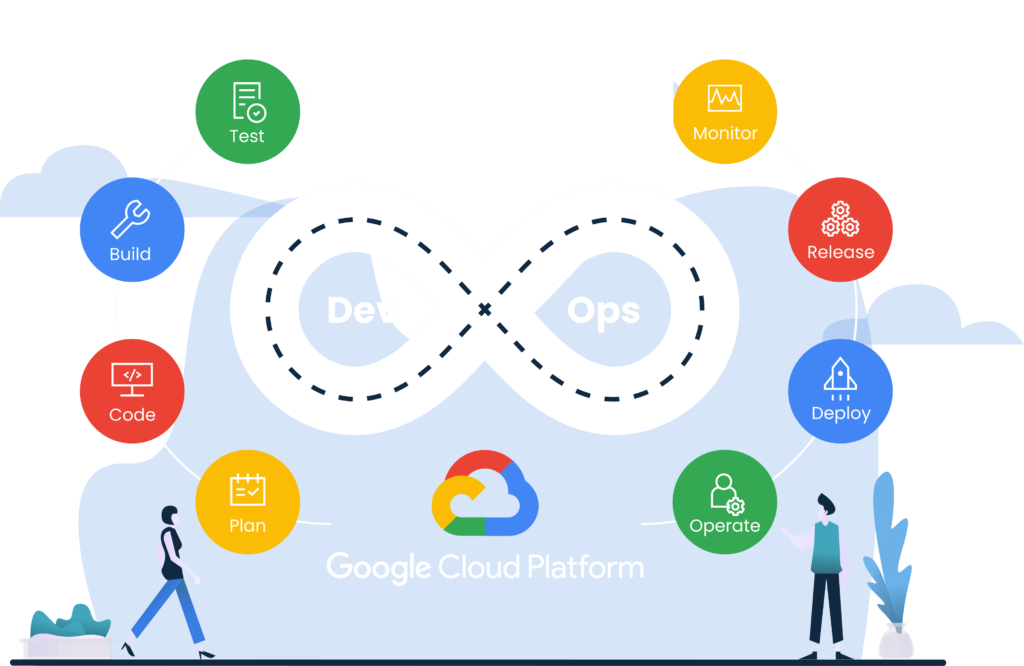
Azure DevOps provided an end-to-end suite of version control, CI/CD automation, and project management tools. Google Cloud gave them auto-scaling, cost savings, and cloud-native capabilities to handle scaling. With these two platforms together, they were able to:
- Automate deployment with effective CI/CD pipelines, minimizing human mistakes.
- Save resources with GCP’s auto-scaling, so they weren’t paying extra for idle infrastructure.
- Improve disaster recovery by employing cloud-based backups for higher reliability.
- Simplify infrastructure management with Infrastructure as Code (IaC) using Terraform.

The Business Impact: Real Results, Not Just Technical Wins
This was not a technical victory—it fundamentally changed the way the business operated. Among some of the biggest benefits were:
- Faster releases – Automation sped up development cycles so teams were able to deploy updates more frequently.
- More flexibility – The multi-cloud setup made it easier to respond to changing business needs.
- Stronger security – Automated compliance checks and testing made sure regulatory demands were constantly being met.
- Lower costs – Pay-as-you-go pricing with GCP meant they weren’t paying for idle resources.
- Better collaboration – With everything on Azure DevOps, development, operations, and QA teams could work seamlessly together.
- Future-proofing – The new infrastructure was scalable, so they wouldn’t be plagued by the same bottlenecks in the future.
Key Takeaways for Business and IT Leaders
For CIOs thinking about making a similar transition, these are some of the key takeaways:
- Migration to the cloud is not about “moving stuff” – It’s an opportunity to rethink how it gets done.
- Automation must be prioritized – The more that can be automated, the less bottlenecks and errors.
- Having a multi-cloud strategy is more adaptable – Being tied to one platform can be challenging.
- Cost optimization is an ongoing process – Cloud spending must be tracked and revised on a recurring basis.
- Security and compliance must be baked in – Security can’t be an afterthought. It must happen now.
- Collaboration breeds success – The right tools tear down silos and facilitate collaboration.
Final Thoughts
For this bank, going to Azure DevOps on Google Cloud was a paradigm shift. It wasn’t just about upgrading IT—it was about enabling faster innovation, enhanced efficiency, and cost savings all the way.
To business leaders, the lesson here is clear: Cloud adoption is not a tech decision—it’s a business strategy. The real question is not whether or not to move forward, but how to do it so that the greatest amount of benefit can be achieved. With the right tools and proper methodology, the opportunities are endless.
Author
Benjamin Samson
 Websites used to be something you built once and basically forgot about. That doesn’t work …Read More »
- Learn how to plan an Optimizely CMS 13 upgrade with .NET 10, Optimizely Graph, Visual …Read More »
- Learn how AI meeting notes automate summaries, action items, and insights from video meetings using …Read More »