
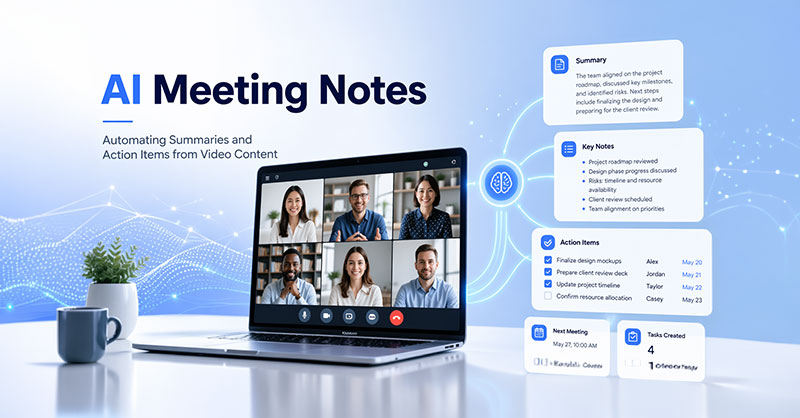
Royal Cyber builds AI-powered meeting intelligence solutions that close this gap for good. Using Microsoft Azure AI services, OpenAI models, and enterprise integration platforms, we design end-to-end pipelines that automatically transcribe, analyze, and summarize recorded meetings — and push structured outputs directly into the tools your teams already work in. This blog walks through exactly how the technology works, what a production-grade pipeline looks like, and what enterprises need to think through before rolling it out at scale.
What Is Meeting Summary Automation?
Fundamentally, meeting summary automation takes an unprocessed video or audio recording and transforms it into systematized, actionable documentation – transcripts, summaries, tasks allocated, and decisions recorded – without anyone needing to complete it manually. The pipeline consists of four interrelated AI parts:
- Speech-to-Text (ASR): Spoken dialogue is converted to text. Azure Speech Service employs a trained Universal Speech Model which supports numerous dialects and domains by default. Whisper, an openAI application, shows almost-human transcription accuracy under a variety of audio conditions, including zero-shot.
- Speaker Diarization:The system determines who spoke and what.A Voice Activity Detection (VAD) model divides audio into speech and silence blocks, and neural speaker-embedding models encode each block and groups them by speaker identity – creating a labeled transcript with every line in it being attributed (Speaker A: ., Speaker B: .).
- NLP Analysis:Transformer-based models extract topics, decisions and action items by digging into the transcript.Extractive methods pick the most significant sentences directly out of the text; abstractive methods (e.g. based on the LLM GPT-4o) rephrase material into a new, shorter, and easier-to-read form. The type of which one is using will depend on the accuracy and fluency needs.
- Summarization and Output:The AI packages the completed output executive summary, topic-based highlights, action-item list, with owners and deadlines – formatted to be delivered directly into your enterprise systems.
The end result: What would have taken someone an hour to summarize by hand is now easily searchable, organized documentation in a few minutes.
Why Automating Meeting Summaries Matters at Enterprise Scale
The numbers here are worth paying attention to. Organizations that have deployed AI meeting intelligence are seeing real, measurable outcomes:
- 40% faster meeting follow-ups — summaries and task lists are ready the moment the recording ends, so there is no lag between what was decided and what gets acted on.
- 25% improvement in action-item completion rates — when tasks are explicitly assigned with named owners and recorded deadlines, fewer things fall through the cracks.
- 395% ROI — reported by organizations using conversation intelligence platforms, driven primarily by the labor hours saved on documentation and follow-up coordination.
- Over 80% enterprise adoption — among large organizations, which tells you this has moved well past the experimental phase and into core operational infrastructure.
The productivity gains are real, but the deeper value is in what gets preserved. Every meeting is full of decisions, risk discussions, customer feedback, and institutional context that — without automation — lives only in the heads of whoever was in the room. AI-archived meeting libraries become a searchable knowledge base that new team members can onboard from, that compliance teams can audit, and that managers can query when context is needed months later.
How AI-Powered Meeting Automation Works: The Technical Pipeline
A production meeting automation system follows a five-stage pipeline. Here is how each stage works in practice:
- Capture the Meeting Recording. Meetings are recorded via the conferencing platform. In Microsoft Teams environments, the Azure Communication Services (ACS) Call Recording API captures the mixed audio stream and writes it to Azure Blob Storage. A blob upload event then triggers an Azure Function to kick off downstream processing — so the handoff from capture to analysis happens automatically, with no manual step required.
- Transcribe Speech to Text. Azure Speech Service or OpenAI Whisper converts the audio to text. Azure’s Universal Speech Model handles diverse dialects and domain-specific vocabulary without custom configuration. Speaker diarization runs in parallel: VAD segments the audio, speaker-embedding models encode each segment, and clustering assigns speaker labels — giving you a structured transcript where every line knows who said it (Alice: …, Bob: …).
- Analyze the Conversation. NLP models extract structure from the labeled transcript across four dimensions:
- Topic Segmentation: Semantic embedding clustering or supervised topic labeling divides the transcript into agenda parts, so a user can go to the part that interests him directly instead of going through the entire transcript.
- Action Item Detection: Intent classifiers and Semantic Role Labeling search through commitment language – I will send, please complete – and extract tasks that have owner, action and deadline. A sentence such as Alice will send the report by Friday would be a clean record: Task: send report, Owner: Alice, Due: Friday.
- Decision Extraction:Abstractive models or LLM prompts are able to extract and summarize the explicit conclusions and decisions that resulted out of the conversation.
- Sentiment / Urgency Tagging (optional): Flags tone or urgency indicators which can be applied to items in downstream workflows.
- Generate Summaries and Action Items. The AI constructs the final output with the extracted structure.The concise summary is generated by a transformer summary model – BART, GPT-4o or domain-fine-tuned version. The formatted output will generally consist of an executive summary paragraph, topic segmentation discussion highlights, the action item list, including the owners and dates, and the decisions made.
Example — using HuggingFace transformers to summarize a transcript: from transformers import pipeline
					summarizer = pipeline("summarization", model="facebook/bart-large-cnn")

transcript_text = get_transcript("meeting_audio.wav")

summary = summarizer(transcript_text, max_length=150, min_length=50, do_sample=False)

print(summary[0]['summary_text'])

Or via an LLM prompt to extract action items directly:

response = openai.ChatCompletion.create(

    model="gpt-4o",

    messages=[

        {"role": "system", "content": "Extract action items and owners from the meeting transcript."},

        {"role": "user", "content": transcript}

    ]

)
5. Store and Share the Output.
Key Capabilities of an Enterprise Meeting Intelligence Solution
A production-grade meeting AI platform does a lot more than transcribe. Here are the capabilities that actually determine whether a solution is enterprise-ready:
- Automatic Speaker Diarization: Neural VAD and speaker-embedding pipelines label each speech segment by participant — improving readability, enabling per-speaker action assignment, and supporting compliance scenarios where attribution is a hard requirement.
- Action Item Extraction with Ownership: The NLP elements trained to classify intents identify task commitments and associate them with the speaker. The result is a formatted table of activities, owners and timelines – that can be immediately imported into your project management.
- Topic Segmentation: Semantic clustering or supervised labeling divides long transcripts of meetings into agenda-navigable parts. Users scroll to what they require rather than reading the entire one.
- Searchable Meeting Knowledge Base: Transcripts, summaries, and metadata are indexed for full-text and semantic search. Vector embeddings handle fuzzy queries well — searching ‘customer escalation’ returns contextually relevant segments even when those exact words weren’t used. Azure Video Indexer and Cognitive Search provide this natively for Teams and ACS recordings.
- Enterprise Workflow Integration: The product integrates through APIs and webhooks with the tools used by teams in real life — Slack, Teams, Jira, Trello, Notion, CRM systems. Action items are fed in automatically.
- Real-Time Assistance (Emerging): Azure Communication Services already provides real-time transcription with in-meeting notifications, compliance flagging during calls and real-time fact-checking against enterprise data, in preview.
Business Benefits of Automating Meeting Notes
- Higher Productivity: Staff stop taking notes and start participating fully. Follow-up handling speeds up by roughly 40%, which means faster execution on every decision made in every session.
- Improved Accountability: Each action item exists in the system with a description of the owner and date.A formatted list of tasks that is centrally located eliminates any confusion over who does what.
- Institutional Knowledge Retention: The decisions, discussions during the design process, risk assessment, and customer feedback are all stored in a long-lasting searchable format.
- Faster Decision Review: Summaries and transcripts are available immediately. Managers can see what was decided, what’s still open, and what needs escalation — without waiting for someone to write it up.
- Distributed Team Alignment: Coworkers who are not in the same time zone or not present during the live meeting read the summary and task list rather than watching the recording of the meeting session- keeping distributed teams on task without unnecessary repetitive meetings.
Best Practices for Implementing Meeting Automation
- Start with high-value meetings: Pilot on meetings in which there is structured output with direct and immediate value – leadership review, project steering, customer calls, incident post-mortem. These contain the most decisions and action items and thus ROI can be easily proved at an early stage.
- Protect sensitive content: Encrypt transcripts and audio on the rest and during transit. Limit access to stored recording and summaries. Where sensitive information is involved in the meetings, on-device solutions like the LFM2 by Liquid AI that do not involve any external data transfer, but act solely on local hardware, can eliminate cloud exposure. Establish set retention and anonymization policies that are consistent with GDPR, HIPAA, or other frameworks as needed in your environment.
- Standardize output formats: Have templates as Key Points, Decisions, Action Items, Participants that are part of any type of meeting. The regular structure allows downstream systems to read outputs and makes it less mental effort on the part of a person reading it.
- Integrate with existing workflows:Meeting AI provides the maximum benefit when its outputs get dropped into the tools teams already use in practice – Slack channels, Jira boards, CRM records, knowledge bases. When people are forced to go somewhere new to get the summary, adoption is harmed.
- Keep humans in the loop, at least initially: Build in a lightweight review step where meeting organizers can validate AI outputs before they go wide. Track transcription error rate, action-item capture precision, and summary accuracy. Use confidence scores to flag uncertain outputs for human review. The AI improves over time; the feedback loop is what makes that happen.
- Plan for continuous improvement:Measure WER, summarization recall, and task extraction precision continuously.Periodically update ASR vocabularies as the terminology of your organization changes, retrain models when the format of those changed, and structure the pipeline in such a way that the individual components of it, such as ASR, NLP, or LLM can be updated without the need to rewrite everything.
The Future of AI in Meeting Intelligence
- Real-Time Meeting Assistants: Software that monitors live discussions and displays in-meeting notices – flagging an outstanding commitment, proposing a follow-up activity, or verifying a statement with enterprise data in real time as it is being spoken.
- Automated Compliance and Risk Checks: AI-based models that identify policy breaches, sensitive information leaks, or reg-related risk sentences during calls – thereby leading to automatic redaction or warning the host that the information has gone beyond its boundaries.
- Context-Aware Follow-Up: AI that follows up on decisions after a meeting – after a budget approval, a discussion with a customer, or any other enterprise record, not a human would manually create a link between the decision and its relevant record.
- Cross-Meeting Analytics: With the increasing archive of meetings, AI uncovers trends across the entire corpus – common project bottlenecks, customer issues that are trending, risks that are revisited across meetings. Natural queries such as How often has Project X timetabled slipped in our meetings this quarter? are answerable.
- On-Device Processing: Systems such as Liquid AI LFM2-2.6B can process one-hour-long meetings in a few seconds using less than 3GB of RAM, which is feasible to conduct sensitive meetings without any data being transmitted to the cloud.
- Multimodal Intelligence: Next-generation meeting AI will handle slides, shared documents, and video cues in addition to the audio transcript, generating summaries with visual context and allowing natural language queries across the entire meeting history, and not just what was said.
Conclusion: From Communication Event to Organizational Intelligence
AI-driven meeting automation is not a futuristic concept — it is production-ready infrastructure available right now. Azure Communication Services, Azure Speech Service, Cognitive Search, and modern LLMs give enterprises everything they need to build pipelines that turn any recorded meeting into structured, searchable, actionable documentation. The organizations investing in this now are not just saving note-taking hours — they are building a compounding organizational asset.
Royal Cyber designs and delivers these implementations end to end. Our AI practice brings together deep Microsoft Azure expertise and enterprise integration experience across financial services, healthcare, and professional services. We build meeting intelligence pipelines that plug into your existing collaboration stack, meet your data governance requirements, and start delivering measurable outcomes from day one. Whether you are still evaluating the technology or ready to move into production, we have the architecture depth and delivery track record to get you there .
Frequently Asked Questions
The majority of production pipelines consist of Azure Speech Service or OpenAI Whisper to do ASR, a neural VAD and speaker-embedding model to perform diarization, and either a fine-tuned transformer (BART) or a prompted LLM (GPT-4o) to summarize and extract action-items. The correct decision between extractive and abstractive summarization depends on your accuracy and fluency needs- extractive maintains the original wording, abstractive generates more readable output, but requires more powerful model.
Intent classifiers find commitment expressions such as I will. or Please complete and mark them as candidate tasks. Semantic Role Labeling subsequently roots the structured elements of owner, action, deadline out of context. Extraction via a prompt using LLM can achieve high quality results without a purpose-trained classifier, but at a cost in API and prompt design.
Transcripts and audio must be encrypted both on the rest and on the transit, and there should be controls over who may access the stored recordings. Policies regarding retention should be based on GDPR, HIPAA, or your relevant frameworks, such as automatic deletion or anonymization after a specified duration.
We build the full pipeline: ACS for recording capture, Azure Speech Service for transcription and diarization, Azure OpenAI Service for GPT-4o-powered summarization, and Azure Cognitive Search for cross-meeting querying. Outputs are pushed into enterprise tools via Microsoft Graph API or Power Automate. Compliance requirements — data residency, access control, retention — get addressed at the architecture stage, not retrofitted after go-live.
The basic metrics are Word Error Rate (WER) of transcription, ROUGE or BERTScore of summation quality, and precision/recall of a list of ground-truth tasks of action-item extraction. In manufacturing, the quality indicator of a human-in-the-loop review in the first rollout helps to propagate continuous improvement. ASR, NLP, and LLM modules should be designed in a modular fashion to enable upgrading of the pipeline to better models as they become available.
Author
AI Engineer - AI Innovation
Content Writer
Agentforce and Microsoft Copilot Studio are the two dominant enterprise…
Read More »
Websites used to be something you built once and basically…
Read More »
Websites used to be something you built once and basically…
Read More »