


AI systems progress and advances at unparalleled speeds due to the inception of Large Language Models (LLMs) allowing for exceptional possibilities of intelligent agents having the abilities to reason in intricate ways. Still, using these models to make them execute multiple-step tasks consistently is the major obstacle.
Problem Statement/Objective
Traditional LLM implementations face several limitations when tasked with complex, multi-step reasoning problems:
- Lack of structured reasoning: LLMs often struggle with maintaining consistent logical flow when solving complex problems that require multiple steps.
- Memory constraints: Standard implementations have limited ability to maintain context over extended interactions or complex reasoning chains.
- Absence of self-correction mechanisms: They generally do not possess error evaluation and rectification tools of a good enough quality.
- Limited process transparency: The internal decision-making processes of LLMs are often hard to audit as they are not transparent, making it difficult to understand how conclusions were derived.
- Workflow control challenges: Directing LLMs through specific reasoning paths or enforcing procedural constraints remains problematic in conventional implementations.
The objective of this implementation is to create an AI agent system using LangGraph and LangChain that addresses these limitations by:
- Establishing a structured, graph-based reasoning framework that guides the agent through complex problem-solving processes
- Implementing persistent state management for improved context retention
- Creating feedback loops that enable self-correction and refinement of reasoning
- Providing clear visibility into the agent’s decision-making processes
- Enabling modular design that allows for customization and extension of agent capabilities
Planning Stage
Phase 1: Environment Setup and Framework Installation
1. Environment Preparation:
- Setup a Python environment (3.9+ recommended)
- Install necessary dependencies including LangChain and LangGraph
- Configure API access for the selected LLM provider
2. Key Configuration Requirements:
python -m pip install langchain langchain-openai langgraph
3. API Configuration:
- Set up environment variables for API keys
- Configure rate limiting and token usage monitoring
- Establish error handling protocols for API communication
Phase 2: Agent Architecture Design
1. Define Agent States:
- Identify core states: Planning, Execution, Reflection, and Termination
- Establish transition conditions between states
- Design state representation schema
2. Agent Memory Structure:
- Design working memory structure
- Implement persistent memory architecture
- Define memory retrieval and update protocols
3. Decision Flow Mapping:
- Create directed graph of state transitions
- Define conditional routing logic
- Establish termination criteria
Phase 3: Core Components Implementation
1. LLM Integration:
- Select and integrate appropriate LLM (e.g., OpenAI’s models)
- Implement prompt templates
- Configure model parameters for different agent states
2. Graph Construction:
- Define nodes for each state
- Implement edge conditions
- Create visualization of the agent graph
3. Tool Integration:
- Define and implement necessary tools for agent execution
- Create interfaces between agent states and external tools
- Implement error handling for tool usage

Phase 4: Testing and Refinement
1. Unit Testing:
- Test individual state transitions
- Validate memory persistence
- Verify tool functionality
2. Integrated Testing:
- Test complete agent workflow
- Identify and resolve circular reasoning issues
- Optimize prompt efficiency
3. Performance Benchmarking:
- Measure completion time for complex tasks
- Analyze token usage efficiency
- Compare with baseline implementations
Development Steps
Step 1: Setting Up the Environment
First, install the required packages for implementing the AI agent:

Step 2: Importing Dependencies
Import the necessary components from LangChain and LangGraph:

Step 3: Defining Agent Tools
Create custom tools that the agent can use to accomplish tasks:

Step 4: Implementing Agent States
Define the core states and their functionality:


Step 5: Creating the Agent Graph
Construct the directed graph that defines the agent’s workflow:

Step 6: Implementing Agent Memory
Set up memory management to maintain context across state transitions:


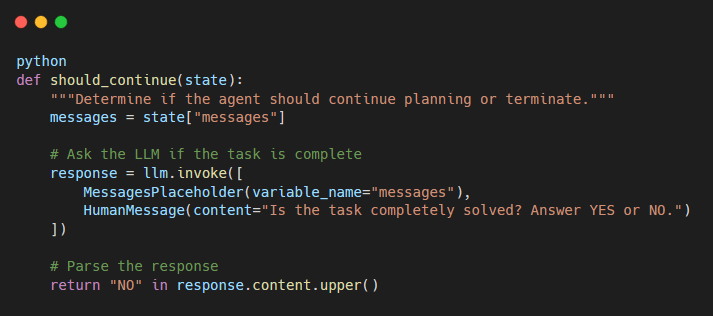
Step 7: Implementing Conditional Logic for State Transitions
Create the decision function to determine when to continue the reasoning loop:

High-Level Solution Design/Architecture
The AI agent architecture is built around a directed cyclic graph pattern that enables sophisticated reasoning through structured workflows. The design consists of several key components:
Core Architectural Components
1. State Graph:
- Central to architecture is the StateGraph object that manages transitions between different reasoning states
- Implements a directed cyclic graph allowing for iterative reasoning processes
- Enables conditional branching based on the agent’s assessments
2. State Handlers:
- Planning: Formulates approach strategies based on user input
- Execution: Carries out planned actions using available tools
- Reflection: Evaluates results and determines if additional reasoning is needed
- Termination: Finalizes the process and presents conclusions
3. Memory Management:
- Conversation buffer maintains context across state transitions
- Working memory holds intermediate results and reasoning steps
- Long-term memory (optional) retains knowledge from previous sessions
4. Tool Integration Layer:
- Provides standardized interfaces for external capabilities
- Includes built-in error handling and retry mechanisms
- Enables seamless integration with both internal and external resources
Architecture Diagram

Data Flow
- User input is processed and converted into an initial state
- The planning state analyzes the request and formulates an action strategy
- The execution state implements the plan using available tools
- The reflection state evaluates results and determines next steps
- Based on reflection, the system either returns to planning (continuing the loop) or terminates with a response
- Throughout the process, the memory system maintains context and accumulated knowledge
This architecture provides several advantages over traditional LLM implementations:
- Clear separation of concerns between different reasoning stages
- Robust handling of complex multi-step tasks
- Improved transparency in the decision-making process
- Enhanced ability to recover from errors through the reflection stage
- Flexible integration of specialized tools and external services
Challenges and Resolutions
Challenge 1: Circular Reasoning and Infinite Loops
Challenge
When implementing feedback loops in the agent architecture, there’s a risk of the agent getting stuck in circular reasoning patterns, continuously revisiting the same steps without making progress. This results in infinite loops and wastes computational resources.
Resolution
Implemented explicit termination conditions and loop counters to track state transitions. Added a maximum iteration limit and designed the reflection state to identify when reasoning becomes circular, forcing termination after a predetermined number of iterations without meaningful progress.
Challenge 2: Prompt Engineering Complexity
Challenge
Creating effective prompts for each agent state proved challenging, especially ensuring that prompts contained sufficient context without overwhelming the model with irrelevant information or exceeding token limits.
Resolution
Developed a tiered prompt system with core instructions and dynamically inserted context. Implemented a prompt management system that selectively includes relevant information based on the current state and task requirements, while maintaining a consistent “persona” across all agent states.
Challenge 3: State Persistence and Memory Management
Challenge
Maintaining coherent context across multiple state transitions posed significant challenges, particularly when dealing with complex reasoning chains that require referencing earlier conclusions.
Resolution
Implemented a structured memory architecture with separate working memory and long-term memory components. Created a context window management system that intelligently prunes less relevant information while preserving critical facts and reasoning paths through explicit memory structures.
Challenge 4: Error Propagation and Recovery
Challenge
Errors in one state could silently propagate through the system, causing cascading failures in subsequent steps without clear indication of the root cause or appropriate recovery mechanisms.
Resolution
Implemented comprehensive error handling at each state transition with explicit error states and recovery paths. Added validation checks between states to verify output quality and consistency, with automatic fallback strategies when outputs don’t meet predefined quality thresholds.
Challenge 5: Tool Integration and Authentication
Challenge
Integrating external tools and APIs while managing authentication securely across the agent’s lifecycle presented operational complexities, especially when tools required different authentication methods.
Resolution
Developed a unified tool registration system with standardized interfaces for authentication management. Implemented credential isolation to ensure secure handling of API keys and other sensitive information, with centralized logging of tool usage to facilitate debugging and performance optimization.
Key Takeaways
- Graph-Based Flow Control Enhances Reasoning Quality: The implementation demonstrated that structured, graph-based control flow significantly improves the quality and reliability of LLM reasoning. By explicitly modeling the reasoning process as distinct states with well-defined transitions, the agent produced more consistent results with fewer logical errors compared to simple prompt-completion approaches.
- Reflection Stages Are Critical for Self-Correction: The inclusion of dedicated reflection states within the agent architecture proved essential for enabling self-correction and improving reasoning quality. The metacognitive capability of the agent is the one which makes it possible to detect the errors it has committed or the limitations of its reasoning process and to adjust the plan of action accordingly.
- Memory Architecture Significantly Impacts Performance: The design of the agent’s memory system proved to be a critical factor in overall performance. Structured approaches to memory management that distinguish between working memory, conversation history, and long-term storage enable the agent to maintain context more effectively across complex reasoning chains.
- Modular Design Enables Rapid Customization: The LangGraph architecture’s modular design enables quick agent capability extension and customization without necessitating a core system redesign.
- Transparent Reasoning Improves User Trust: Having the reasoning states and their representation explicitly modeled has the benefit of the agent’s decision-making process becoming clear for everyone. In other words, the transparency in this case would mean that the user is able to see the reasons behind the agent’s decision. Accordingly, this feature will empower users both in terms of understanding how conclusions are drawn and finding problems in the sequence of reasoning. Ultimately, without transparency, the smartest, most capable, and fastest thinking agent can do very little or even… more unintentional harm.
The deployment of AI agents through LangGraph and LangChain marks a major breakthrough toward building dependable AI solutions which show transparency and efficiency. The agent reasoning system built as a directed graph with explicit planning, execution, and reflection states solves multiple issues which exist in typical LLM implementations. The system maintains context while using feedback loops for error correction and integrates specialized tools to create AI agents that can perform complex multi-step tasks better than traditional methods. This structured implementation offers organizations a valuable framework that merges large language models with necessary control and transparency for mission-critical applications and creative capabilities. Research in this domain needs to enhance agent learning capabilities from historical interactions while optimizing state transition processes and developing advanced reflection mechanisms that will improve reasoning quality.
Contributor
Mohsin Awais
 Websites used to be something you built once and basically forgot about. That doesn’t work …Read More »
- Learn how to plan an Optimizely CMS 13 upgrade with .NET 10, Optimizely Graph, Visual …Read More »
- Learn how AI meeting notes automate summaries, action items, and insights from video meetings using …Read More »