

April 10, 2025

Introduction
Traditional AI models, while powerful, often struggle with complexity, adaptability, and scalability. Monolithic systems are excellent at handling narrowly defined tasks but fall short when enterprises need intelligent solutions that can reason, collaborate, and evolve. This is where the shift toward Agentic AI systems becomes essential.
At Royal Cyber, we help enterprises move from theory to execution by designing and deploying Agentic AI systems tailored to industry needs. Our expertise spans single-agent and multi-agent architectures, secure communication frameworks, reinforcement learning, and integration with enterprise ecosystems. Whether you’re exploring autonomous process automation, adaptive decision systems, or collaborative AI agents, we bring the strategy, tools, and execution roadmap to help you harness this next generation of intelligence.
Agents in this model are intelligent software entities that can:
- Independently perceive, reason, and act
- Learn over time from feedback
- Collaborate or negotiate with other agents to achieve system-wide goals
Overview
This document provides a comprehensive guide to the design, implementation, and operationalization of agentic AI systems, rooted in real-world scenarios and architectural rigor.
This blog is intended for architects, developers, and researchers interested in:
- Building AI solutions with flexible, agent-based logic
- Understanding communication and coordination among distributed agents
- Designing scalable and resilient AI platforms
Understanding Agentic AI Systems
Agentic AI systems are not just about automation, they embody purpose, adaptability, and self-direction. Each agent operates:
- Autonomously: Managing its own state and decisions
- Reactively: Responding to real-time input from its environment
- Proactively: Planning and executing based on internal goals
- Socially: Communicating with other agents or systems
An agent in Agentic AI is a modular, goal-oriented component that can:
- Perceive: sense the environment or receive input (via APIs or sensors)
- Decide: interpret context, plan actions, and resolve conflicts
- Act: take action or generate output
- Learn: adapt from results and feedback
The BMCBot architecture, for instance, illustrates how domain-specific capabilities, such as natural language understanding, task execution, and contextual memory can be distributed across a federation of cooperating agents.
Architecture Overview
Single-Agent System
A single-agent system has a centralized control loop:
- Input → Decision Engine → Action
- Examples: chatbot, edge processing IoT bot, intelligent scheduler

Designed for focused, contained tasks. Example: a CoAP Receiver Bot processing telemetry data from IoT devices.
Components:
- Perception Handler (Input Parser)
- Decision Engine (Logic/Rules)
- Action Dispatcher (Output Channel)
- Logging & Error Monitor
Multi-Agent System
Multi-agent systems have multiple agents performing tasks in parallel:
- Autonomous nodes with individual roles
- Communication via shared memory, event bus, or direct messaging
- Decentralized or hybrid control
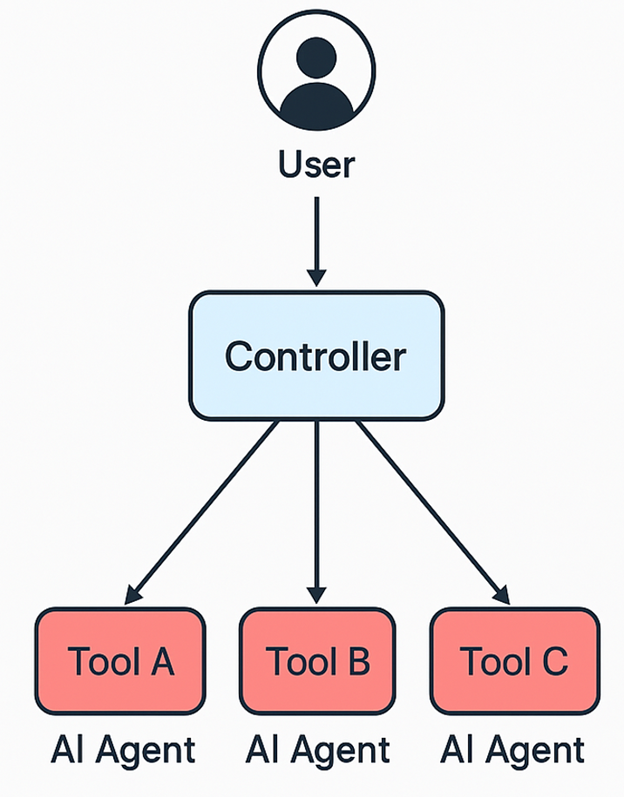
Layers in MAS Architecture:
- Agent Layer: Distributed logic per role
- Communication Layer: Messaging bus (e.g., MQTT, RabbitMQ)
- Coordination Layer: Centralized planner or distributed consensus (e.g., RAFT)
- Environment Interface: Input/output boundaries
MAS scale horizontally by delegating different responsibilities across agents:
- Planner Agent: Coordinates workflows
- Executor Agent: Performs concrete tasks
- Communicator Agent: Interfaces with users or external APIs
- Memory Agent: Maintains state, logs, and context
BMCBot Example: Dialogue orchestration, customer query handling, and content fetching are distributed across dedicated agents that share context via a central memory module.
Key Components of Agentic AI Systems
| Component | Description |
|---|---|
| Agent Kernel | Handles perception, reasoning, and action planning. |
| Belief State | Internal memory/Knowledge base updated through perception and events. |
| Goals | Persistent or dynamic objectives driving agent behavior. |
| Actuators | Interfaces through which agents interact with systems. |
| Communication Channel | Enables message exchange (direct or brokered). |
| Intent Handler | Prioritizes and resolves competing objectives.</ |
Communication and Coordination Models
Agent Communication Styles:
- Synchronous Requests: REST/GraphQL APIs for immediate feedback
- Asynchronous Events: Message queues for decoupled interactions
- Dialogue State Models: Used in conversational agents like BMCBot
Protocols for Agent Messaging:
- Direct Messaging: Peer-to-peer communication (e.g., via HTTP or WebSocket)
- Brokered Messaging: Decoupled model using message brokers (e.g., Kafka, RabbitMQ)
- Standards: FIPA ACL, JSON-LD, or CoAP/MQTT for IoT
Coordination Approaches:
- Centralized Planning: Tasks assigned by an orchestrator
- Market-Based: Agents bid for responsibilities
- Swarm Dynamics: Emergent behavior via simple local rules
- Federated Control: Agents maintain autonomy while contributing to shared goals
- Consensus Models: RAFT or Paxos for state agreement
Define System Goals
- Identify problem scope (narrow vs. distributed goals)
- Identify agent roles (e.g., “data fetcher”, “response generator”)
- Define interdependencies and trust boundaries
Design Modular Agents
- Isolate capabilities: parsing, processing, rendering
- Keep agents stateless when possible (stateful if needed like memory agents)
Architecture Design:
- Choose single vs. multi-agent model
- Define communication and task coordination approach
Agent Development:
- Modular agents with configuration-driven behavior
- Persistent belief-state per agent
Integrate Communication Layer:
- Connect agents to sensors, databases, APIs, or message queues
- Use standard protocols (WebSocket, MQTT, or gRPC)
- Implement JSON-based messaging for simplicity
Add Learning and Adaptivity
- Reinforcement or supervised learning for agents with feedback loops
- Continuous learning pipeline via experience replay
Security & Observability:
- JWT/OAuth for secure agent identity
- Distributed tracing and logging (OpenTelemetry)
Testing and Validation:
- Simulation environments for multi-agent interaction
- Load testing and latency profiling

Use Cases:
A CoAP-based receiver bot ingests real-time messages from edge sensors, parses payloads, and logs data to a backend system
Functional Flow:
- CoAP packet received
- Header parsed → payload extracted
- Payload stored in NoSQL DB
- Error handling or retries triggered if storage fails
Justification as Single-Agent
- Stateless and isolated
- Requires low-latency parsing
- Communication is unidirectional (edge → cloud)
Functional Flow:
A smart building deploys agents for:
- Air quality monitoring
- Motion detection
- Occupancy tracking
Each agent processes sensor data locally and communicates anomalies to a central orchestration agent, which triggers alerts.
Justification as Multi-Agent
- Horizontal scalability
- Fault isolation
- Edge processing + centralized intelligence
Key Challenges & Resolutions
| Challenge | Resolution |
|---|---|
| Agent collision/conflict | Prioritization + coordination contract |
| Message overload | Throttling, backpressure techniques |
| Debugging behavior | Tracing tools per agent ID |
| Evolving context | Shared memory with TTL policies |
| Scalability | Use service discovery and elastic clusters |
| Debugging | Enable agent-level tracing and telemetry |
Key Takeaways
- Modular Development: Agents can be built and improved independently
- Scalability: Easy to replicate or shard agents
- Resilience: System remains operational despite partial agent failure
- Context-Awareness: Agents maintain long-term memory or statelessness based on role
At Royal Cyber, we don’t just architect these Agentic AI systems — we make them practical, secure, and business-ready. Our team works closely with you to design agent-based solutions that seamlessly integrate into your ecosystem, ensuring resilience, performance, and long-term adaptability.
Author
Zeeshan Mukhtar
 Websites used to be something you built once and basically forgot about. That doesn’t work …Read More »
- Learn how to plan an Optimizely CMS 13 upgrade with .NET 10, Optimizely Graph, Visual …Read More »
- Learn how AI meeting notes automate summaries, action items, and insights from video meetings using …Read More »