
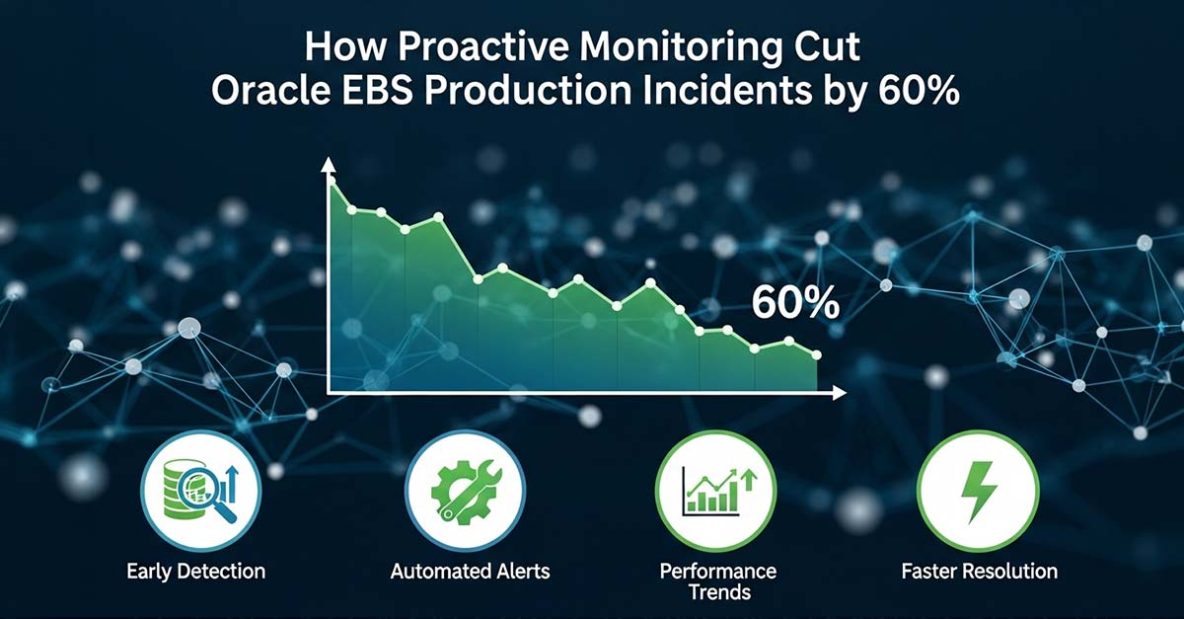
This scenario plays out in enterprises worldwide, and it’s entirely preventable. The culprit isn’t inadequate technology or under-skilled teams. It’s the reactive support model that most organizations still rely on a “wait and respond” approach that allows problems to escalate into crises before anyone takes action.
At Royal Cyber, we’ve helped numerous organizations break free from this reactive cycle by implementing proactive database monitoring solutions. This article explores how one global manufacturing enterprise transformed their Oracle EBS database operations—and the lessons learned along the way.
The Hidden Cost of Reactive Database Management
The Hidden Cost of Reactive Database Management
In a reactive model, the chain runs:
User Discovery → Ticket Creation → Manual Investigation → Delayed Resolution.
Problems are not detected until they have already interrupted the operations and, in most cases, they occur at the worst times when operations are most needed such as month-end closing or when transactions are at their peak. DBAs also use their time to fight fires rather than undertake strategic enhancement. Recurrence is normal since emphasis is given on symptoms rather than underlying causes.

Figure 1: The fundamental difference between reactive and proactive database support models
The Proactive Alternative: Early Detection and Prevention
Contrast that with:
Automated Monitoring → Intelligent Alerting → Preventive Action → Continuous Improvement.
When Royal Cyber implemented this for a global manufacturing client, the results spoke for themselves:

Real-World Challenge: A Case for Transformation

The Pain Points
Storage Surprises: Tablespace capacity issues appeared without warning, causing unexpected outages during financial processing.
Session Blocking Chaos: Long-running queries and blocking sessions degraded performance during peak hours. By the time users reported slowness, transactions were already backed up.
Object Validity Mysteries: Invalid database objects appeared sporadically, causing application errors.
Performance Blind Spots: Slow-running SQL queries degraded system performance gradually, with cumulative impact invisible until operations were disrupted.
The Tipping Point
Building the Proactive Solution
Pillar 1: Comprehensive Monitoring Coverage
We implemented monitoring across five critical database dimensions:
- Storage Management monitors the tablespace usage on the fly and alerts at 80% capacity – long before critical limits have been exceeded. This early warning enables advance expansion against emergency interventions.
- Session Monitoring Before it moves down into system-wide performance problems, Session Monitoring identifies blocking sessions, long-running queries and simultaneous resource conflicts.
- SQL Performance Analysisis used to continuously determine the query execution plans, which show inefficient SQL statements and suggest optimization opportunities.
- Concurrent Manager Health monitors the EBS concurrent processing framework, ensuring batch jobs and scheduled processes complete successfully without resource conflicts.
- Object Validity Checks automatically scan for invalid database objects daily, with immediate alerts when issues are detected—before they cause application errors.

Pillar 2: Automated Health Check Execution


Pillar 3: Intelligent Alerting
Threshold-based alerting distinguishes urgency levels:
- 70% utilization: Informational notice logged for trending analysis
- 80% utilization: Warning alert sent to DBA team for scheduled action
- 90% utilization: Critical alert requiring immediate response
This graduated approach prevents alert fatigue while ensuring genuine issues receive appropriate priority.
Pillar 4: Integration with Existing Workflows
Alerts flow into the team’s established communication channels, providing immediate visibility without requiring new tools or workflows.
The Technical Implementation
Successful implementation required careful technical execution given Oracle 11g’s constraints and EBS complexity.
Custom SQL Health Checks


Scheduling and Orchestration
Alert Delivery and Response
The Transformation: Before and After

The Transformation: Before and After
Operational — Before DBAs spent 60–70% of their time responding to user-reported issues, diagnosing root causes under pressure during critical operations.
Operational — After Most issues are resolved before users are impacted. DBAs invest their time in strategic improvements, performance tuning, and preventive maintenance.
Business — Before Financial close periods were high-stress events with frequent delays from unexpected database issues.
Business — After Financial close cycles proceed with zero database-related delays. Strategic initiatives receive DBA support previously consumed by firefighting.
Key Lessons and Best Practices
Across multiple enterprise deployments, these success factors consistently stand out:
- Start with Critical Pain Points: Begin with the issues causing the most frequent or severe disruptions. Build momentum with quick wins before expanding coverage.
- Tune Your Thresholds: Generic thresholds rarely work. Analyze your environment’s normal operating ranges and set thresholds that provide meaningful warnings without noise.
- Automate Ruthlessly: Manual health checks are inconsistent and unsustainable. If a check is worth doing, it’s worth automating.
- Provide Context with Alerts: Include diagnostic information, historical trends, and recommended actions in every alert.
- Iterate and Improve: Regularly review alert patterns, adjust thresholds, and refine coverage based on operational experience.
Looking Forward: The Evolution of Database Operations
Taking the First Step
Conclusion
The distinction between reactive and proactive database management is not only operational, but strategic. The reactive organizations utilize DBA resources to combat fires. The proactive monitors place the same resources in constant improvement, strategic efforts and business empowerment.
This change has been witnessed at Royal Cyber in various industries and settings. The outcomes are always good: they are reduced in incidents, resolve quicker, operations are more stable, and the teams working are empowered and can work confidently instead of feeling anxious.
It is not a question of proactive monitoring whether it brings value or not- the data clearly shows that it does. The question here is how long can your organization survive without it?
Partnering with Royal Cyber
Royal Cyber is an IT consulting and services firm that has specialized in the field of Oracle applications, cloud solutions and digital transformation. Our database service offers assist businesses to optimize the Oracle environment in terms of performance, reliability and cost-effectiveness.
Ready to Transform Your Database Operations?
Talk to Royal Cyber Oracle practice on how proactive monitoring can be used to minimize incidences, enhance performance, and liberate your DBA team so that they can concentrate on strategic initiatives.
Frequently Asked Questions (FAQs)
Problems only surface after operations are already disrupted — typically during critical periods like financial close — leaving DBAs in constant firefighting mode. Since the focus stays on symptoms rather than root causes, the same issues keep recurring, making instability the norm.
The framework covers comprehensive monitoring, automated health checks, intelligent graduated alerting, and seamless integration with existing workflows. Together, these shift database operations from “wait and respond” to “detect and prevent.”
Three urgency tiers — informational at 70%, warning at 80%, and critical at 90% utilization — ensure genuine issues stand out without overwhelming teams with noise. Lower-level signals are still tracked for trend analysis while critical alerts demand immediate action.
Most issues were resolved before users ever noticed them, and financial close cycles ran without a single database-related delay. DBAs shifted from 60–70% reactive firefighting to focusing on strategic improvements and preventive maintenance.
Royal Cyber builds tailored monitoring frameworks starting with an organization’s most critical pain points, combining custom SQL health checks, automated scheduling, and intelligent alerting. The consistent results across enterprise deployments include reduced incidents, faster resolutions, and DBA teams freed up for strategic work.
Agentforce and Microsoft Copilot Studio are the two dominant enterprise…
Read More »
Websites used to be something you built once and basically…
Read More »
Websites used to be something you built once and basically…
Read More »