
Home > Blogs > Middleware > Enterprise Integration Architecture: From ESB to AI with IBM App Connect Enterprise
April 28, 2026
Enterprise Integration Architecture: From ESB to AI with IBM App Connect Enterprise
Table of Contents
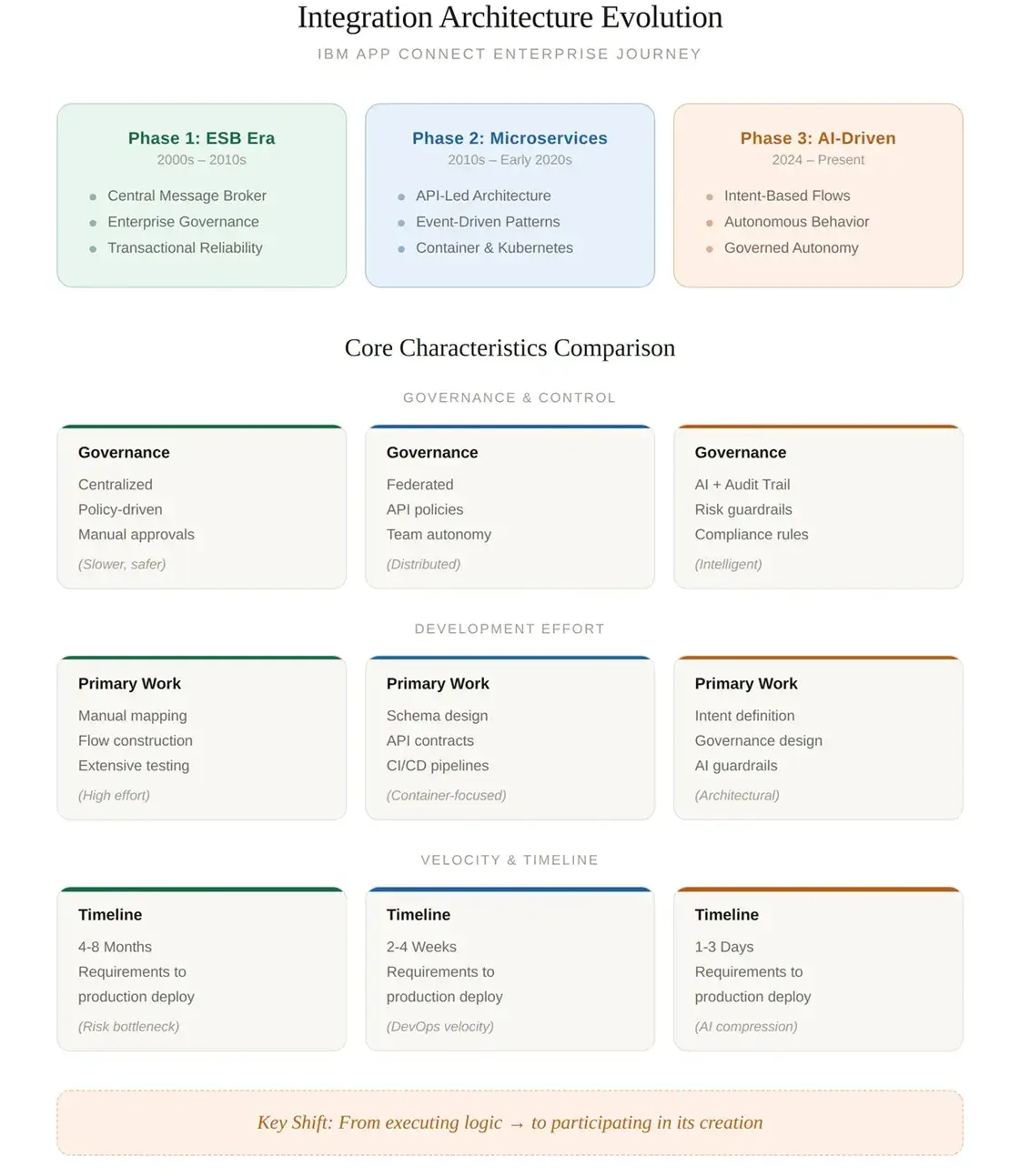
The middleware industry has a consistent pattern: it reinvents itself every few years, and integration architectures that defined best practice in one era become the technical debt of the next. Enterprise integration has gone through three distinct architectural phases:
- Point-to-point to ESB — centralized governance replaced unmanaged system sprawl
- ESB to containerized microservices — decentralized deployment aligned integration with DevOps
- Rule-based to AI-driven — the current shift, where integration platforms move from executing logic to participating in its creation
Each prior phase expanded what integration teams could deliver. This one changes the nature of the work itself. IBM App Connect Enterprise (ACE) — from its origins as IBM Integration Bus through API-led containerized deployments — is at the center of this transition.
At Royal Cyber, we have worked with IBM ACE across financial services, healthcare, manufacturing, and retail — from modernizing mainframe-era integration estates to building event-driven architectures on OpenShift. The organizations that understand what AI-driven ACE looks like in production, not just in architecture diagrams, will be the ones that build durable competitive advantage from it. This blog examines that evolution in practical terms: what has changed, what is arriving now, and what integration practitioners need to prioritize.
Thinking About Modernizing Your IBM ACE Environment?
The ESB Era: Governance That Came at a Cost
Before the ESB, enterprise integration was largely ungoverned — direct point-to-point connections, no reuse, no centralized ownership. The ESB resolved this with standardized routing, centralized governance, and reusable integration assets. IBM ACE was the enterprise-grade implementation of that model, delivering:
- Robust message transformation and protocol mediation
- Transactional reliability for mission-critical pipelines
- Enterprise-grade security and centralized flow governance
The limitations emerged as digital transformation accelerated. Centralized broker architectures concentrate change risk by design — a modification to a shared library or routing policy could trigger weeks of regression testing across dependent flows. Stability came at a velocity cost that organizations could no longer absorb.
The re-engineering of IIB into ACE addressed the deployment constraint. Containerization on Docker and OpenShift brought integration teams into CI/CD alignment with broader DevOps practices. What persisted was the manual effort in the development process itself — schema mapping, transformation logic, edge-case handling — unchanged regardless of how the runtime was packaged.
The API and Event-Driven Shift: Integration as a Business Capability
Microservices and cloud-native adoption exposed the structural limits of centralized ESB governance. Distributed architectures demanded:
.
- Lightweight, asynchronous communication protocols
- Independent deployment cycles — days, not quarters
- Federated policy enforcement rather than centralized control
- Real-time event propagation as the baseline, not the exception
IBM ACE extended its architecture to meet these requirements — adding API-led integration, event-driven patterns via Kafka and IBM MQ, Kubernetes-based containerized runtimes, and hybrid multi-cloud support. Integration moved from a back-office connectivity function to a core enabler of business agility: the mechanism through which distributed systems achieve coherent, real-time operation.
Intent-Based Integration: What AI Is Changing in the ACE Development Lifecycle
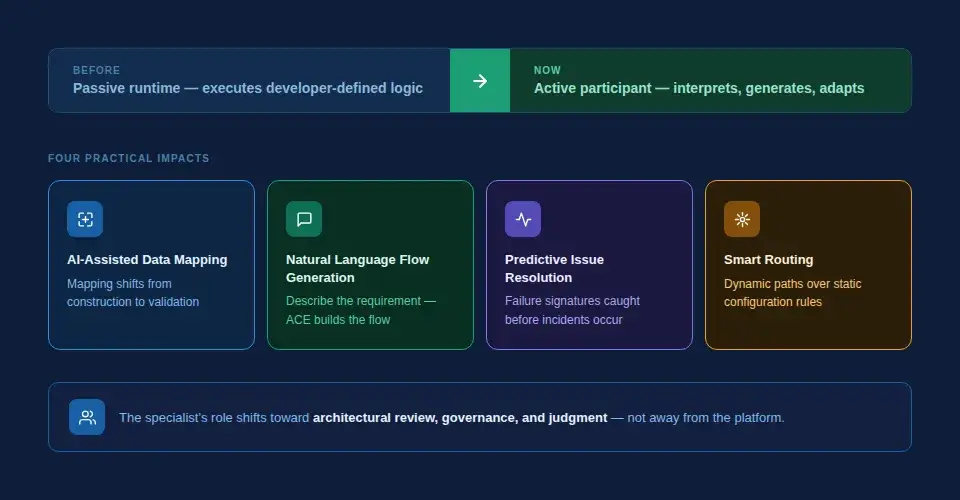
ACE is transitioning from a passive runtime that executes developer-defined logic to an active participant in the integration development lifecycle. The concept practitioners are converging on — Intent-Based Integration — describes a model where the platform helps interpret requirements, generates candidate implementations, and adapts to runtime conditions.
The practical impacts across the development and operations lifecycle:
- AI-assisted data mapping: The platform analyses patterns across existing integrations to surface high-confidence field mappings and schema alignments for specialist review. Mapping shifts from a primary development activity to a validation exercise.
- Natural language flow generation: A specialist defines the requirement descriptively — retrieve incidents from ServiceNow, join with customer data from DB2, route a summary to the support queue — and ACE generates a candidate flow using connectors and policies already configured in the environment.
- Predictive issue resolution: AI models trained on ACE runtime metrics identify failure signatures before they manifest as incidents, enabling proactive remediation rather than reactive response.
- Smart routing: Message paths are determined dynamically based on load, context, and business priority rather than static configuration rules.
The specialist’s role shifts toward architectural review, governance oversight, and the judgment calls the platform cannot make autonomously — not away from the platform entirely.
The Agentic Shift: Autonomous Behaviour Within Governed Boundaries
Agentic integration is the next evolution of the message flow. Where a deterministic pipeline fails on unexpected input, an AI-enabled ACE flow is designed to assess the situation, apply a resolution if confidence is sufficient, and escalate with context already assembled when it is not.
Schema drift is the most immediate illustration:
- Traditional response: Source system changes a field format → flow breaks → alert fires → engineer diagnoses, updates transformation logic, redeploys. A disproportionate cycle for what is often a minor structural change.
- Agentic response: ACE detects the change, uses an LLM to evaluate the new field against available metadata, proposes an updated mapping, and applies it autonomously above a confidence threshold. Below that threshold, it escalates with the proposed resolution pre-assembled for human review.
IBM watsonx extends this into unstructured data processing — emails, PDFs, voice transcripts converted into structured events consumable by downstream systems. ACE moves from a conduit between structured systems to an active processor of the full range of enterprise data flows.
Explore Royal Cyber's AI-Driven IBM ACE Solutions
Why ACE's Governance Layer Becomes More Critical in an AI-Driven Architecture
As AI assumes a larger role in integration decision-making, a question arises naturally: what is the function of a structured middleware layer when the platform is generating and adapting flows autonomously? In practice, governance becomes more important, not less. The autonomy that makes AI-driven integration valuable is only operationally viable when it operates within a framework that enforces enterprise-grade constraints.
In regulated environments — financial services, healthcare, public sector — autonomous systems making unaudited decisions about transaction routing, data access, or record transformation create compliance exposure that organizations cannot accept. IBM ACE provides the governance infrastructure that makes AI-driven integration safe to deploy at scale:
- Security: ACE enforces data access policies that prevent AI processes from inadvertently exposing personally identifiable information to unsecured endpoints or public model APIs.
- Transactionality: ACID properties are maintained across AI-assisted flows. If a downstream operation fails, rollback guarantees are preserved regardless of how the upstream flow was generated.
- Auditability: ACE maintains an immutable audit trail of all integration decisions — including those made or influenced by AI — which is a baseline requirement for regulatory compliance and post-incident analysis.
- Centralized governance: API policies, access controls, and compliance rules are applied consistently across all flows, irrespective of whether they were manually built or AI-generated.
The operational framing that reflects this accurately: AI determines what to do; ACE ensures that every action taken is authorized, encrypted, logged, and delivered according to enterprise policy. One layer does not substitute for the other.
Bridging the Gap: ACE as the Cognitive Gateway Between Legacy and Modern Systems
Enterprise modernization does not happen as a clean cutover. Most large organizations operate hybrid landscapes where core business logic still runs on legacy platforms — COBOL applications, CICS transaction managers, mainframe data stores — while modern workloads are built on cloud-native APIs and AI-assisted tooling. The integration challenge in this environment is not simply connecting systems; it is enabling systems that are architecturally decades apart to exchange information reliably and securely.
With capabilities like the Model Context Protocol (MCP), IBM ACE functions as a cognitive gateway between these environments. A modern AI agent issues a clean, structured request; ACE handles protocol transformation, data format conversion, and security handshake processing transparently, presenting the legacy system’s data as a contemporary API response. The mainframe that communicates in EBCDIC and the AI agent that expects GraphQL can interoperate because ACE manages the translation layer that neither endpoint is equipped to handle independently.
For organizations with substantial legacy estates — which describes the majority of large enterprises in financial services, insurance, and the public sector — this capability is what makes AI-driven modernization practically achievable. It removes the requirement for a full platform rewrite as a prerequisite for adopting intelligent integration patterns.
Observability and Data Quality: The Operational Foundation AI Requires
The effectiveness of AI in an integration context is directly proportional to the quality and completeness of the operational data it draws from. IBM ACE generates a rich set of runtime metrics and structured logs across all integration flows. Feeding this telemetry into AI models creates operational intelligence that extends well beyond conventional monitoring: root cause analysis that traces failures to their origin rather than their symptom, performance optimization recommendations generated before degradation affects production throughput, and anomaly detection that distinguishes genuine failure patterns from statistical variance.
Realizing this potential requires clean, well-governed data at the interface level. Inconsistent schemas, incomplete field documentation, and undeclared semantic conventions create ambiguity that degrades AI output quality in proportion to its prevalence. Data contracts — formal, versioned specifications of interface semantics — address this directly. When AI agents operate against precisely defined interfaces, they produce reliable outputs. When they operate against inferred or undocumented ones, failure modes become harder to predict and diagnose. Formalizing data contracts is increasingly a prerequisite, not an optimization, for AI-driven integration architectures.
The Evolving Role of the Integration Specialist
The concern that AI will displace integration specialists reflects a misreading of where the complexity in enterprise integration actually resides. Generating a syntactically valid flow is not the hard part. Understanding the business context in which it operates, the edge cases that break it in production, the compliance constraints it must satisfy, and the downstream systems it affects — that understanding is not something AI acquires from pattern matching. It comes from practitioners with domain depth.
What is changing is the allocation of specialist effort. ESQL and Java remain foundational skills. The practitioners who will be most effective as AI capabilities mature are those who extend that foundation in three directions:
- Python proficiency: ACE supports direct invocation of Python scripts and interaction with AI model APIs. Fluency with Python is becoming a core requirement for integration development, not an ancillary skill.
- Data contract discipline: Formalizing interface specifications so that AI agents operate on precisely defined semantics — field names, data types, valid value ranges, transformation rules — prevents the ambiguity that produces unreliable AI behaviour at runtime.
- Governance and AI trust frameworks: Understanding how to implement IBM watsonx governance — including explainability, safety guardrails, and model oversight — is becoming the differentiating competency for senior integration practitioners.
The role is transitioning from flow construction to intelligent ecosystem design. Integration specialists will increasingly define the rules within which AI operates, establish the governance boundaries that protect enterprise systems, and interpret the operational intelligence that AI surfaces. That is a more strategically significant function than what the role encompassed previously.
Challenges That Require Direct Attention
The trajectory toward AI-driven integration is clear, but the path involves friction that organizations need to plan for rather than discover in production:
- Skill transformation: AI/ML fundamentals, data analysis, and automation strategy are becoming core competencies for integration practitioners. Organizations that treat these as specialist skills rather than baseline requirements will face capacity constraints as AI adoption accelerates.
- Governance and explainability: AI-influenced decisions in regulated environments must be explainable, auditable, and reproducible. Architectures that cannot satisfy these requirements will encounter compliance barriers regardless of their technical merits.
- Data quality: The reliability of AI-driven integration is bounded by the quality of the data it processes. Organizations with inconsistent schemas, undocumented field semantics, or poorly governed master data will see degraded AI performance that no platform configuration can compensate for.
- Cultural adaptation: Teams that have operated in deterministic, fully predictable integration environments require structured support to become effective in probabilistic, adaptive architectures. The change management dimension of this transition is frequently underestimated.
The Road Ahead for IBM App Connect Enterprise
The strategic direction for IBM ACE is not incremental expansion of throughput capacity or connector coverage. It is the compression of the distance between an integration requirement and a production-grade implementation. Organizations that execute this transition effectively will operate with response times to market change measured in days rather than months, significantly reduced integration maintenance overhead, and the ability to deliver digital experiences that rule-based, manually built integration architectures could not support at the required pace or scale.
The timeline compression that DevOps and containerization delivered — from months to weeks — is continuing. AI-driven integration compresses it further. What remains constant through each phase of this evolution is the requirement for practitioners who understand where architectural complexity concentrates, where edge cases create systemic risk, and where governance cannot be delegated to automation. That expertise does not depreciate as AI handles more of the routine development work. It becomes the critical differentiator between integration architectures that perform reliably at scale and those that do not.
Final Thoughts: The ESB Is Gone — The Integration Specialist's Role Has Never Been More Strategic
The transition from ESB to AI-driven integration is a substantive architectural shift, not a rebranding exercise. IBM ACE has demonstrated the capacity to evolve through each major inflection point in enterprise integration — from centralized broker to containerized runtime to intelligent integration engine. The organizations that are investing in AI capability development and integration modernization now are building the architectural foundations that will determine their competitive position as this shift matures.
The ESB model is no longer the relevant frame of reference. The integration specialist’s role, however, has not diminished — it has become more consequential. The platform is more capable, the problems are more complex, and the decisions that specialists make about architecture, governance, and data quality have broader organizational impact than they did in the ESB era.
Royal Cyber’s IBM ACE practice is built for this environment. Our certified integration architects bring direct experience modernizing ACE deployments across financial services, healthcare, manufacturing, and retail — from legacy mainframe integration through AI-assisted flow design and watsonx governance implementation. Whether the immediate priority is containerizing an existing ACE estate or evaluating what agentic integration looks like in a specific operational context, Royal Cyber provides the technical depth to move from architecture to production with precision and confidence.
Ready to Build the Intelligent Integration Enterprise?
Frequently Asked Questions (FAQs)
Q: How does the traditional IBM ACE integration and AI-driven integration differ in terms of functionality?
ACE has a deterministic traditional form of integration: at build time, flows are run to execute rules, and unexpected inputs cause errors, which must be fixed manually. The AI-driven integration brings in adaptive behaviour: schema drift detection, AI-assisted or auto-generated mappings, predictive failure detection, and context-driven dynamic routing. There is no change to the ACE runtime, transactional guarantees, and governance layer – AI is an extension of the platform, not its foundations of reliability.
Q: Is it necessary to replace current integration flows in order to introduce AI-driven features in ACE?
No. IBM ACE can add AI capabilities step by step and they can be integrated with the existing flows. An implementation process usually starts with AI-aided mapping during the development phase, moves to predictive operational monitoring, and develops to agentic flows as the organization gains confidence and governance systems. Royal Cyber suggests a gradual implementation plan that is limited to the risk tolerance of an organization, the constraints of its legacy, and its modernization goals.
Q: What is the integration of IBM ACE with existing mainframe systems in an AI-based architecture?
IBM ACE relies on such capabilities as Model Context Protocol (MCP) to act as a cognitive gateway between the contemporary AI agents and older platforms that use EBCDIC, CICS, or other older protocols. ACE transparently transforms protocols, converts formats, and processes security information – it exposes the data in legacy systems to AI agents as a modern API reply. This eliminates the need to rewrite legacy platforms as a pre-condition to integrate patterns based on AI.
Q: What is the strategy of Royal Cyber in the modernization of IBM ACE in the enterprise with complex legacy environments?
Royal Cyber is a set of engagements with an integration landscape assessment to map the existing flows, measure the technical debt, and create a prioritized sequence of modernization. In organizations that have large on-premise or mainframe estates, we design hybrid environments that maintain current investments and gradually replace them with containerized runtimes of ACE and API-based integration layers and AI-assisted tooling. The architecture phase is not the stage of post-implementation corrections, but rather governance and compliance requirements, and this is especially crucial to clients in regulated industries.
Q: Which technical skills do integration experts need to focus on as AI capabilities of ACE advance?
There are three competencies that are gaining importance in addition to the already existing ESQL and Java knowledge. To begin with, Python knowledge Python Python ACE supports Python script execution and direct AI model interaction, thus it is a fundamental integration development skill. Second, formalization of data contract – interface specifications are clearly specified a condition to credible AI-based integration behaviour. Third, IBM watsonx governance skills – including AI trust frameworks, explainability needs, and safety guardrails – is becoming the distinguishing capability of advanced integration practitioners.
Talk To Our Experts
Recent Blogs
May 26, 2026
Websites used to be something you built once and basically…
Read More »
May 26, 2026
Using Generative AI for API Design in Google Apigee API…
Read More »
May 25, 2026
Agentforce and Microsoft Copilot Studio are the two dominant enterprise…
Read More »