
Home > Blogs > Generative AI > Using Generative AI for API Design in Google Apigee API Platform
May 26, 2026
Using Generative AI for API Design in Google Apigee API Platform
Table of Contents
APIs have become the connective tissue of modern enterprise systems. They power application-to-application communication, expose business capabilities to partners, and serve as the foundation for mobile and web channels. What receives less attention is how difficult API design actually is at scale. Each new contract requires careful decisions about resource naming, versioning, authentication, payload structure, error handling, and governance — and across hundreds of APIs built independently by different teams, those decisions compound into significant inconsistency.
Generative AI is changing how this work gets done.
Google’s Apigee platform has long been the enterprise standard for API management. With AI capabilities now embedded directly into the design workflow, Apigee is evolving into an intelligent engineering environment in which architects and developers can accelerate delivery without compromising on quality. The sections that follow examine what this looks like in practice, the problems it addresses, and the points at which human oversight remains essential.
The challenge facing most enterprises is structural. Years of independent API development across business units have produced large, inconsistent API estates in which standards drift between teams, documentation lags behind implementation, and governance gaps surface only during audit cycles. Layering an additional tool onto an already complex platform does not resolve this. The more effective approach is to embed AI directly into the design phase, where standards can be enforced before code is written and routine specification work can be automated.
This is the implementation pattern Royal Cyber delivers for enterprise teams on Apigee and the wider Google Cloud stack. Our API practice helps organizations design, govern, and migrate API estates using AI-assisted workflows engineered to operate at production scale. Teams evaluating where AI fits within their API strategy can engage Royal Cyber for a structured assessment of their current platform and target architecture.
Schedule a free Apigee AI consultation

The Real Problem with API Design at Scale
Ask any senior architect what slows enterprise API delivery, and design surfaces as a primary constraint. The underlying concepts are not difficult — REST patterns, schema definitions, status codes, and security flows are well documented. What proves difficult is applying those concepts consistently across years of development and across teams that operate independently.
In smaller organizations, design standards can be maintained informally. Within a single team, conventions are visible and reinforced through everyday review. At enterprise scale, where six or eight independent squads ship APIs against separate roadmaps, that informal coordination breaks down. The common symptoms include duplicate functionality exposed under different names, documentation that diverges from implementation, authentication gaps surfaced only during audits, and delivery timelines that consistently overrun.
Generative AI does not eliminate these issues outright, but it closes a meaningful capability gap. Used effectively, AI functions as a continuously available design assistant that enforces standards, identifies inconsistencies early, and removes the repetitive overhead that currently absorbs senior engineering time.
What AI actually does in the API Design Process
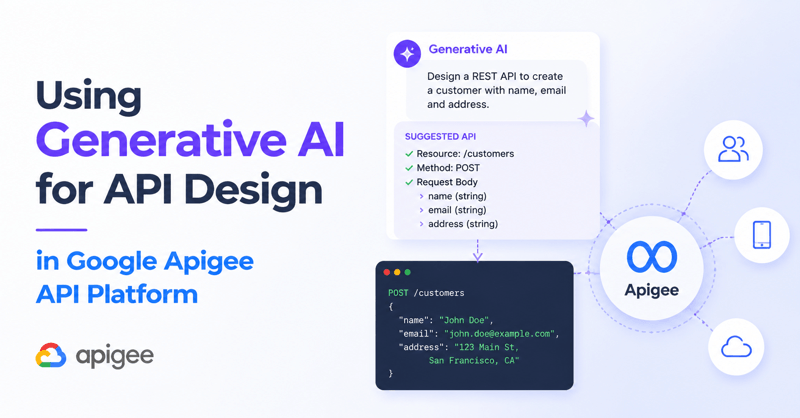
In practical terms, generative AI translates plain-language requirements into structured API blueprints. Rather than building specifications from scratch, an architect describes the intended API in natural language, and the model produces a working draft aligned with established design conventions.
Consider a typical scenario: an architect designing a customer onboarding API. The prompt — “Create a REST API for customer onboarding with endpoints for registration, KYC validation, profile update, and account status retrieval” — generates a complete output within seconds, including resource paths, HTTP methods, JSON schemas, status codes, example responses, and a fully formed OpenAPI definition.
This is not a production-ready API. It is, however, approximately 70 to 80 percent of the design scaffolding, delivered in seconds rather than hours.
Beyond initial specification, generative AI contributes across the API design lifecycle in several measurable ways:
- Recommends appropriate security policies for sensitive endpoints
- Regenerates documentation automatically when the specification changes
- Produces realistic mock payloads to unblock frontend and partner development
- Identifies inconsistencies between APIs that should share design patterns
- Flags governance violations before they reach production deployment
Apigee as an AI-powered API platform
Apigee provides a mature foundation for enterprise API management: proxy configuration, traffic control, security enforcement, analytics, developer portals, and complete lifecycle support. The notable evolution is the introduction of AI capabilities into the design phase itself, rather than runtime alone.
The table below summarizes where AI contributes across the API lifecycle:

| API Lifecycle Stage | AI Capability |
|---|---|
| Design | Generates API contracts and OpenAPI specs from natural language |
| Development | Suggests policy configurations and proxy setups |
| Testing | Creates test scenarios and edge cases automatically |
| Documentation | Generates and updates developer docs as specs change |
| Governance | Catches naming violations, missing auth, and non-standard patterns |
| Monitoring | Predicts traffic anomalies and performance issues |
| Optimization | Recommends caching strategies and latency improvements |
A capability worth highlighting specifically is Specification Boost within Apigee API Hub. It improves existing specifications in measurable ways. Vague descriptions such as “Gets data” are rewritten as “Retrieves a detailed summary of user account balances and transaction history.” Realistic JSON examples are generated for both request and response bodies. Terminology is normalized across endpoints. This is the kind of quality pass that engineering teams consistently agree is necessary yet rarely complete under delivery pressure.
See how Royal Cyber delivers Apigee AI for enterprise teams
Practical use cases worth knowing
Generating OpenAPI specs from business requirements
This capability delivers the most immediate impact for product teams. Consider a team building a new payments API. Traditional design work — defining resources, payloads, validation rules, and documentation — typically requires a full working day or longer. With AI assistance, the team submits business requirements and receives a structured OpenAPI specification that imports directly into Apigee for proxy creation. Design time compresses from a day to a few hours.
Auto-generated documentation that stays current
Documentation is the artifact most teams intend to maintain but rarely do. Generative AI changes this equation because documentation is produced directly from the specification: API summaries, parameter descriptions, usage examples, and error references are all derived automatically. When the underlying API changes, documentation regenerates accordingly. For enterprises maintaining hundreds of APIs, this represents a meaningful shift in how developer experience is sustained over time.
AI-assisted policy generation
Apigee policies handle OAuth enforcement, rate limiting, threat protection, traffic shaping, and a wide range of other concerns. Writing them correctly requires familiarity with both the XML structure and the policy catalog. With AI assistance, a developer can describe the intended behaviour in plain language — for example, “Generate an Apigee policy for JWT authentication and rate limiting of 100 requests per minute” — and receive a valid policy configuration. The result is fewer implementation errors and a substantially shorter learning curve for developers new to the platform.
AI-driven governance and standardization
This capability is particularly valuable at enterprise scale. AI can analyze APIs deployed within Apigee and flag deviations from enterprise standards: missing OAuth enforcement, incorrect HTTP methods, non-standard error response formats, versioning violations, and potential exposure of sensitive data through response payloads. Rather than relying on retrospective governance reviews, validation shifts into the design phase, where remediation cost is minimal and turnaround is fast.
Mock APIs for parallel development
Frontend and mobile teams routinely lose productivity waiting for backend APIs to reach a stable state. AI-generated mock APIs remove this dependency. Apigee can expose realistic mock endpoints based on generated schemas, enabling UI development, integration testing, and partner sandbox environments to proceed in parallel with backend implementation.
A Real-World Example: Retail API Design
Consider a retail enterprise building APIs for product catalog, customer loyalty, inventory, order tracking, and payments. Under traditional approaches, multiple architects would invest several weeks establishing design standards, drafting specifications, and producing documentation before any endpoint reached production.
With AI integrated into Apigee, the workflow compresses substantially. An architect provides the high-level business requirements. The model returns REST resources, OpenAPI specifications, and request and response schemas. Those artifacts are imported into Apigee, where proxies are generated. AI then recommends appropriate security configurations — OAuth flows, quota policies, and threat protection. Developer portal documentation is generated automatically. Finally, a governance check validates the design against enterprise standards before any artifact is exposed to consumers.
Work that previously required weeks can realistically complete within days. That delivery gap is consequential for organizations competing on speed to market.

The Benefits, and the Honest Limitations
The benefits are concrete and measurable. Delivery cycles shorten. APIs developed using consistent AI-assisted patterns exhibit greater uniformity across the estate. Documentation becomes a usable asset rather than a perpetual liability. Security and governance issues surface during design, when remediation is inexpensive. And most importantly, architects and senior engineers redirect time from repetitive configuration work toward higher-value problems.
The limitations are equally important to acknowledge.
AI-generated APIs still require human review. The output is a working draft, not a deliverable. Security controls, compliance requirements, business logic accuracy, and data privacy considerations all require validation by an experienced architect. AI accelerates the work; it does not replace engineering judgment.
Governance frameworks must evolve in parallel. Organizations that adopt AI-generated artifacts without corresponding approval workflows and version control risk introducing inconsistency at higher velocity, rather than resolving the underlying problem. The governance model must develop alongside the tooling.
Data privacy is a material consideration. Where AI tools process business requirements, organizations must understand the data flow — where information travels, which models receive it, and what retention or training policies apply. Secure enterprise deployments and explicit internal policies on AI usage are essential prerequisites for adoption at scale.
Where this is Heading
AI integration into API design remains at a relatively early stage, but the trajectory is clear. Platforms such as Apigee are advancing toward intelligent API engineering environments, in which the platform interprets business intent and translates it into secure, scalable API designs.
Several capabilities can reasonably be expected over the next few years: autonomous governance enforcement, AI-driven integration flow generation, predictive performance optimization based on observed traffic patterns, and conversational API creation that extends well beyond current capabilities. The role of the API architect will continue to shift from manual specification authoring toward oversight and validation of AI-driven design processes.
This is not a diminished role. It is a more strategic one.
Getting Started
Organizations already operating on Apigee that have not yet explored its AI capabilities can begin with Specification Boost. Running a small set of existing specifications through the tool produces immediate, observable improvements in description quality, example coverage, and terminology consistency.
A useful next step is to generate a new OpenAPI specification for a simple API using a natural-language prompt. Comparing the output against what an engineer would produce manually establishes a quick view of where AI delivers meaningful time savings and where domain expertise must continue to drive design decisions.
Generative AI will not replace the architectural judgment that distinguishes well-designed APIs from those that require eventual rework. It does, however, remove a substantial volume of repetitive design work — a tradeoff worth serious consideration.
Conclusion
Enterprise API design has historically penalized teams attempting to move quickly. The integration of AI into Apigee changes this dynamic: speed and consistency are no longer competing priorities. Organizations that adopt these capabilities early will be positioned to deliver cleaner APIs at greater velocity with leaner specialist teams. Those that defer adoption will continue to absorb the cost of legacy design practices.
For organizations ready to operationalize AI-assisted API design — whether building from a clean foundation, migrating from legacy gateways, or scaling an existing Apigee deployment — Royal Cyber’s API and integration practice provides the engineering capacity and platform expertise to deliver production-grade outcomes. Our team works across Google Cloud, Apigee, and enterprise integration to build API programs designed to operate under real-world load.
Ready to modernize your API estate?
Frequently Asked Questions
Does generative AI replace the need for experienced API architects?
No. AI speeds up the work, but the output is always a draft — not a deliverable. Security controls, compliance, business logic, data privacy: those still need an experienced architect signing off. What shifts is where that expertise lands. Less time on repetitive spec work, more on the decisions that actually require senior judgment.
How accurate are the OpenAPI specs Apigee's AI generates?
Around 70 to 80 percent complete on first pass. Resource paths, HTTP methods, JSON schemas, status codes, sample responses — all generated. Accuracy is highest for standard patterns like customer onboarding, payments, or catalog APIs. Complex business logic and unusual integration patterns still need architect review before anything ships to production.
How does Apigee's AI compare to using ChatGPT or Gemini directly?
Integration. General-purpose models can produce an OpenAPI spec from a prompt, but the output lives outside your platform — manual import, manual reconciliation against your standards. Apigee’s AI runs inside the platform: specs flow into API Hub, policies scope to Apigee’s catalog, governance checks run against your actual standards, docs land in the developer portal. One closed loop instead of three or four disconnected steps.
What does Royal Cyber's Apigee AI practice actually deliver?
End-to-end Apigee programs — design workflow setup, governance frameworks, AI-assisted spec generation, developer portal rollout, and team enablement. We’re not a tool reseller. We build the program around the platform, then hand it over so the internal team can run it without us.
How long does a Royal Cyber Apigee AI rollout typically take?
Depends on where you’re starting. Teams already on Apigee with documented standards can usually run a pilot in four to six weeks. Teams migrating from legacy gateways or building governance alongside AI adoption run a three to six month program — workflow setup, governance, enablement, all in scope. What decides success isn’t the timeline. It’s treating this as a platform program rather than a tool rollout.
Talk To Our Experts
Recent Blogs
May 26, 2026
Websites used to be something you built once and basically…
Read More »
May 26, 2026
Using Generative AI for API Design in Google Apigee API…
Read More »
May 25, 2026
Agentforce and Microsoft Copilot Studio are the two dominant enterprise…
Read More »