
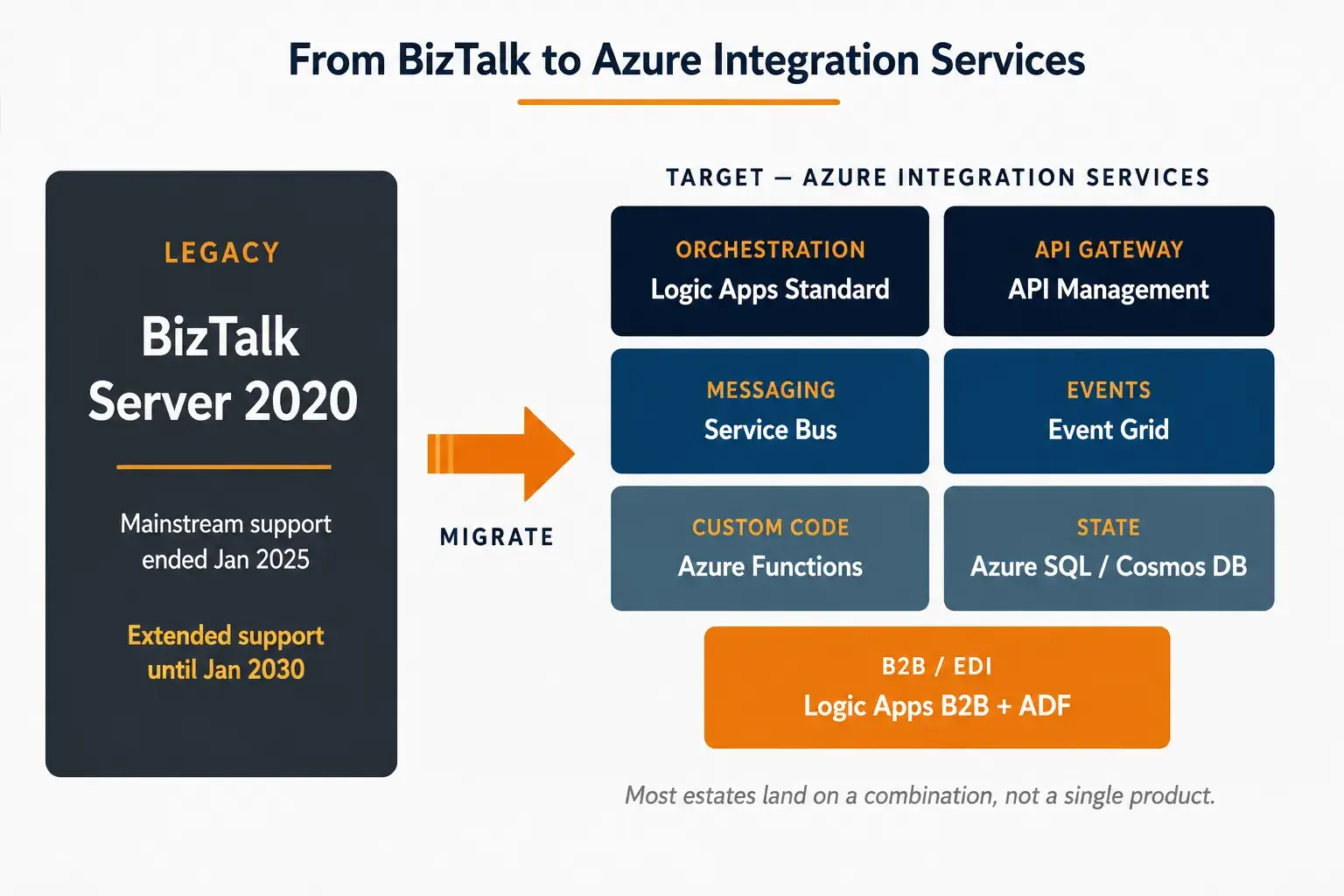
BizTalk Server 2020 mainstream support ended in January 2025. Extended support continues to January 2030, but that runway is shorter than it looks once you factor in test cycles, integration partners, and the holiday code-freezes most enterprises observe. At Royal Cyber, BizTalk-to-Azure Integration Services migration is now our highest-volume integration practice. This playbook condenses what we’ve learned across more than 40 enterprise migrations.
Why Migrate Now, Not Later
Three forces shorten the runway.
- Talent attrition BizTalk skills are aging out of the workforce, and the people who can debug a complex orchestration are leaving.
- Partner pressure VANs and trading partners are demanding TLS 1.3, modern AS2 ciphers, and OAuth flows that BizTalk requires extensive customization to support.
- Innovation cost Every quarter you keep BizTalk, you accumulate “tax” in the form of integrations you can’t easily add to the modernization roadmap.
The Target: Azure Integration Services
The target is rarely a single Azure product. Most BizTalk estates land on a combination:
- Logic Apps Standard for orchestrations and most workflows.
- Azure API Management for HTTP-fronted ports.
- Service Bus for guaranteed messaging.
- Event Grid for fan-out and notifications;
- Functions for custom pipeline components.
- Azure SQL or Cosmos DB for state; and Azure Data Factory or a dedicated B2B accelerator for AS2/EDIFACT/X12.
The Mapping Table
The 90-Day Playbook
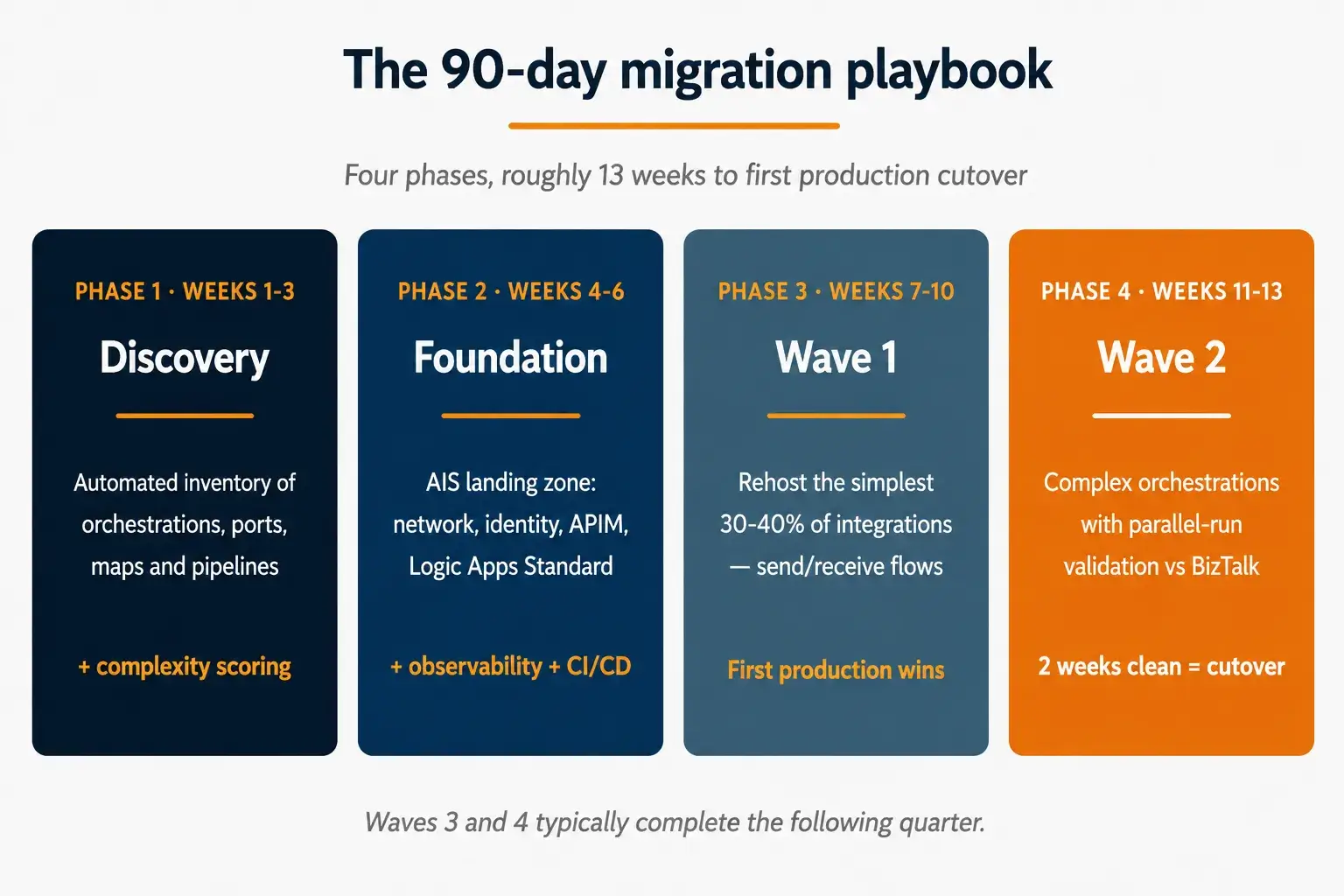
Royal Cyber’s standard playbook runs in four phases.
- Discovery (weeks 1-3) uses an automated assessment tool to inventory orchestrations, ports, maps, and pipelines, scoring each on complexity.
- Foundation (weeks 4-6) stands up the AIS landing zone; networking, identity, APIM, the first Logic Apps Standard environment, observability, and CI/CD.
- Wave 1 migration (weeks 7-10) rehosts the simplest 30-40% of integrations, typically straightforward send-receive flows.
- Wave 2 migration (weeks 11-13) handles complex orchestrations, with parallel-run validation against BizTalk. Most customers complete waves 3 and 4 in the following quarter.
The Four Migration Patterns
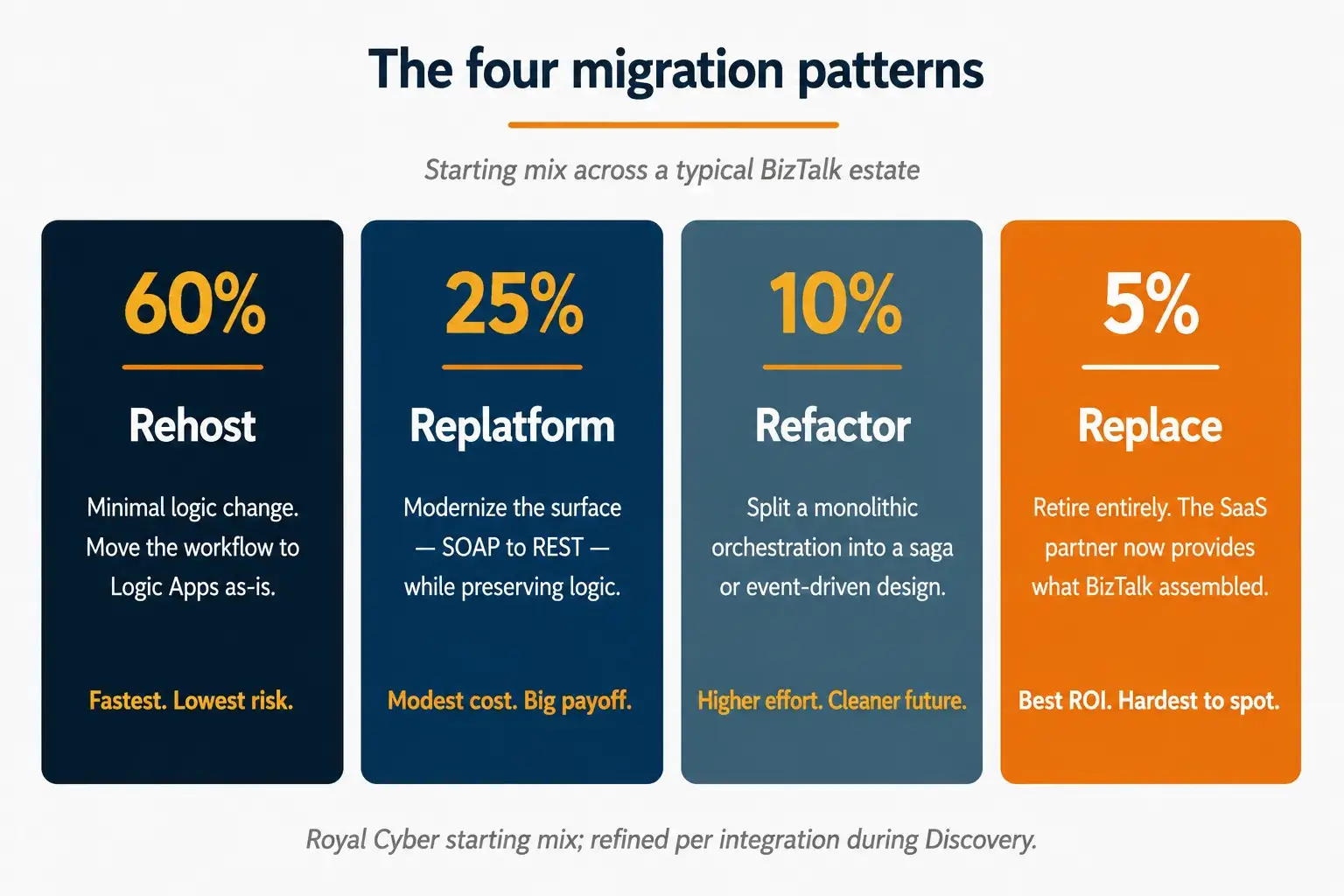
We use four patterns depending on the integration.
- Rehost : Minimal logic change, just move it.
- Replatform : Modernize the surface (e.g., SOAP to REST) while preserving the business logic.
- Refactor : Split a monolithic orchestration into a saga or event-driven design.
- Replace : Retire the integration entirely, often because the SaaS partner now provides what BizTalk was assembling. We aim for 60% rehost, 25% replatform, 10% refactor, 5% replace as a starting mix.
Accelerator Tooling
Three accelerators carry most of the load.
- The orchestration scanner parses ODX files and produces a Logic Apps skeleton plus an effort estimate.
- The map converter converts BizTalk XSLT maps into Logic Apps Data Mapper format with manual review.
- The reference patterns library covers the 20 most-common BizTalk scenarios : file-receive-to-AS2-send, AS2-receive-to-SAP-IDoc, JD Edwards-to-Salesforce, and so on , as ready-to-deploy Logic Apps.
Parallel-Run Validation
B2B Specifically
AS2, EDIFACT, X12, and XML EDI live in BizTalk’s B2B engine. Three options exist on Azure.
- Logic Apps B2B Connectors are the lowest-friction path for moderate volumes.
- Azure Integration Account still exists but is on a deprecation path; new estates should avoid it.
- Specialized accelerators Royal Cyber and a couple of ISVs ship B2B engines on Azure that handle high-volume EDIFACT and X12 with proper acknowledgements, retries, and audit trails. Choose based on volume and partner complexity.
What about Cost?
BizTalk Server is licensed; Azure is consumption-billed. We routinely model both. For high-volume estates with stable load, Logic Apps Standard on a fixed App Service Plan plus reserved APIM units beats BizTalk on TCO within 18 months and you stop paying for Windows Server, SQL Server, MSMQ, and the SAN. For low-volume estates, consumption pricing wins out of the gate. The exact crossover depends on workload mix.
Skills and Team Transition
Common Pitfalls
Three pitfalls show up repeatedly.
- Lift-and-shift everything sometimes the right answer is to retire, not migrate.
- Underestimating B2B complexity partner certificates, AS2 MDNs, and EDI envelope hierarchies are devil-in-the-details work.
- Skipping observability BizTalk’s tracking is rich; Application Insights with Log Analytics needs deliberate design to match.
Why Customers Pick Royal Cyber
Closing
A BizTalk migration is an opportunity, not a chore. The estates that get retired are usually the most fragile, the most expensive, and the least loved. The estates that emerge on Azure are typically faster, cheaper, easier to operate, and ready for the agentic features arriving across AIS. The clock is ticking, but you don’t need to panic : you need a plan.
Frequently Asked Questions
How long does a BizTalk-to-AIS migration actually take?
First production cutover in roughly 13 weeks with the four-phase playbook Discovery, Foundation, Wave 1, Wave 2. Most enterprises complete the remaining waves over the following quarter, depending on estate size and B2B complexity.
Will moving to Azure actually save us money?
For high-volume estates with stable load, Logic Apps Standard plus reserved APIM units beats BizTalk on TCO within 18 months, once you stop paying for Windows Server, SQL Server, MSMQ, and the SAN. Low-volume estates typically save from day one on consumption pricing.
Can our BizTalk developers transition to Logic Apps?
Yes , typically in three to six months with structured upskilling on Logic Apps Standard, APIM policies, Azure DevOps, and observability. The biggest migration risk is people, not technology. Customers who invest in enablement end up with a stronger team than they started with.
What's actually inside Royal Cyber's accelerator tooling?
What does the free Royal Cyber migration assessment deliver?
A phased migration plan, a complexity-scored inventory of your orchestrations and maps, an effort estimate, and a risk register: fixed-fee, partner-led, and designed to pay for itself in the program plan.
BizTalk to Azure Integration Services Migration Guide Table of Contents…
Read More »Agentforce and Microsoft Copilot Studio are the two dominant enterprise…
Read More »Websites used to be something you built once and basically…
Read More »
