
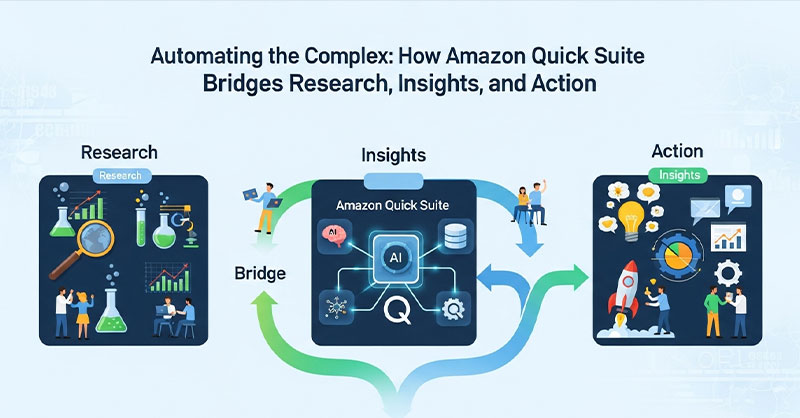
In today’s enterprise landscape, data is abundant but actionable intelligence is scarce. Teams are siloed, tools are disconnected, and the path from raw research to decisive action is fraught with friction. This operational complexity isn’t just inefficient; it’s a direct drag on innovation and growth. Enter Amazon Quick Suite AI agents—a transformative framework from AWS designed to automate this very journey. It’s not merely another tool; it’s an integrated orchestration layer that connects data, analysis, and execution into a seamless, intelligent workflow.
What is Amazon Quick Suite: An Overview
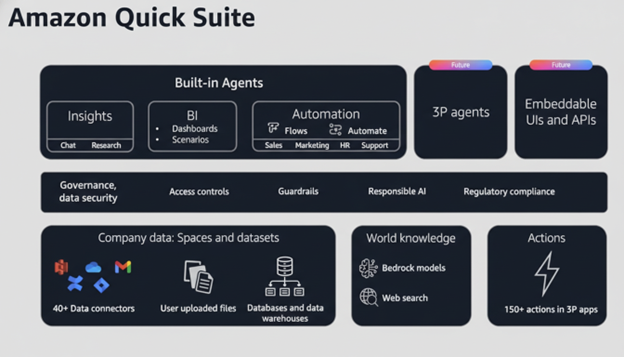
At its core, Amazon Quick Suite is a unified environment within the AWS ecosystem that brings together purpose-built AI agents, data integration tools, and automation capabilities. The homepage itself serves as a mission control center, offering a dashboard view of active agents, workflow statuses, and synthesized insights.

- Centralized Agent Dashboard: View and manage all your AI agents—from research crawlers to data analysts and execution bots—in one place.
- Workflow Canvas: A visual, low-code interface where you can design, link, and monitor multi-step processes that move data from one intelligent agent to the next.
- Unified Data Lake Access: Quick Suite natively integrates with AWS data services like Amazon S3 and Redshift, providing agents with a secure, governed access point to your organization’s information.
- Insights Feed: A real-time stream of key findings, anomalies, and recommendations generated by your agent network, prioritized for human review.
The message is clear: this is where disparate data points converge to become a clear line of sight for decision-makers.
Amazon Quick Suite’s Integrated Capabilities
Quick Suite’s power lies in its interconnected capabilities, moving beyond single-task AI to a collaborative agent network.
- Intelligent Research Agents: These agents autonomously scour internal databases, approved web sources, and document repositories. They don’t just fetch data; they summarize, cross-reference, and flag trends based on your queries.
- Analytical Insight Agents: Raw data is parsed by these agents using statistical models and business logic. They perform root-cause analysis, generate forecasts, and create visual narratives. A recent Forrester study found that companies using integrated AI analytics suites reduced time-to-insight by 65%, a key metric Quick Suite is built to surpass.
- Action & Execution Agents: This is the bridge. These agents turn insights into tickets, personalized customer communications, inventory purchase orders, or code deployments by integrating with tools like Salesforce, ServiceNow, or internal APIs.
- Governance & Learning Hub: Every action is logged. The suite learns from human feedback and corrections, continuously improving agent accuracy and ensuring compliance with set guardrails.
Quick Suite Architecture: The Engine Behind the Magic
Understanding the architecture demystifies its reliability and scalability. It’s built on a serverless, event-driven AWS backbone.
- Agent Fabric Layer: This is the brain trust. Each “agent” is a containerized microservice combining specialized machine learning models (e.g., for NLP, forecasting) with access permissions and API connectors.
- Orchestration Engine (Powered by AWS Step Functions): This component manages the state and flow of complex multi-agent workflows, ensuring tasks are passed correctly and errors are handled gracefully.
- Universal Data Connector: Acts as a secure translator, allowing agents to pull from and push to virtually any data source or SaaS application, whether on AWS or not.
- Security & Governance Envelope: All agent activities are encrypted and logged via AWS CloudTrail. Fine-grained IAM roles ensure agents only access the data they are expressly permitted to, a critical feature for enterprise adoption.
How Amazon Quick Suite Works in Daily Life: A Real-World Scenario
Consider a national retail chain. A social media sentiment agent detects a spike in negative mentions about a popular product’s durability. Here’s Quick Suite in action:
- The sentiment agent automatically triggers a research agent, which cross-references the social data with recent customer service tickets and product return logs in the CRM.
- An analytical agent ingests this consolidated data, identifying a specific manufacturing batch and a 15% higher return rate from a key region.
- This insight automatically kicks off a multi-pronged action workflow:
- An execution agent generates a report and alerts the supply chain and quality assurance managers via Slack.
- Another agent places a hold on the affected batch in the warehouse management system.
- A customer communication agent drafts a personalized apology and replacement offer for customers who already purchased the product, queuing it for manager approval.
This entire cycle—from detection to initial corrective actions—unfolds in minutes, not days, containing brand damage and operational cost.
Use Cases of Quick Suite in Every Department
- Marketing: Agents analyze campaign performance in real-time, automatically reallocating budget to top-performing channels and generating A/B test hypotheses.
- Sales: Integrated agents qualify leads from website behavior, enrich CRM profiles, and recommend next-best-action scripts for reps based on deal stage and client sentiment.
- Customer Support: Automatically categorizes ticket urgency, suggests solutions from knowledge bases, and for complex cases, pre-fetches all relevant customer data and interaction history for the human agent.
- Product & R&D: Continuously scans competitor releases, patent filings, and academic papers, summarizing relevant innovations. Manages and prioritizes feature request backlogs from multiple inputs.
- Finance & Operations: Monitors for procurement anomalies, automates routine financial reporting, and models cash flow scenarios based on real-time sales and market data.
Quick Suite vs. Microsoft Copilot vs. Google Gemini: The Enterprise Orchestration Edge
Quick Suite vs. Microsoft Copilot vs. Google Gemini

Amazon Quick Suite AI agents operate at a different layer:
- Scope: Quick Suite is an enterprise workflow automation platform where AI agents are persistent, specialized workers. Copilot/Gemini are generalist assistants for individual users.
- Integration: Quick Suite is designed for deep, backend system integration (ERP, CRM, custom databases). Copilot/Gemini focus on front-end office applications.
- Action: Quick Suite’s core function is to autonomously execute multi-step business processes. While Copilot can automate tasks within an app, Quick Suite automates processes across the entire tech stack.
Think of it this way: Gemini can help you write a report on sales trends. Copilot can create the chart in PowerPoint. But Amazon Quick Suite AI agents can discover the trend, adjust the inventory order, notify the sales team, and then draft the report for your review.
The Road Ahead: What’s Upcoming for Amazon Quick Suite?
- Specialized Industry Agent Blueprints: Pre-built workflow templates for healthcare (prior auth automation), financial services (compliance reporting), and manufacturing (predictive maintenance).
- Enhanced Agent Collaboration: Moving from linear workflows to a “hive mind” where agents dynamically debate findings for higher-confidence outcomes before taking action.
- Proactive Opportunity Agents: Shifting from reactive problem-solving to agents that continuously model scenarios to suggest new revenue streams, cost optimizations, or innovation opportunities.
- Deeper No-Code Customization: Empowering business analysts to build and train department-specific agents with even simpler drag-and-drop interfaces and natural language prompts.
From Insight to Imperative: Your Next Move
Frequently Asked Questions (FAQs)
Q: What is Amazon Quick Suite?
Q: How is Quick Suite different from Microsoft Copilot or Google Gemini?
Q: What kind of results can I expect?
Q: Is my data secure with Quick Suite?
Q: Do I need coding skills to use Quick Suite?
Q: Can Quick Suite integrate with our existing tools?
Absolutely. Quick Suite connects to 40+ data sources including AWS services (S3, Redshift) and can execute 150+ actions in third-party applications like Salesforce and ServiceNow. It offers 1,000+ app connections via MCP for comprehensive integration across your tech stack.
Content Writer
Agentforce and Microsoft Copilot Studio are the two dominant enterprise…
Read More »
Websites used to be something you built once and basically…
Read More »
Websites used to be something you built once and basically…
Read More »