

??
Home > Blogs > AI Services > Deep Agent AI: The Next Evolution of Autonomous AI Research
November 4, 2025
Deep Agent AI: Revolutionizing Digital Commerce
Table of Contents
What are "Deep Agent AI"?
Deep Agents AI are an emerging class of AI systems – built on advanced large language models (LLMs) – that can autonomously tackle complex, multi-step tasks in a way traditional AI assistants cannot. Unlike a standard chatbot that answers one question at a time, a deep agent is capable of conducting multi-step research: it dynamically plans a series of actions, gathers information from numerous sources, and synthesizes the results into a coherent output. In essence, you give the agent a high-level goal or query, and it will find, analyze, and synthesize information from hundreds of sources to produce a comprehensive report at the level of a human research analyst.
Deep Agent AI differs fundamentally from earlier AI approaches like Retrieval-Augmented Generation (RAG) or basic tool-using bots. Traditional RAG systems could fetch facts from a fixed database to improve accuracy, and simple tool-using agents followed a pre-scripted sequence of actions. However, these approaches lacked deep reasoning or adaptability for truly complex tasks. A deep agent, by contrast, offers autonomy, continual reasoning, and adaptive planning – it can react to the information it finds, adjust its strategy on the fly, and dig into evolving questions. This makes deep agents uniquely suited for complex research scenarios that require exploring diverse sources and handling unexpected findings, which is a core component of advanced AI for digital commerce analytics.
Key Capabilities of Deep Agents
- Long-Horizon Reasoning: They can maintain a reasoning chain over many steps, continually updating plans as new information arrives. This means a deep agent can handle long multi-turn research sessions, much like a human analyst brainstorming and refining their approach.
- Real-Time Information Retrieval: Deep Agent AI retrieves information from diverse sources in real time, using web search, APIs, or databases. They are not limited to a fixed knowledge base, so they can find up-to-date data and even niche information scattered across the internet.
- Tool Use & Multimodal Processing: These Deep Agent AI systems integrate external tools iteratively – for example, running code to analyze data, reading PDF documents, extracting facts from images, or other domain-specific tools. They leverage such tools to process multimodal data (text, images, graphs) during their research.
- Structured Outputs with Citations: Rather than a loose answer, a deep agent produces a structured, well-documented report of its findings. Every claim can be backed by citations to the original sources, and the agent often provides a summary of its own reasoning process. This transparency makes it easier to verify and trust the results.
In short, a deep agent acts like an autonomous research analyst: it independently discovers and consolidates insights from across the web and other data sources, then delivers a thorough, cited analysis. OpenAI’s Deep Research agent, for example, can accomplish in tens of minutes what would take a human many hours, by scouring countless webpages and documents to answer a complex query. This leap in capability marks a significant milestone toward more general Deep Agent AI autonomy.
Accelerate Your AI Journey with Royal Cyber
How Do Deep Agents Work?
At the core, a deep agent still uses an LLM (like GPT-4 or newer) to drive its behavior. The core algorithm is the familiar loop of an LLM reasoning and calling tools, often referred to as the ReAct framework (for “Reasoning and Acting”). In the ReAct approach, the agent alternates between thinking (reasoning) and acting (performing an action like a web search or API call). This means the agent generates a chain of thought, decides an action (e.g. search query), observes the result, then continues reasoning – repeating this cycle until it converges on an answer. By interleaving logical reasoning with actions, the agent can dynamically refine its plan and gather new information as needed. This is a key enabler for deep agents: the model isn’t confined to its initial knowledge or a single-step response; it can learn and adjust during the task by pulling in external information.
What makes deep agents especially powerful is how they extend this basic loop with additional structures and training. Research and industry implementations have converged on a few critical components that allow agents to “dive deep” into complex tasks:
- A Detailed System Prompt: Deep Agent AI systems are guided by an extensive system prompt (or policy) that provides instructions, tools usage formats, and examples. This “prompt blueprint” encodes how to plan, how to use each tool, and how to format results. For instance, Anthropic’s Claude Code (an AI coding assistant) uses a very long system prompt with detailed tool instructions, which was found to generalize to broader tasks. In deep research scenarios, the prompt might include guidelines for rigorous web research, citation requirements, and step-by-step approach examples. These detailed prompts effectively program the agent’s behavior and keep it on track, which is crucial for handling long-horizon tasks without losing focus.
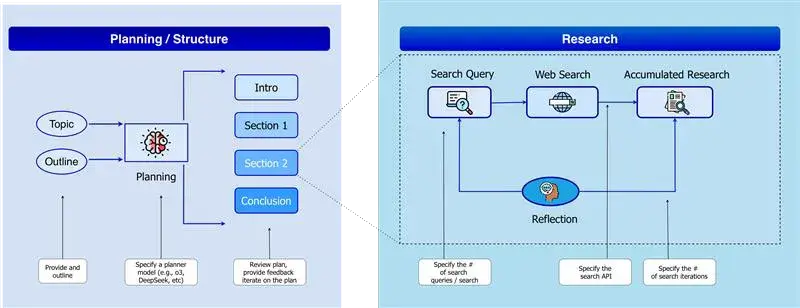
- Planning Mechanism (Task Decomposition): To manage complex problems, deep agents often employ an explicit planning step or a “to-do list” tool. The agent can outline sub-tasks or a plan of attack before diving into execution. In practice, this may be implemented as a pseudo-tool that doesn’t affect the environment (a no-op) but lets the agent write down a plan for itself. This strategy of prompting the agent to formulate and update a plan helps it break down the query into manageable parts and ensures it remembers the high-level goals throughout the multi-step process. Even a simple checklist of steps in the agent’s working memory can significantly improve performance on long, complex tasks.
- Ability to Spawn Sub-Agents: Some deep agent architectures allow the agent to spin off sub-agents dedicated to specific sub-tasks. For example, an agent might create a subordinate agent to focus solely on parsing scientific papers, while another sub-agent gathers statistical data – all coordinating towards the overall goal. These sub-agents operate like specialized workers on different aspects of the problem. By dividing labor, the main agent can explore multiple avenues in parallel or handle different aspects of a task with focused expertise. This modular approach is useful in complex workflows (and indeed, providers like Anthropic have designed agents that can invoke copies of themselves as helpers). It also opens the door to multi-agent systems collaborating on a problem.
- Tool Integration & File System Memory: Deep Agent AI systems have a rich toolbox at their disposal. They use web browsers for online research, APIs and databases for factual queries, and even a Python interpreter for data analysis or visualization. Notably, they also have access to a file system or memory storage to keep track of intermediate results. The agent can read and write files, which serves as an external memory – for example, saving notes, caching information from one step to use in later steps, or writing a draft report that can be refined. This persistent workspace is shared among the agent and any sub-agents, enabling collaboration and context sharing. Having a “file browser” essentially means the agent can browse not only the web but also user-provided files or its own saved data. In fact, OpenAI’s deep research agent can ingest user-uploaded files (like PDFs or spreadsheets) as part of its analysis and incorporate that with online information. The agent’s Python tool allows it to generate graphs or perform calculations on the fly, then it can embed the generated charts or images into its final report for clarity. All tool use is orchestrated by the agent’s reasoning – it decides when to search, when to read a file, when to run code, etc., based on what the task requires.
- Self-Reflection and Refinement: A hallmark of “deep” autonomy is that the agent can evaluate its own intermediate outputs and improve on them. Deep Agent AI often employs a self-reflection mechanism: after drafting an answer or reaching a preliminary conclusion, the agent pauses to critique its result and check for errors or missing pieces. This is implemented via a special prompting strategy (sometimes called the Reflexion approach) where the agent generates a review of its work and then uses that feedback to adjust its subsequent actions. In practice, the agent might ask itself: “Did I answer all parts of the question thoroughly and correctly? Did I rely on credible sources? Are there inconsistencies?” If issues are found, the agent will loop back into research mode or revise its findings. This iterative feedback loop continues until the agent is satisfied with the quality of the output. Such self-correction mechanisms dramatically improve reliability and depth, as the agent effectively learns from its mistakes during the session and reduces reasoning errors or hallucinations.
All these components work together with the LLM at the center. It’s important to note that achieving a truly effective deep agent often involves training or fine-tuning the model on the process of multi-step research. For instance, OpenAI’s deep research agent was trained via reinforcement learning on real browsing and reasoning tasks, which taught it how to backtrack when hitting dead-ends and how to pivot its strategy based on new information. This training yields an agent with a more human-like problem-solving approach, able to handle unexpected findings and diverse domains. The result is evident in benchmarks: OpenAI reported that their deep research model achieved state-of-the-art accuracy on complex, real-world question benchmarks by effectively seeking out specialized information when necessary.
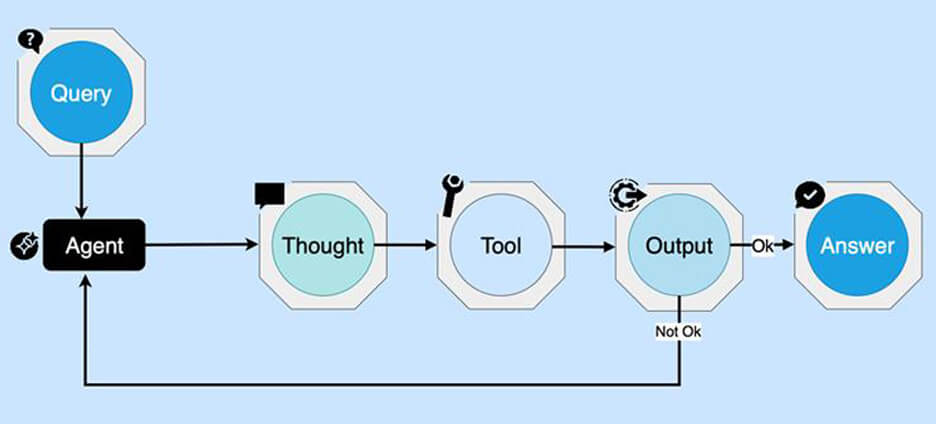
In summary, a deep agent’s operation can be visualized as a sophisticated loop:
Plan → Research (use tools) → Analyze → Plan refinement → Further research → … → Synthesize report.
Throughout this loop, it uses a well-crafted prompt as a guide, possibly delegates tasks to sub-agents, keeps notes in files, and applies self-reflection to refine its work. This allows the Deep Agent AI to execute on goals that require dozens of decisions and actions over a prolonged period – something earlier “shallow” agents could not reliably do.
Transform Your Business with Royal Cyber’s AI Expertise.
Real-World Use Cases Across Industries
Because deep agents essentially automate research and complex problem-solving, their applications span across many industries and domains. Any field that involves gathering and interpreting large amounts of information can potentially benefit. Below are a few real-world use cases illustrating what deep agents make possible:
- Financial Analysis and Consulting: A deep agent can serve as a financial research assistant – for example, conducting due diligence on a company by reading through financial reports, news articles, market data, and analyst commentary. It could compile a comprehensive investment analysis or risk report with all supporting data cited. This helps investment firms or consultants rapidly evaluate opportunities with an AI doing the heavy lifting of data gathering. In corporate finance, an agent might automate competitive analysis or market research on demand (e.g. analyzing streaming platforms or telecom markets as hinted by OpenAI).
- Scientific Research and Healthcare: Researchers and R&D teams can use deep agents to perform literature reviews and evidence synthesis. Imagine asking an agent to investigate a biomedical question – it will search scientific journals, read relevant papers and clinical trial results, and then summarize the findings. This could greatly speed up drug discovery research, or help doctors stay up-to-date with the latest medical literature on a condition. The agent’s ability to interpret PDFs of academic papers and even extract data to plot graphs means it can handle technical sources that a normal chatbot could not. The result might be a report highlighting, say, which studies support a particular treatment and what gaps remain, saving scientists weeks of manual effort.
- Public Policy and Legal: In government or law, deep agents can automate policy analysis or legal research. For instance, a policy advisor could task the agent with comparing international regulations on data privacy. The agent would retrieve laws and policy papers from various countries, summarize key points, and highlight differences – providing a cited briefing document for decision-makers. Lawyers could similarly benefit from an agent that scours case law and statutes to build a legal argument or contract review, referencing each source. Because the agent can adapt as it finds new precedents or clauses, it won’t miss relevant information even if the inquiry evolves in scope.
- Engineering and Technical Design: Engineers often need to consult vast technical documentation, standards, and prior art. A deep agent can expedite this by researching, say, the best practices for a certain software architecture or the properties of a new material. It might pull information from engineering textbooks, online forums, patent databases, and product manuals to produce a detailed technical brief. For complex design problems, the agent could break the task into sub-problems (materials, cost, regulations, etc.) using sub-agents, and then aggregate the findings. This cross-referencing of many technical sources can lead to more informed engineering decisions and innovation.
- Retail and Personalized Shopping: On the consumer side, even individuals can use deep agents as ultra-advanced personal shoppers. For example, “discerning shoppers looking for hyper-personalized recommendations” on big purchases like cars or appliances can query a deep agent. The agent will research across review sites, spec sheets, user forums, and expert articles to recommend the best product for the user’s specific needs – all with reasons and references. It can consider nuanced criteria (fuel efficiency, maintenance records, resale value, etc.) that a normal shopping assistant might overlook. This leads to more data-driven purchase decisions, with the agent doing the tedious comparison work, a key benefit of using AI for digital commerce.
- Education and Knowledge Work: Students and knowledge workers can utilize deep agents for learning or content creation. For example, a student writing a thesis can ask the agent to gather relevant references on their topic. The agent could deliver a literature survey with key quotes and citations. Similarly, journalists or writers could have an agent perform investigative research on a complex story – compiling facts from archives, interviews, and databases into a coherent summary. In all cases, the agent accelerates the research phase of knowledge work, enabling humans to focus on synthesis and creative insights.
These examples barely scratch the surface. Essentially, any task that requires “research + analysis + writing” can be turbocharged by deep agents. Major AI providers have noticed this potential: all the leading AI platforms (OpenAI, Google, Anthropic, etc.) are developing deep research agents or similar autonomous assistants for coding and analysis. Many organizations are also creating custom deep agents tailored to their vertical or proprietary data. For businesses, adopting Deep Agent AI can mean faster decision cycles, more thorough market and competitive intelligence, and support for employees to handle complex projects with AI augmentation, which is the ultimate goal of sophisticated AI for digital commerce.
Conclusion
Deep Agent AI represents a significant leap in what AI can do, moving from simple Q&A or single-step tasks to true autonomous problem solving. They work by combining powerful LLM reasoning with tool use, memory, and self-refinement techniques – enabling AI to carry out multi-step research in a very human-like, yet superhumanly efficient manner. This technology was not possible just a few years ago; today, it is rapidly becoming a reality, with OpenAI’s Deep Research agent and open-source projects demonstrating performance on par with human analysts in certain domains.
For enterprises and decision-makers, deep agents offer a new kind of workforce: always-on digital analysts that can tackle complex research across finance, science, law, engineering, and more. They produce credible, transparent results (with citations and logs of their thought process) that can support high-stakes decisions. Early adopters are using these agents to save time, reduce costs on research tasks, and uncover insights that might have been missed otherwise. As the technology matures – with improvements in reliability, the ability to handle real-time data, and better multi-agent collaboration protocols – we can expect Deep Agent AI to become an indispensable tool across industries.
Deep agents are ready to deliver real-world results, and Royal Cyber is here to guide you. As a leading provider of AI solutions in the US, we’ll help you explore how this AI-driven technology can transform your business. Ready to get started? Get in touch with our specialists today!
References
- OpenAI. Introducing Deep Research (2025, OpenAI Blog).
- ReAct: Synergizing Reasoning and Acting in Language Models (Yao et al., 2023).
- Reflexion: Language Agents with Verbal Reinforcement Learning (Shinn et al., 2024).
- LangGraph / LangChain – Deep Agents Overview Documentation (2025).
- How we built our multi-agent research system (2025).
Frequently Asked Questions (FAQs)
Q1: What is Deep Agent AI and how does it differ from traditional AI?
Deep Agent AI represents advanced artificial intelligence systems capable of autonomous multi-step research and complex problem-solving. Unlike traditional AI that typically handles single tasks or queries, Deep Agent AI can plan, execute, and refine strategies across extended operations, making it particularly valuable for sophisticated business applications and is a powerful form of AI for digital commerce.
Q2: How can businesses implement Deep Agent AI solutions?
Implementation typically follows a structured approach starting with comprehensive needs assessment, progressing through pilot testing phases, and advancing to full-scale integration. Most organizations benefit from partnering with experienced providers who can ensure seamless integration with existing systems and workflows.
Q3: What types of business problems can Deep Agent AI solve?
These advanced Deep Agent AI systems excel at handling complex research tasks, data analysis across multiple sources, competitive intelligence gathering, customer insight generation, and strategic planning support. They’re particularly effective for scenarios requiring synthesis of information from diverse data streams.
Q4: How does Deep Agent AI ensure data security and privacy?
Reputable Deep Agent AI solutions implement robust security protocols including data encryption, access controls, and compliance with relevant data protection regulations. Security measures should be discussed with implementation partners to ensure alignment with organizational requirements.
Q5: What is the typical implementation timeline for Deep Agent AI?
Implementation timelines vary based on organizational complexity and specific use cases, but generally range from several weeks to a few months for full deployment. Most providers offer phased implementation approaches to minimize disruption while maximizing value realization.
Q6: Can Deep Agent AI integrate with existing business systems?
Yes, modern Deep Agent AI platforms are designed with integration capabilities that allow connectivity with existing CRM, ERP, analytics, and other business systems through APIs and customized connectors.
Talk To Our Experts
Recent Blogs
June 9, 2026
Agentforce and Microsoft Copilot Studio are the two dominant enterprise…
Read More »
June 4, 2026
Websites used to be something you built once and basically…
Read More »
June 4, 2026
Websites used to be something you built once and basically…
Read More »