
Table of Contents
SAP Joule is SAP’s generative AI copilot, embedded natively across the SAP application portfolio. In 2026 it reaches general availability across S/4HANA Cloud, SuccessFactors, Ariba, and SAP Build, with deeper integration through SAP Business Technology Platform (BTP) and SAP Datasphere.
The reason this rollout matters now, rather than in 2024 or 2025, is concrete: Joule has moved from preview features in isolated modules to a cross-suite capability that touches finance close, source-to-pay, and hire-to-retire on the same trust layer. Engagement on LinkedIn SAP influencer posts about Joule is up roughly 240% year over year, and CIO budget conversations have shifted from “should we pilot AI” to “where is our 12-month rollout plan.”
For SAP leaders, the practical implication is that month-end close time, integration error rate, and custom code reduction become board-level metrics in 2026. The teams shipping today treat their SAP Joule AI copilot rollout as a product capability with executive sponsorship, not an IT side project.
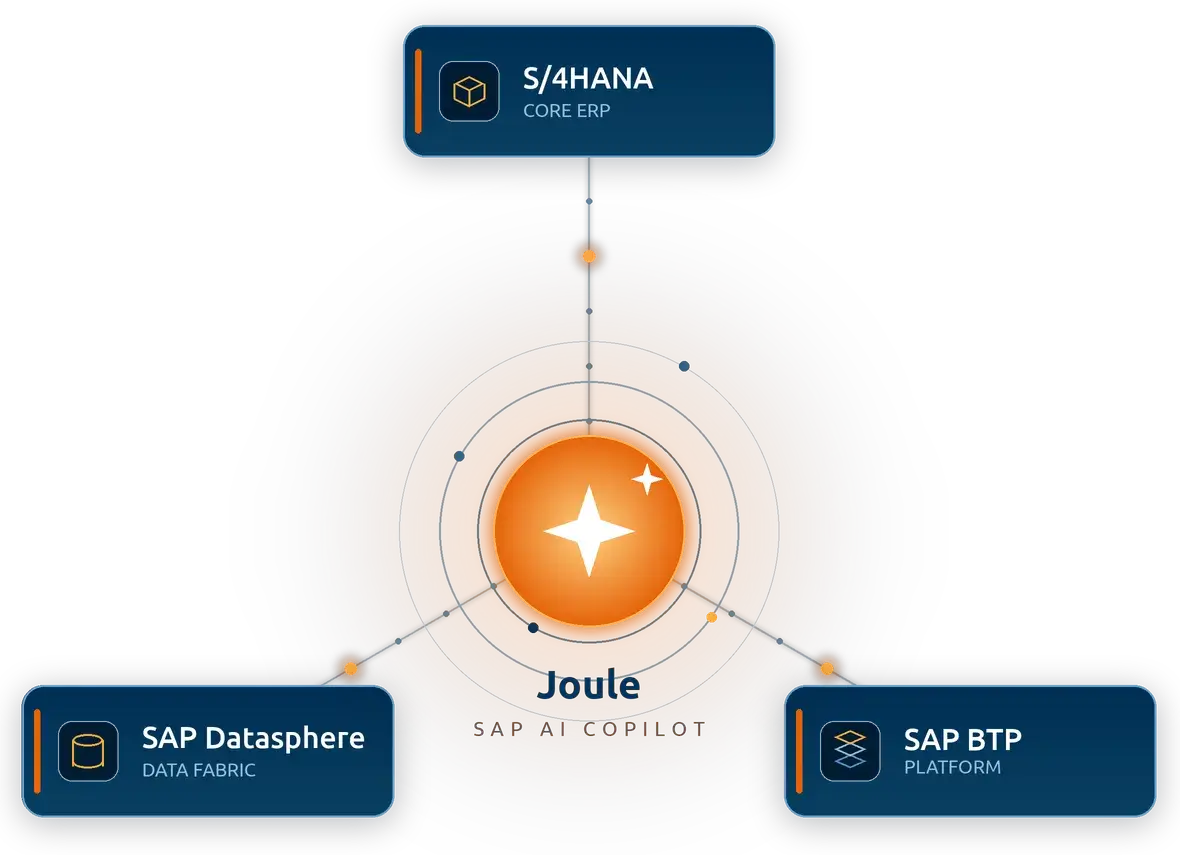
Discover What’s New in SAP
The SAP Reference Architecture for a Joule Rollout
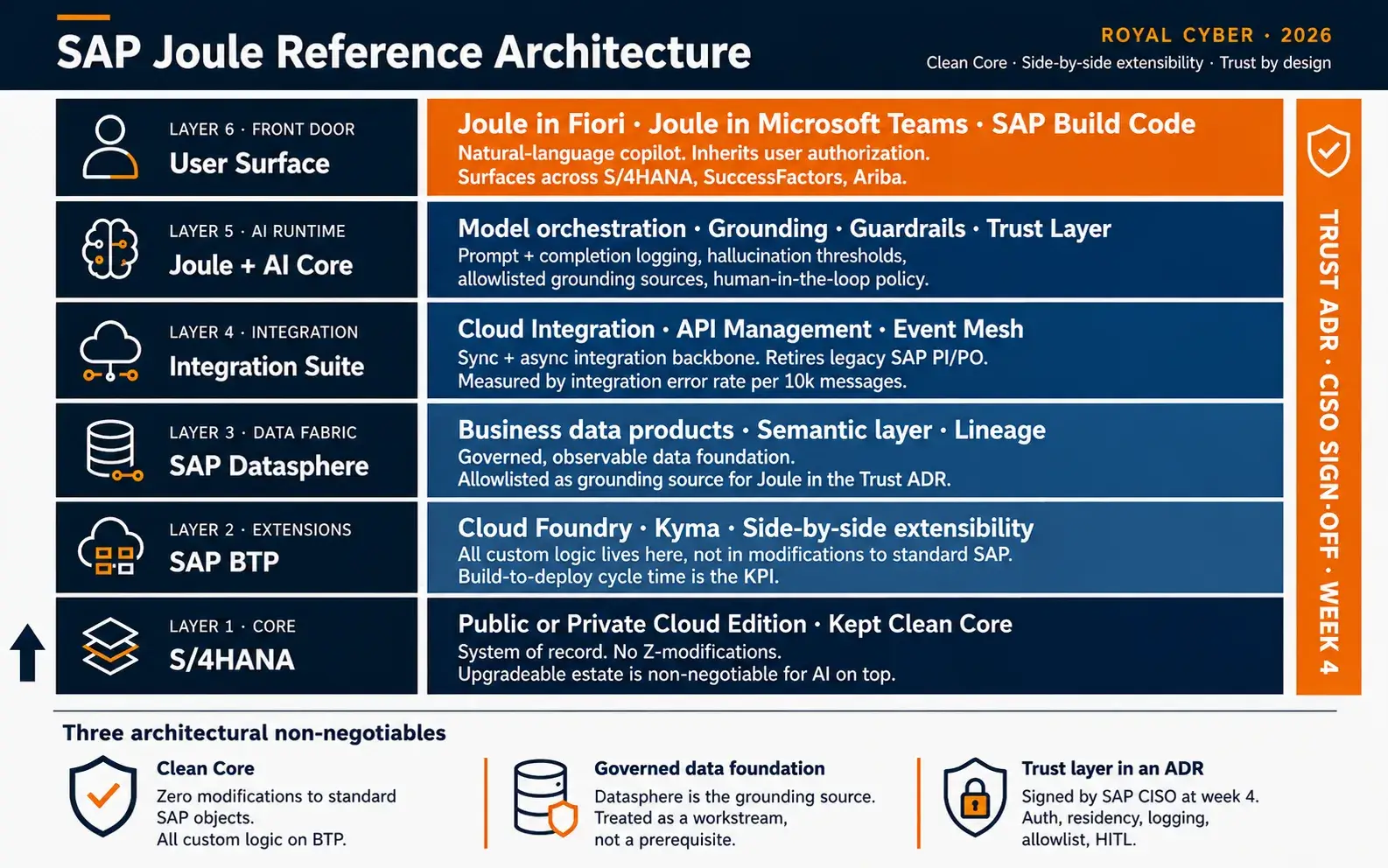
A defensible SAP Joule AI copilot rollout architecture has four layers. Skip any of them and the program stalls at pilot.
Capability decomposition on the SAP stack
Map Joule to two or three named business capabilities your platform should expose, not to a feature backlog. Typical capability anchors:
- Finance close acceleration on S/4HANA (reconciliations, journal explanations, variance analysis)
- Talent intelligence on SuccessFactors (skills inference, succession suggestions, learning recommendations)
- Source-to-pay copiloting on Ariba (supplier risk summaries, contract clause extraction, invoice anomaly detection)
A Modern Data Foundation (the Part Most Programs Underestimate)
Joule only pays off when the underlying data is governed, observable, and accessible. On SAP engagements we treat data readiness as a parallel workstream, not a prerequisite, and we wire it into S/4HANA via Clean Core extensions on BTP.
The default reference data architecture:
| Layer | SAP Component | Purpose |
|---|---|---|
| Transactional core | S/4HANA (public or private cloud edition) | System of record, kept Clean Core |
| Extension plane | SAP BTP (Cloud Foundry / Kyma) | Custom logic, side-by-side extensions |
| Data fabric | SAP Datasphere | Business data products, semantic layer |
| Integration backbone | SAP Integration Suite (Cloud Integration, API Management, Event Mesh) | Sync and async integration |
| AI runtime | SAP AI Core + Joule | Model orchestration, grounding, guardrails |
| Front door | Joule in Fiori, Joule in Microsoft Teams | User-facing copilot surface |
The non-negotiable: keep the core clean. Custom logic lives in BTP extensions, not in modifications to standard SAP objects. This is the difference between an upgradeable estate and a frozen one.
A Trust Layer Codified in an ADR
Guardrails, lineage, prompt observability, and access controls are designed in from week one, not retrofitted. The SAP CISO signs off the Trust ADR (Architecture Decision Record) at week 4 of the rollout.
A minimum-viable Trust ADR for SAP Joule covers:
- Authorization propagation – Joule actions inherit the user’s S/4HANA authorization objects, including derived roles
- Data residency – Where prompts, completions, and grounding data are processed, by SAP data center region
- Prompt and completion logging – Retention period, access roles, redaction rules for PII
- Grounding source allowlist – Which Datasphere data products Joule can read, by capability
- Hallucination handling – Confidence thresholds, fallback behavior, human-in-the-loop triggers for high-risk actions (anything that posts to the GL, anything that changes payroll)
An Evaluation Harness Measured against Build-to-Deploy Cycle Time
Before you ship a Joule scenario, build the measurement. Track extension build-to-deploy cycle time on BTP from the first sprint. If your cycle time is measured in months, no AI feature will save you, because the feedback loop is too slow to learn from.
Side-by-Side vs In-App Extensibility: When to use which
This is the architectural decision most SAP teams get wrong on a Joule rollout.
| Extension type | Use when | Risk |
|---|---|---|
| In-app extensibility (key user, developer) | Field additions, custom logic close to a standard SAP object, low complexity | Couples extension lifecycle to S/4HANA upgrade cycle |
| Side-by-side on BTP | New microservices, AI orchestration, cross-system workflows, anything calling Joule from outside SAP | Adds integration surface, requires BTP operating model |
Rule of thumb: anything that orchestrates Joule across more than one SAP app goes side-by-side. Anything tightly bound to a single Fiori app can be in-app.
KPIs that Earn the Next Round of Funding
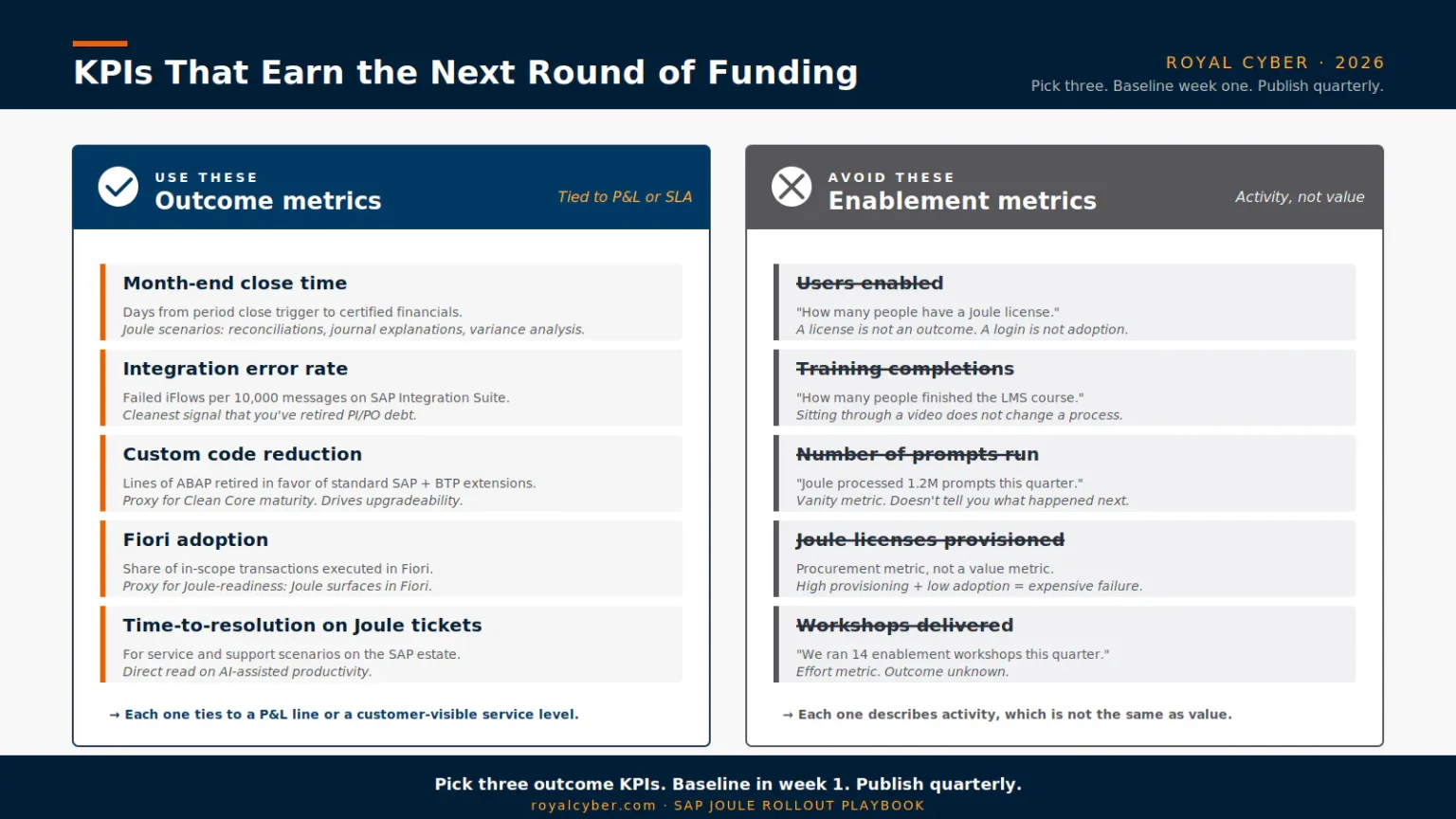
CIO patience for “AI strategy” is short. Royal Cyber clients who secure follow-on funding pick three KPIs from this list, baseline them in week 1, and publish them quarterly.
Use these (outcome metrics):
- Month-end close time – days from period close trigger to certified financials
- Integration error rate – failed iFlows per 10,000 messages on SAP Integration Suite
- Custom code reduction – lines of ABAP retired in favor of standard + BTP extension
- Fiori adoption – share of in-scope transactions executed in Fiori (a proxy for Joule-readiness, since Joule surfaces in Fiori)
- Time-to-resolution on Joule-handled tickets – for service and support scenarios
Avoid these (enablement metrics that don’t move boards):
- Users enabled
- Training completions
- Number of prompts run
- Joule licenses provisioned
The pattern: outcome metrics tie to a P&L line or a customer-visible service level. Enablement metrics describe activity, which is not the same as value.
A 90-day SAP Joule Rollout Plan
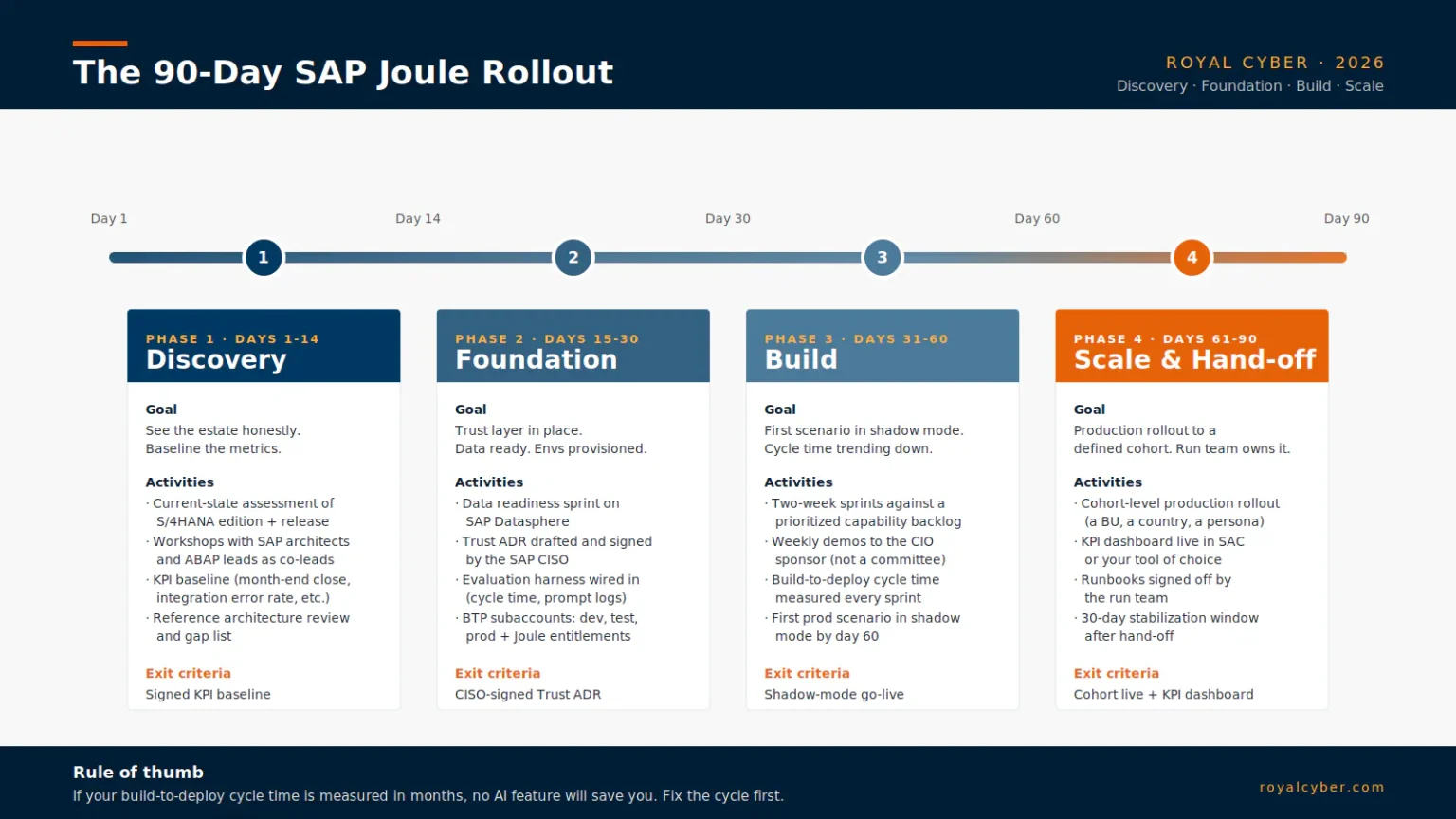
This is the sequence Royal Cyber runs on real engagements. It is opinionated. The dates assume one CIO sponsor, one SAP architect lead, one BTP lead, one data lead, and a product owner per capability.
Days 1-14: Discovery
- Current-state assessment of the SAP estate (S/4HANA edition and release, BTP subaccount topology, integration inventory)
- Stakeholder workshops with SAP architects and ABAP leads (they are co-leads on this program, not stakeholders)
- KPI baseline against month-end close time and the other two metrics you picked
- Reference architecture review and gap list
Days 15-30: Foundation
- Data readiness sprint on Datasphere (which data products, which semantic models, which consumers)
- Trust ADR drafted and signed by the SAP CISO
- Evaluation harness wired in (cycle time, prompt logs, hallucination rate sampling)
- Environment provisioning – BTP subaccounts for dev, test, prod, with Joule entitlements assigned
Days 31-60: Build
- Two-week sprints against a prioritized capability backlog on the SAP stack
- Weekly demos to the CIO sponsor, not a steering committee (steering committees absorb time without making decisions)
- Extension build-to-deploy cycle time measured every sprint
- First production scenario in shadow mode by day 60 (Joule generates suggestions, humans still execute)
Days 61-90: Scale and Instrument
- Production rollout to a defined cohort (a specific business unit, a specific country, a specific persona, not “all finance users”)
- KPI dashboard live in SAP Analytics Cloud or your tool of choice (cycle time, cost-to-serve, quality)
- Runbooks signed off by the run team
- Hand-off to the run team with a 30-day stabilization window
SAP Joule vs Microsoft Copilot vs Standalone LLM Agents: When does Joule Win?
This comparison comes up in every CIO conversation. The honest answer is that it depends on where your data and your authorization model live.
| Dimension | SAP Joule | Microsoft 365 Copilot | Standalone LLM agent (OpenAI, Anthropic, etc.) |
|---|---|---|---|
| Native grounding in SAP data | Strong (S/4HANA, SuccessFactors, Ariba, Datasphere) | Weak without connectors | None by default |
| Authorization propagation | Inherits SAP roles and auth objects | Inherits Microsoft Graph permissions | Custom build |
| Best for | SAP-centric processes (finance close, HR, procurement) | Microsoft-centric productivity (email, docs, meetings) | Cross-stack workflows, niche use cases |
| Total cost to deploy | License + BTP + integration | License + tenancy work | High - you build the grounding layer |
| Time to first value | Fastest if SAP is already cleaned up | Fast if M365 is the system of record | Slowest |
The pragmatic answer: most enterprise SAP shops will run Joule for SAP-bound processes, Copilot for productivity, and reserve standalone LLM agents for cross-stack scenarios that neither vendor solves. Choose by data gravity, not by vendor preference.
Conclusion
Royal Cyber’s SAP practice has delivered SAP Joule AI copilot rollouts end-to-end – discovery through run – across financial services, healthcare, and manufacturing. If you would value an outside perspective on your roadmap, book a 30-minute discovery call. We will walk through your current state, share comparable benchmarks from our portfolio, and give you a candid view of what is achievable in your first 90 days.
FAQ
Q1. What are the top SAP Joule use cases for finance, HR, and procurement in 2026?
The highest-ROI use cases in our 2026 engagements cluster around three modules. In S/4HANA Finance: automated journal explanations, reconciliation drafting, and month-end variance analysis. In SuccessFactors: skills inference from job history, succession candidate suggestions, and personalized learning recommendations. In Ariba: supplier risk summaries, contract clause extraction, and invoice anomaly detection. The rule of thumb: pick one capability per module for the first 90 days, not all nine.
Q2. How much does a SAP Joule rollout cost in 2026?
Cost is driven by three variables: how clean your S/4HANA core is, how many capabilities are in scope, and how much foundation work is needed in Datasphere. A 90-day rollout for a single capability typically lands in the low-to-mid six figures for license plus services combined. Enterprise-wide adoption over 9 to 18 months runs into low seven figures. The dominant cost is rarely Joule licensing itself; it is the implementation services and the BTP consumption around it.
Q3. Should we run a SAP Joule pilot before a full enterprise rollout?
Yes, but call it a “first capability” rather than a pilot. Pilots have a tendency to stay pilots: they never get instrumented for production, never get a run team, never get exit criteria. Pick one capability (for example, journal explanations in S/4HANA Finance), run it through the 90-day plan, ship it to a defined cohort in production by day 90, and decide on the next capability based on observed KPIs, not on a pilot retrospective.
Q4. What team and skills do we need for a successful SAP Joule rollout?
A minimum viable team is: a CIO sponsor, an SAP architect lead, a BTP lead with Cloud Foundry or Kyma experience, a Datasphere data product owner, an ABAP lead for Clean Core migration, a process owner per business capability in scope, and a security architect to own the Trust ADR. Treat SAP architects and ABAP leads as co-leads with the business, not as vendors. The most under-resourced role on most rollouts is the data product owner.
Q5. How is SAP Joule licensed in 2026?
Joule is bundled into specific SAP cloud subscriptions rather than sold as a standalone product. S/4HANA Cloud Public Edition includes Joule entitlements at the user tier. SuccessFactors and Ariba bundle Joule into their suite licenses with usage tiers. Custom Joule scenarios built on SAP BTP consume AI Core capacity units, billed separately. Check your existing SAP contract before assuming you need new licenses; in many cases the entitlement is already there, unused.
Author
Pooja Reddy Sodum
Marketing Executive
Talk To Our Experts
Recent Blogs
June 9, 2026
Agentforce and Microsoft Copilot Studio are the two dominant enterprise…
Read More »
June 4, 2026
Websites used to be something you built once and basically…
Read More »
June 4, 2026
Websites used to be something you built once and basically…
Read More »