RosettaNet B2B Integration: An in-depth Implementation Guide

RosettaNet B2B Integration
RosettaNet B2B Integration: An in-depth Implementation Guide
Zeeshan
Zeeshan Mukhtar

Global Head

July 4, 2025

AI-Driven Enterprise Chatbot Implementation

The use of RosettaNet standards for business-to-business (B2B) integration in the electronics and high-tech industries is discussed in this technical blog. RosettaNet supports seamless business transactions among trading partners through XML-based message formats and standardized communication protocols.

From planning to deployment, this comprehensive guide addresses all aspects of the implementation cycle from technical challenges, solutions, and real-world applications. The blog examines cluster configurations, Partner Interface Processes (PIPs), enterprise system integration such as IBM Sterling Integrator, and provides valuable insights based on successful implementations at firms such as Lenovo.

What is RosettaNet?

RosettaNet is a standards body driven by a consortium that defines XML-based message structures and communication protocols for enabling efficient cooperation among companies involved in the design, production, and distribution of electronic components. 

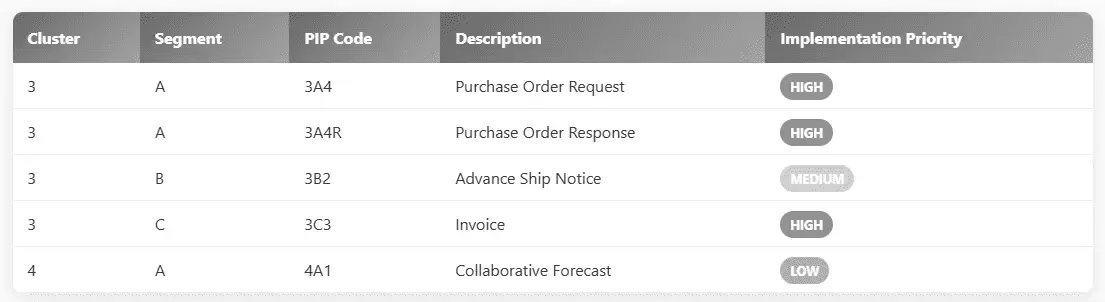
The framework’s comprehensive set of Partner Interface Processes (PIPs), categorized into functional clusters encompassing order management through to inventory control and manufacturing support, removes manual steps, reduces errors, and significantly streamlines supply chain efficiency.

What’s the Challenge?

  • Manual Process Dependencies: Manual processes are primarily involved in conventional business-to-business transactions, which lead to errors, delays, and inefficiencies.
  • Not enough Standardization The utilization of different communication formats and protocols by numerous trading partners increases the complexity of integration.
  • Inadequate real-time visibility into inventory position, shipment status, and order status across the supply chain.
  • Data Inconsistency: Different business rules and data formats between multiple trading partner systems.
  • Scalability Issues: One-off integration needs hinder onboarding of new trading partners.

Goals That Matter

  • Applying RosettaNet PIPs to develop integrated B2B communication protocols.
  • Semiautomating the procure-to-pay and order-to-cash processes.
  • Increasing real-time data exchange and supply chain visibility.
  • Reducing manual intervention and associated errors.
  • Enabling rapid onboarding of new trading partners.
  • Enforcing compliance with trading partner needs and industry standards.

Plan Your Approach

This phase sets the foundation by identifying the right RosettaNet PIPs and defining the integration scope.

Phase 1: Assessment and Requirements Gathering

Activities:
  • Examine existing B2B processes and trading partner needs.
  • Determine relevant RosettaNet PIPs and clusters.
  • Evaluate existing system landscape and integration capabilities.
  • Establish scope and prioritize implementation by business value.
Deliverables:
  • Examine existing B2B processes and trading partner needs
  • Determine relevant RosettaNet PIPs and clusters
  • Evaluate existing system landscape and integration capabilities
  • Establish scope and prioritize implementation by business value
AI-Driven Enterprise Chatbot Implementation

Phase 2: Design and Architecture

Tasks:
  • Design integration architecture adopting RosettaNet standards.
  • Specify message transformation mappings.
  • Develop security and authentication mechanisms.
  • Design error handling and monitoring strategy.
Deliverables:
  • Technical architecture document
  • Message flow diagrams
  • Security implementation plan
  • Monitoring and alerting strategy
AI-Driven Enterprise Chatbot Implementation

Phase 3: Development and Configuration

Activities:
  • Configure RosettaNet adapters and message formats
  • Develop custom transformations and business logic
  • Implement security protocols and certificates
  • Create monitoring and logging mechanisms
Deliverables:
  • Configured RosettaNet solution
  • Custom transformation code
  • Security certificates and configurations
  • Monitoring dashboards

Phase 4: Testing and Validation

Activities:
  • Unit testing of individual components
  • Integration testing with trading partners
  • Performance and load testing
  • User acceptance testing
Deliverables:
  • Test execution reports
  • Performance benchmarks
  • Trading partner certification

Phase 5: Deployment and Support

Activities:
  • Unit testing of individual
  • Production deployment and cutover
  • Trading partner onboarding
  • User training and documentation
Deliverables:
  • Production deployment
  • User training materials
  • Support documentation

RosettaNet Implementation Setup

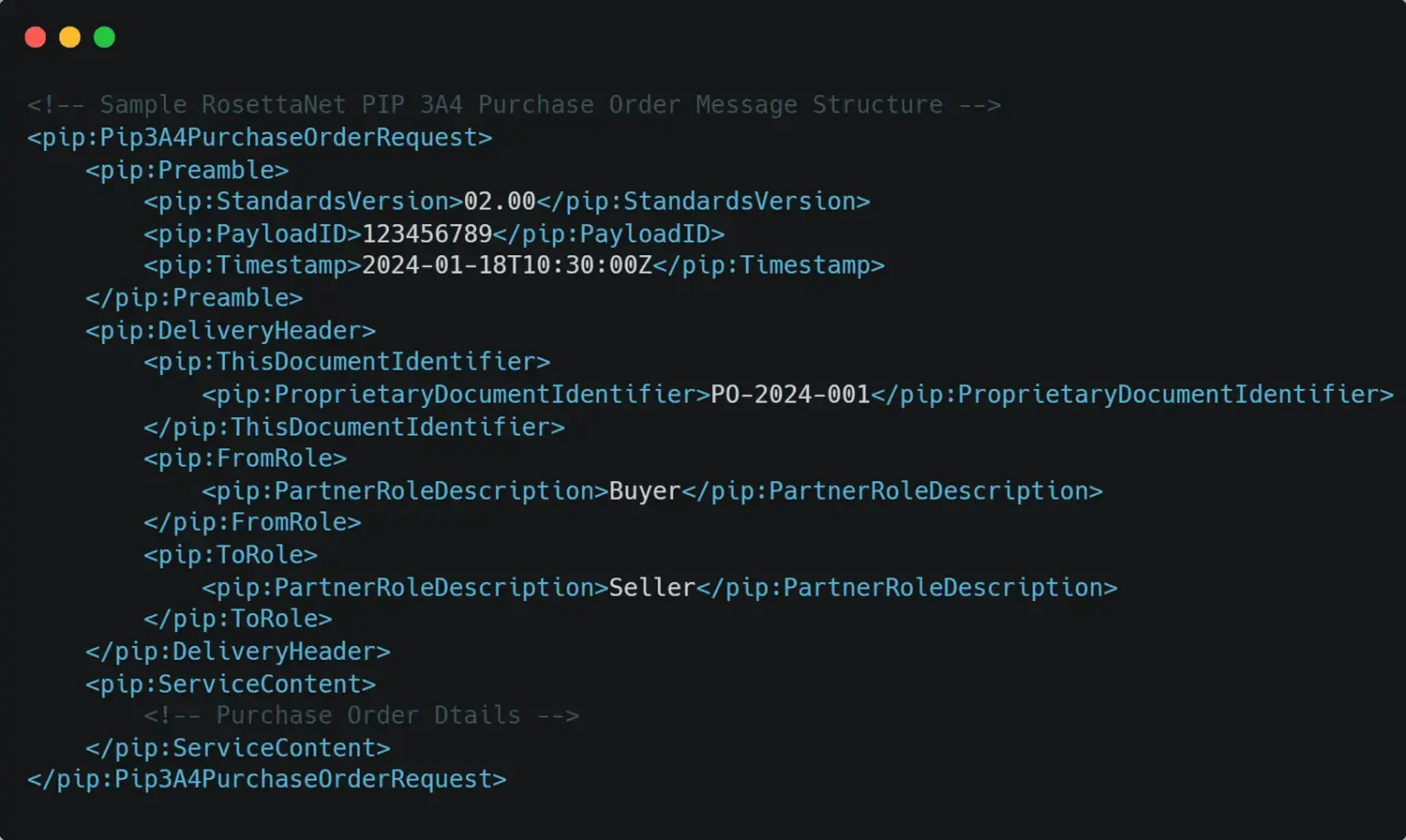
The implementation involved setting up the environment and creating the configurations and mappings:

RosettaNet Message Structure Configuration

AI-Driven Enterprise Chatbot Implementation

Sterling Integrator Business Process Configuration

AI-Driven Enterprise Chatbot Implementation

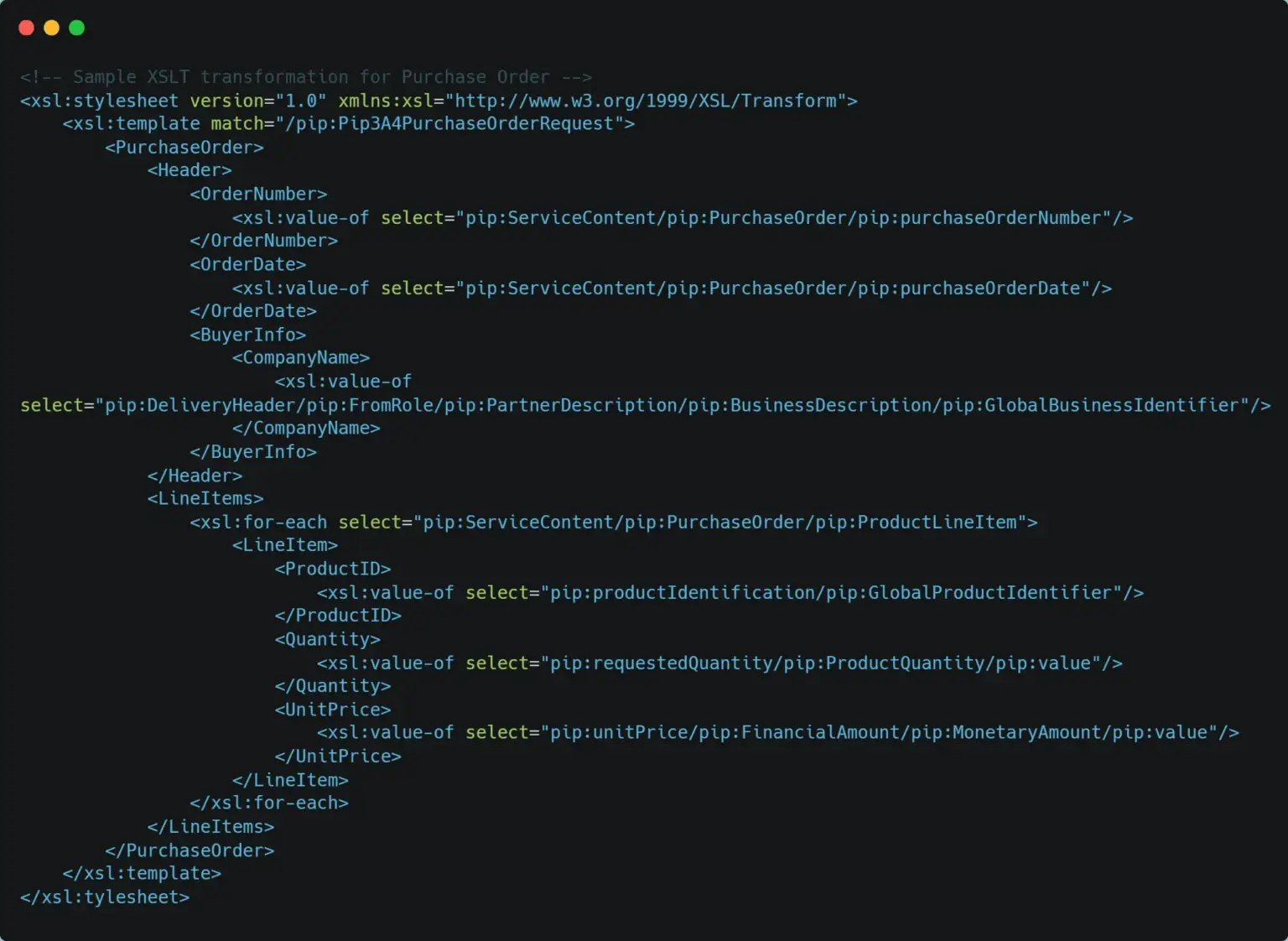
Message Transformation and Mapping

AI-Driven Enterprise Chatbot Implementation

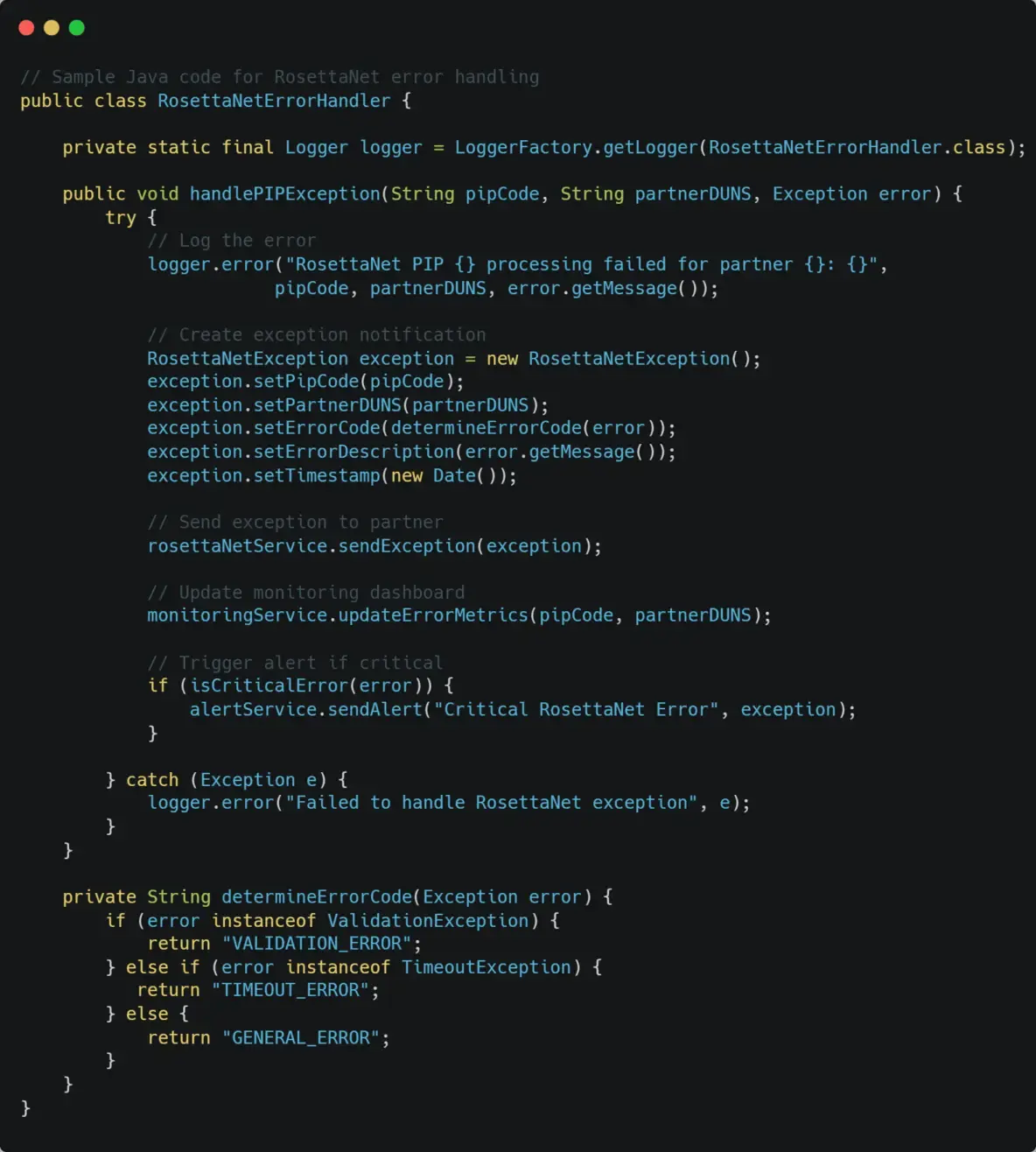
Error Handling and Monitoring

AI-Driven Enterprise Chatbot Implementation

High-Level Solution Design and Architecture

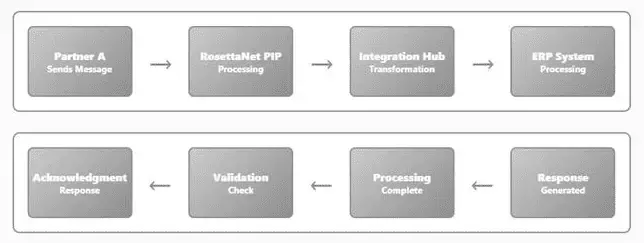
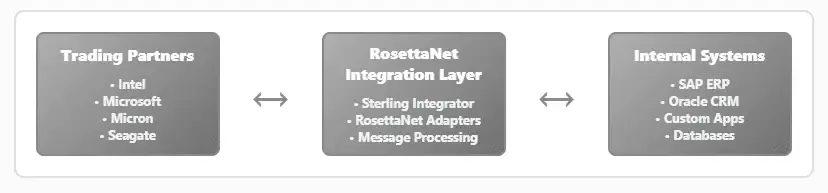
A modular RosettaNet architecture ensures seamless message flow, transformation, and system integration.

AI-Driven Enterprise Chatbot Implementation

Component Architecture

Message Reception Layer
  • Receives RosettaNet messages over HTTPS/RNIF protocols
  • Validates message structure and certificates
  • Processes acknowledgments and exceptions
Transformation Engine
  • Maps RosettaNet PIPs to internal data formats
  • Applies business rules and validations
  • Processes data enrichment and cleansing
Integration Hub
  • Directs messages to proper backend systems
  • Processes transaction state and retry logic
  • Offers monitoring and auditing features
Backend System Integration
  • Integrates with ERP, CRM, and other enterprise systems
  • Processes synchronous and asynchronous processing
  • Processes data consistency and integrity
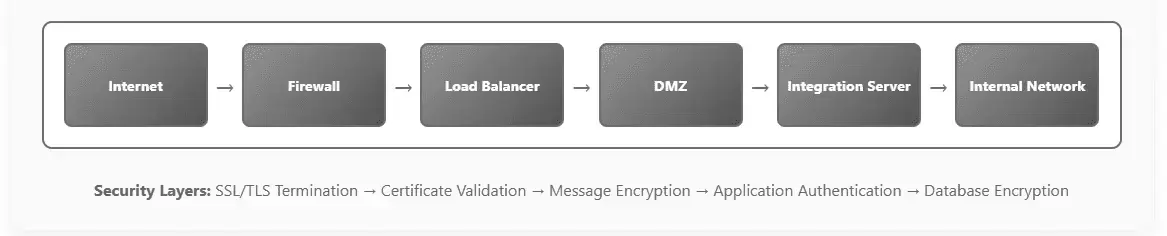
Security Architecture
AI-Driven Enterprise Chatbot Implementation

Implementation Challenges and Resolutions

From certificate management to message mapping, B2B integration isn’t without hurdles.

Certificate Management and Security

  • Challenge: Digitally certificate management to facilitate secure RosettaNet communication may prove tricky, particularly with varying certificate authorities and renewal cycles among multiple trading partners.
  • Resolution: Introduce an automated certificate management system with central certificate store, automated renewal reminders, and backup certificate storage. Have well-defined certificate lifecycle management processes in place with trading partners.

Message Transformation Complexity

  • Challenge: Various trading partners implement
    variations of RosettaNet standards, necessitating
    intricate transformation logic to process multiple formats and business rules together.
  • Resolution: Establish a
    transformation engine that can be configured with partner-specific mapping templates and business rule engines. Build a repository of reusable transformation components and integrate detailed testing frameworks for validation.

Performance and Scalability Issues

  • Challenge: Heavy volumes of B2B transactions can overload integration systems and cause processing lag and message loss during spikes.
  • Resolution: Use horizontal scaling with load balancing, asynchronous message queuing, and performance monitoring with auto-scaling triggers. The system should be designed using stateless components to enable simple scaling.

Error Handling and Recovery

  • Challenge: Network outages, system crashes, and message corruption can disrupt core business processes and necessitate strong error handling and recovery processes.
  • Resolution: Leverage comprehensive retry logic with exponential backoff, dead letter queues for rejections, and failover automation. Define escalation procedures and monitoring alerts for urgent failures.

Trading Partner Onboarding Complexity

  • Challenge: Every new trading partner necessitates custom configurations, testing, and certification, making onboarding tedious and resource-constrained.
  • Resolution: Create standardized onboarding processes with automated test tools, self-service config portals, and extensive documentation. Make reusable config templates and introduce automated validation mechanisms.

Key Takeaways

With the right planning and architecture, organizations can scale fast and onboard partners with ease.

Standardization Impacts Efficiency

  • Benefit: Adoption of RosettaNet standards eliminates integration complexity and facilitates quicker onboarding of new trading partners.
  • Impact: Organizations realize 60-70% cost savings in integration development for new partners and enhanced data consistency for the entire supply chain ecosystem.

Automation Eliminates Human Errors

  • Benefit: Automated RosettaNet processing eliminates human intervention and reduces errors in key business processes such as order management and invoicing.
  • Impact: Firms achieve up to 90% error reduction in order processing and significant reduction in order-to-cash cycle times, resulting in improved customer satisfaction and cash flow.

Real-time Visibility Enhances Decision Making

  • Benefit: RosettaNet implementation extends visibility to real-time supply chain processes, facilitating improved demand planning and inventory management.
  • Impact: Organizations realize enhanced inventory turnover and decreased carrying costs due to improved demand forecasting and supplier cooperation, generally experiencing 15-25% inventory efficiency improvement.

Scalable Architecture Facilitates Growth

  • Benefit: Properly designed RosettaNet architecture has the ability to scale to accommodate growing volumes of transactions and new trading partners without major changes to infrastructure.
  • Impact: Businesses can manage 5-10x transaction volume growth with low performance impact and facilitate aggressive business growth into new markets and alliances.

Audit Readiness and Compliance

  • Benefit: Implementation of RosettaNet offers detailed audit trails and compliance reporting features necessary for trading partner and regulatory requirements.
  • Impact: Organizations realize quicker audit completion and better compliance scores, lowering regulatory risks and enhancing trading partner relationships through openness and accountability.
Final Words

RosettaNet implementation is a strategic investment in B2B integration functionality that realizes substantial operational benefits and competitive edge in the electronics and high-tech industries. The use of partner communication through standardized means, along with strong integration platforms such as IBM Sterling Integrator, allows organizations to realize seamless supply chain collaboration while ensuring scalability and reliability. RosettaNet success in implementation depends on meticulous planning, deep business process understanding, and adherence to best security, error handling, and performance improvement practices. 

Organizations that invest in thorough RosettaNet implementations, as shown by firms such as Lenovo, set themselves up for sustainable growth and better partner relationships within the increasingly interconnected digital economy. The evolution and use of the framework in more industries guarantees its value for future B2B integration needs, making it a worthwhile long-term investment for organizations that want to maximize their supply chain activities and trading partner interactions.

Author

Zeeshan Mukhtar
Talk With Our Expert

    [recaptcha]

    Recent Blogs

    Agentforce and Microsoft Copilot Studio are the two dominant enterprise…

    Read More »
    copilot-azure-logic-apps-workflow-automation

    Websites used to be something you built once and basically…

    Read More »

    Websites used to be something you built once and basically…

    Read More »