
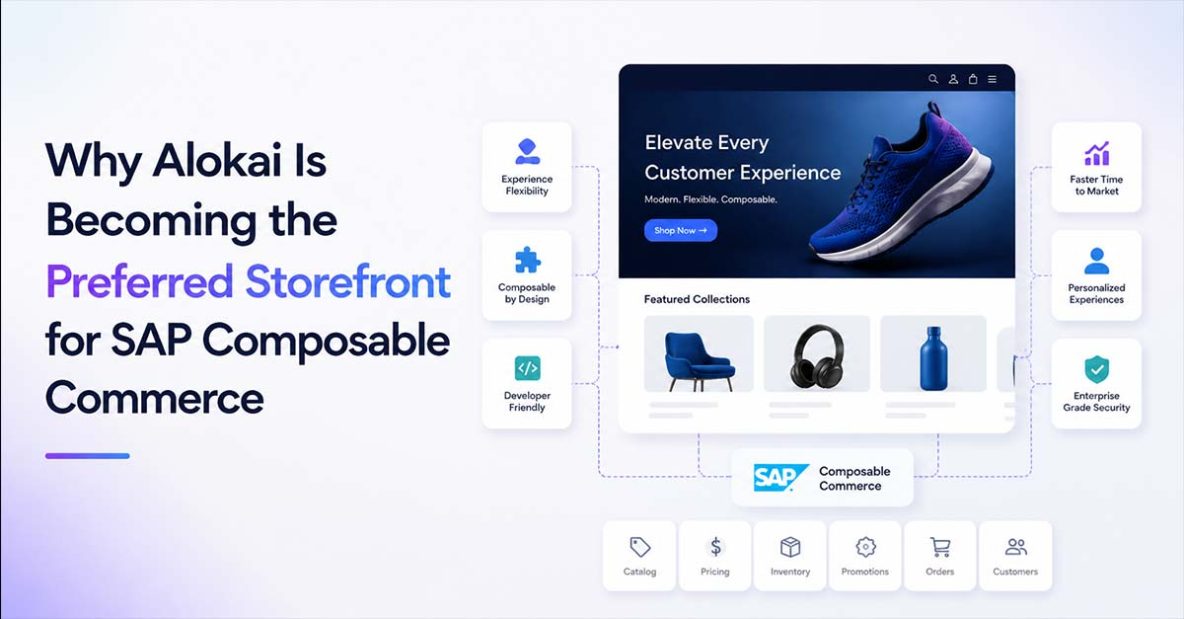
Home > Blogs > SAP Commerce > Why Alokai Is Becoming the Preferred Storefront for SAP Composable Commerce
May 7, 2026
The reason is structural. Most SAP Commerce implementations still rely on storefront frameworks that were built for a different era — tightly coupled to backend logic, slow to customize, and not architected for the performance standards that modern customers expect. A composable backend paired with a rigid frontend does not deliver the agility the business was promised. That gap is exactly what Alokai is built to close.
At Royal Cyber, we have implemented SAP Commerce across cloud and on-premise environments for clients spanning B2B, retail, and manufacturing. What we consistently find is that modernizing the storefront — without touching the SAP core — is the fastest, lowest-risk path to measurable digital improvement. As an official Alokai partner, we recommend that Alokai as the platform for that transformation.
The reason is structural. Most SAP Commerce implementations still rely on storefront frameworks that were built for a different era — tightly coupled to backend logic, slow to customize, and not architected for the performance standards that modern customers expect. A composable backend paired with a rigid frontend does not deliver the agility the business was promised. That gap is exactly what Alokai is built to close.
What Alokai Is and How It Connects to SAP Commerce
Alokai, formerly known as Vue Storefront, is a frontend platform purpose-built for headless and composable commerce architectures. At its core, it is a modern storefront layer that connects to SAP Commerce — both Cloud and on-premise — via the SAP Commerce OCC (Omnichannel Commerce) APIs, leaving the backend entirely intact.
Architecturally, Alokai executes with the assistance of a middleware layer – Alokai SDK and server middleware – that abstracts the API communication between the frontend and SAP Commerce. This middleware layer provides authentication and request transformation, response normalization, so your frontend developers get clean, consistent data contracts instead of raw SAP API responses. The storefront itself is written in Next.js or Nuxt, providing engineering teams with a modern, components-based development experience that has complete control over the performance, routing, and rendering strategy.
This is not a bolt-on or a theme. It is a proper decoupling of the presentation layer from the commerce engine — which is what makes it genuinely composable and why it integrates so cleanly with third-party services like Algolia for search, Contentful or Storyblok for CMS, and Bloomreach or Dynamic Yield for personalization, all without requiring changes to the SAP backend.
Five Reasons SAP Commerce Customers Are Choosing Alokai
1.Decoupling the Frontend Without Disrupting the Backend
The most common concern we hear from SAP Commerce customers considering modernization is risk. Nobody wants to destabilize a commerce engine that is processing orders at scale. Alokai removes that risk entirely by operating exclusively at the presentation layer. The SAP Commerce backend — its pricing engine, catalog management, order processing, and customer data — remains completely untouched. For cloud customers, this accelerates composable adoption within the existing SAP investment. For on-premise customers, it provides a meaningful modernization path without forcing a migration timeline that the business is not ready for.
2.Performance Improvements That Show Up in Business Metrics
Page performance is rarely treated as a strategic priority until it starts affecting conversion. Alokai’s Next.js and Nuxt foundation enables server-side rendering, static site generation, and incremental static regeneration — rendering strategies that directly improve Core Web Vitals scores, particularly Largest Contentful Paint and Cumulative Layout Shift. In practice, SAP Commerce storefronts rebuilt on Alokai typically see significant improvements in mobile load times and Google PageSpeed scores. For high-traffic commerce environments, even modest gains in page speed translate directly into lower bounce rates, longer session times, and improved conversion — outcomes that justify the investment within the first quarter post-launch.
3. A Genuinely Composable Architecture for Headless SAP
When your organization is headed in the direction of headless SAP Commerce, the point of integration that becomes critical is the storefront. Alokai is API-first, meaning it is built to integrate well with SAP OCC API layer, and supports the addition of third-party composable services without changing the backend. Teams can change a search provider, test a new CMS, or even add a personalization layer without changing SAP Commerce or redeploying the entire storefront. That is what composable commerce should feel like in practice, and that is what most SAP implementations have not been able to deliver using traditional storefront frameworks.
4. Frontend Velocity That Breaks the Dependency on Backend Cycles
One of the most significant operational benefits of Alokai is the independence it gives frontend teams. Even simple UI modifications, a banner update, a checkout flow modification, a new product listing element, etc., can trigger a need of backend involvement, change management, and multi-week release cycles in traditional SAP Commerce implementations. In the case of Alokai, the frontend is completely decoupled, i.e. digital teams are able to build, test, and deploy without collaborating with other development teams. The use of feature flags and A/B testing and staged rollouts become the norm and not the exception. For organizations where speed to market is a competitive differentiator, this operational shift alone often drives the business case for adoption.
5.A Viable Modernization Path for Legacy On-Premise Deployments
One of the most significant operational benefits of Alokai is the independence it gives frontend teams. Even simple UI modifications, a banner update, a checkout flow modification, a new product listing element, etc., can trigger a need of backend involvement, change management, and multi-week release cycles in traditional SAP Commerce implementations. In the case of Alokai, the frontend is completely decoupled, i.e. digital teams are able to build, test, and deploy without collaborating with other development teams. The use of feature flags and A/B testing and staged rollouts become the norm and not the exception. For organizations where speed to market is a competitive differentiator, this operational shift alone often drives the business case for adoption.
Where Royal Cyber Sees Alokai Deliver the Most Impact
B2B Commerce
B2B storefronts built on SAP Commerce often carry the heaviest burden of legacy complexity — account-based pricing, complex catalog hierarchies, approval workflows, and contract-specific catalogs that are notoriously difficult to surface cleanly in a traditional frontend. Alokai’s component-based architecture allows teams to build account-aware experiences, faster ordering workflows, and self-service portals that reflect the actual complexity of B2B buying — without rebuilding the SAP pricing and catalog logic that already works.
Retail and eCommerce
For retail, performance and personalization are the two variables that most directly drive revenue. Alokai’s rendering architecture handles the performance side, while its clean integration with personalization platforms like Bloomreach and Dynamic Yield handles the experience side. The result is a storefront that loads fast, adapts to the individual customer, and gives merchandising teams the frontend agility to respond to campaigns and seasonal changes in days rather than sprint cycles.
Manufacturing and Distribution
Manufacturing and distribution customers using SAP Commerce typically need self-service portals, spare parts ordering, and supply chain visibility features that are deeply integrated with backend ERP data. Alokai’s middleware layer makes it straightforward to surface that SAP and ERP data in a clean, modern interface without the performance overhead of traditional server-rendered SAP storefronts. The outcome is a portal that field teams and customers can actually use efficiently on any device.
Alokai and SAP AI: The Storefront Becomes the Experience Layer
As SAP continues its investment in AI — through Joule, BTP AI services, and embedded machine learning across the Commerce suite — the storefront is no longer just a presentation layer. It becomes the surface where AI actually interacts with the customer. Alokai’s composable architecture is well-positioned for this shift. AI-driven product recommendations, dynamic personalization, and intelligent search can be integrated at the storefront layer through composable services, without waiting for SAP to expose those capabilities natively through its own frontend.
For organizations that want to experiment with AI-driven commerce experiences today — rather than waiting for platform roadmaps — Alokai provides the flexibility to integrate best-in-class AI services alongside SAP Commerce, using the same middleware abstraction that makes the rest of the composable architecture work. Royal Cyber’s practice spans both the SAP AI ecosystem and composable frontend delivery, which means we can help clients design these integrations in a way that is both commercially practical and technically sound.
The Storefront Is the Strategy — Treat It That Way
The SAP Commerce storefront has long been viewed as a presentation layer and not a source of competitive advantage. The organizations that are increasingly gaining ground in digital commerce have realized that the customer experience, how fast the page loads, how intuitive the journey feels, how quickly the team can react to market changes, is not a frontend detail. It is a company deliverable.
Alokai does not ask you to walk away from your SAP Commerce investment. It asks you to get more from it. By decoupling the frontend, your backend keeps doing what it does well, while your digital teams gain the speed, flexibility, and performance they need to compete. That is modernization without disruption — and in most cases, it is the most commercially sensible path available to SAP Commerce customers today.
The rational starting point, as it applies to most organizations, is an eye-opening analysis of where the current storefront is causing friction both to customers, to developers, and to the business itself and what a realistic modernization roadmap would look like given current SAP investments. Such an evaluation does not have to be months-long. It only takes days with the right partner.
Royal Cyber has an extensive experience in composable commerce changes that ensure no investments are lost in the process, but rather new investments are unlocked. Whether you are on SAP Commerce Cloud or a long time on-premise deployment, we will assist you in defining the fastest and least risky way to a storefront that performs, scales, and evolves as fast as your business needs. As an official Alokai partner, we have direct access to the platform team — which means faster problem resolution, earlier access to new capabilities, and implementations built to Alokai’s own standards. The storefront is no longer just a UI decision. Make it a strategic one.
Frequently Asked Questions
No, and that is one of its most useful attributes. Alokai is connected to SAP Commerce via the OCC (Omnichannel Commerce) APIs, leaving your pricing engine, catalog reasoning, order administration, and customer information entirely untouched. The Alokai SDK and server middleware means that all of the API communication in the implementation of the storefront happens in the frontend layer and that all of the API communication in the implementation of the storefront does not need to involve any of your SAP teams at all. The backend keeps running. The frontend gets modernized.
Spartacus is an Angular-based storefront that, while more modern than older Accelerator templates, still operates within SAP’s release cycle and maintains dependencies on backend customizations. Alokai is fully decoupled — built on Next.js or Nuxt, running through its own middleware abstraction layer. This means frontend teams can build and deploy independently of SAP, and composable services like Algolia for search, Contentful for CMS, or Bloomreach for personalization can be integrated or swapped without a single change to the SAP backend.
Absolutely. Alokai connects to SAP Commerce via standard OCC APIs regardless of whether your deployment is cloud or on-premise. Many organizations use it specifically to extend the life of their on-premise investment — modernizing the customer-facing storefront, improving mobile performance, and giving frontend teams independence — without committing to a backend migration they are not ready for. It is a phased approach: improve what the customer sees today, migrate the backend on your own terms.
A standard implementation runs eight to twelve weeks depending on the complexity of your existing SAP customizations and the composable services being integrated. Royal Cyber begins every engagement with a two to three day Storefront Assessment — mapping your current SAP Commerce architecture, identifying integration points, and defining the service stack. From there we move into a structured delivery covering middleware configuration, storefront build, OCC API integration, and performance validation, with full documentation and knowledge transfer at handover.
Yes, and it is one of the more in-demand engagements we are delivering right now. Because Alokai’s middleware layer connects to any API-based service, integrating platforms like Bloomreach, Dynamic Yield, or Algolia — as well as SAP BTP AI services and Joule — is architecturally straightforward. Royal Cyber’s practice spans both the SAP AI ecosystem and composable frontend delivery, so we design these integrations to be commercially practical and production-ready, not just technically possible. Your first consultation is free.
Agentforce and Microsoft Copilot Studio are the two dominant enterprise…
Read More »
Websites used to be something you built once and basically…
Read More »
Websites used to be something you built once and basically…
Read More »