
Table of Contents
Over the past decade, integration technology has undergone a dramatic shift. We’ve moved away from those stiff, old-school architectures toward much faster, API-driven setups. But even with all the new tech, the goal is still the same as it’s always been i.e tying separate systems together so a business actually runs like it’s supposed to. Across every industry, the real challenge isn’t the technology itself — it’s getting disconnected systems to finally speak the same language, in real time, at scale.
Behind all of the present-day digital functionality lies a gargantuan back-end that is a jumble of booking platforms, logistics systems, and customer information. And this is where MuleSoft comes in serving as to join these disjointed systems, ensuring everything between operation schedules and partner networks, from one another, linking the various systems into co-operation, and providing customers with a modern experience.
This is precisely the challenge Royal Cyber is built to solve. As a certified MuleSoft partner, Royal Cyber brings an enterprise-grade integration methodology that moves organizations from fragile point-to-point connections to a resilient, API-led application network. Our practice team has designed and delivered integration architectures across multi-cloud ecosystems, complex partner networks, and highly distributed operational environments — ensuring that the digital backbone of a business is as robust as the operations it supports.
Ready to Modernize Your Integration Stack?
The Integration Challenges Every Connected Enterprise Faces
Modern enterprises — regardless of industry — struggle with the same core integration problem: operations are spread across systems, locations, and partner networks that were never designed to talk to each other. The result is fragmented data, delayed decisions, and customer experiences that feel disjointed. The key pain points are consistent:
- Disconnected systems operating in silos with no real-time data exchange
- Intermittent or high-latency connectivity between distributed locations and central operations
- Fragmented customer experience across multiple touchpoints without a unified record
- Complex partner ecosystems that require standardized, reliable integration to function smoothly
Why MuleSoft Is a Game-Changer
- A Structure Built for Complexity: The way MuleSoft layers its integrations is exactly what complex industries need. By using System APIs to hook into old core tech, Process APIs to handle the bulk of workflows, and Experience APIs to polish the customer-facing side, it creates a structure that can actually handle a disintegrated environment.
- Speed, Flexibility, and Reuse: This design not only gives a clean look to the backend, but also makes it possible for a business to move fast. It streamlines everything across locations, central offices, and entire partner networks while giving the company the flexibility to shift as trends change. Instead of building new connections from scratch every time, teams can reuse what they already have. Basically, it stops the noise and builds a foundation that actually lasts. That way, the IT team isn’t always stuck scrambling just to keep up with every new tech trend.
- A Genuine Survival Strategy: MuleSoft’s approach to API connectivity is far more than just an industry buzzword; for enterprise IT teams, it is a genuine survival strategy. By organizing integrations into distinct layers for systems and experiences, it provides a clear blueprint to bridge the massive gap between distributed operations and the home office.
The Three-Layer API Architecture
What makes MuleSoft genuinely different from other integration tools is the deliberate separation of concerns across three reusable API layers:
- System APIs sit closest to the source — databases, ERPs, mainframes, SaaS platforms. They expose raw data in a clean, standardized format without requiring any changes to the underlying system. Build it once and every process above it can consume it.
- Process APIs sit in the middle and own the business logic. They orchestrate data from multiple System APIs to execute a specific workflow — calculating a balance, routing a request, synchronizing a record. Complexity lives here, isolated from both the data below and the delivery channel above.
- Experience APIs are purpose-built for the consuming channel — a mobile app, a web portal, a partner feed, a voice assistant. Each one shapes data exactly as that channel needs it without duplicating business logic. Change a channel requirement and only that Experience API needs updating. Everything beneath it stays untouched.
This decoupled architecture is what gives MuleSoft-based integration estates their longevity. Point-to-point connections break every time something upstream changes. Layered APIs absorb change at the appropriate tier and insulate everything else.

The Three-Layer API Architecture
MuleSoft’s Anypoint Platform is the operational environment that ties the architecture together. It covers the full integration lifecycle from design through production monitoring:
- Anypoint Design Center — a browser-based IDE for designing APIs in RAML or OAS and building integration flows visually or in code. Teams can define contracts before writing a line of implementation.
- Anypoint Exchange — a shared asset library where connectors, API templates, and reusable integration patterns are published and discovered. Reuse replaces rework across teams and projects.
- Mule Runtime Engine — the lightweight execution engine that runs integration flows. It is fully portable: on-premises, in any public cloud (AWS, Azure, GCP), or in MuleSoft’s managed CloudHub environment.
- Anypoint Monitoring and Visualizer — real-time visibility across the full application network. Every API, every dependency, and every data flow is visible in one place — critical for operating at scale.
- Anypoint Security — policy-based access control, tokenization, and threat protection applied at the API gateway layer consistently across every integration, regardless of the underlying system.

Real Business Impact
Adopting MuleSoft isn’t just a technical upgrade; it delivers some pretty massive wins across the entire business. First and foremost, guest satisfaction goes through the roof when the experience actually feels seamless rather than disjointed. When we can use data to offer guests exactly what they want, when they want it, we see a direct hit on the bottom line — personalization and smart upselling naturally drive up onboard spending.
On the operational side, it’s a total game-changer for the IT team. By moving away from messy, point-to-point connections, we’re stripping away layers of complexity that usually slow everything down. This shift to reusable APIs means our innovation cycles get much faster; we aren’t reinventing the wheel every time we want to launch a new feature. Finally, it makes partnering up way easier. Standardized integrations mean we can sync with travel agents and port services without the usual technical headaches, keeping the whole ecosystem moving smoothly.
Adopting MuleSoft in the cruise industry can lead to:
- Improved guest satisfaction through seamless experiences
- Increased revenue via personalization and upselling
- Reduced operational complexity by eliminating point-to-point integrations
- Faster innovation cycles with reusable APIs
- Better partner collaboration through standardized integrations
See How Royal Cyber Delivers These Outcomes
Hybrid and Edge Deployment
The Mule runtime is portable by design. It runs on-premises on local servers, in any public cloud, or at the edge of a network — processing transactions entirely within a local environment and syncing with central systems only when connectivity allows. For organizations where data must stay local for compliance reasons, where bandwidth is constrained, or where real-time connectivity to a central system simply isn’t guaranteed, this hybrid capability is not a nice-to-have. It is the architecture that makes reliable integration possible at all. This is precisely why MuleSoft is the right platform for environments like cruise ships — and we will get to exactly that in the next section.
The Modern Cruise Backbone: Why MuleSoft is the Real Engine at Sea
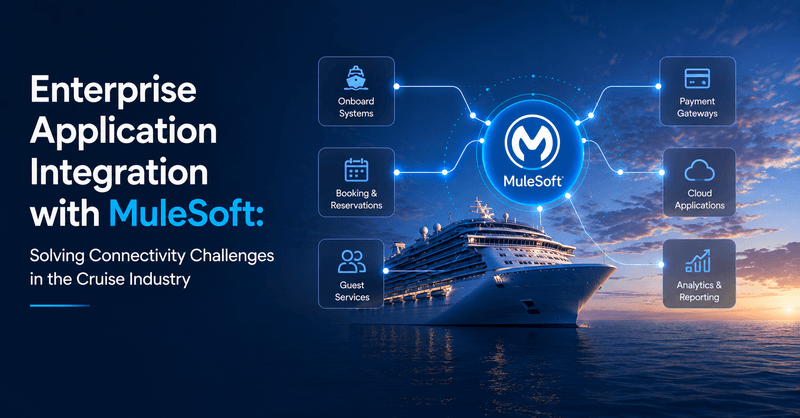
Most people look at a cruise ship and see sun decks, buffets, and endless ocean views. However, for those of us in the integration world, that ship is actually a massive, floating enterprise. Now, let’s imagine a modern vessel as a high-tech smart city. It isn’t just a boat; it’s a luxury hotel, a restaurant chain, a retail hub, and a medical center all rolled into one big vessel. But keeping all these systems in sync is a headache when your ‘office’ is constantly moving across the ocean on satellite links, that are often as unpredictable as the waves.
To pull off a seamless, personalized guest experience out at sea, we can’t just rely on patchwork fixes. We need a truly resilient application network. MuleSoft is currently the quiet engine behind this shift, proving that smart integration is no longer just a back-office necessity. And, it’s indeed a massive strategic edge.
The Unique Integration Challenges in the Cruise Industry
Cruise operations are unlike most other industries. A cruise ship is essentially a floating city, operating with limited connectivity while managing thousands of passengers and crew.
Here are some of the key challenges:
Disconnected Systems Across Land and Sea
Cruise lines operate across:
- Onshore systems (booking, CRM, finance)
- Offshore systems (shipboard POS, cabin management, entertainment)
- Third-party partner systems (travel agencies, port authorities)
These systems often operate in silos, making real-time data exchange difficult.
Intermittent Connectivity
Ships rely on satellite communication, which can be:
- Expensive
- High latency
- Intermittent
This makes real-time integration and synchronization a significant challenge.
Fragmented Guest Experience
Passengers interact across multiple touchpoints:
- Pre-booking
- Check-in and boarding
- Onboard services
- Shore excursions
- Post-trip engagement
Without integration, delivering a consistent and personalized experience becomes nearly impossible.
Complex Partner Ecosystem
Cruise lines depend heavily on:
- Travel agents
- Port services
- Excursion providers
- Payment gateways
Managing these integrations efficiently is critical for smooth operations.
How MuleSoft Keeps the Ship on Course
MuleSoft’s approach to API connectivity is far more than just a industry buzzword; for maritime IT teams, it is a genuine survival strategy. By organizing integrations into distinct layers for systems and experiences, it provides a clear blueprint to bridge the massive gap between a vessel at sea and the home office.
- Middle of the Ocean Problem.
- Golden Passenger Record.
Solving the “Middle of the Ocean” Problem with Edge Computing
By using a hybrid setup, cruise lines can run lightweight systems directly on the ship’s local servers. This means guests get instant, lag-free processing for things like excursion bookings or any other quick purchases. The data is simply queued , piled up and kept aside, waiting to sync with onshore side systems the moment the satellite bandwidth opens up or is available. If the connection drops entirely, no data is lost; rather the system just waits and pushes everything through automatically, once the link is back.
Crafting the “Golden Passenger Record”
Every guest wants a vacation that feels tailored and customized to them. MuleSoft pulls data from fragmented CRMs and property management systems to build a unified, 360 degree profile. This single record essentially follows the guest everywhere i.e from their first clicks on the website to the moment they check in and engage with onboard loyalty perks. It ensures the journey stays consistent and personal, no matter where they are on the ship or the globe.
How MuleSoft Actually Looks in Action: Real-World Examples
- Cleaning Up the Booking Mess: A major global cruise line used MuleSoft and Salesforce to finally get their booking platforms on the same page. Before this, things like cabin availability, special promos, and payments were trapped in separate systems. By opening these up through APIs, the company got real-time data across their website, mobile app, and travel agents. This didn’t just stop errors; infact, it actually cut the time it takes to book a trip by 35%.
- Fixing the Check-in Headache: One operator decided to tackle the chaos of embarkation day by linking their booking, ID verification, and port logistics. This meant guests could handle everything on their phones and show up with a digital boarding pass. It made the whole process about 35% faster, which meant much shorter lines at the terminal and a lot less stress for the passengers.
- Staying Connected at Sea: Another line put MuleSoft runtimes directly on their ships to handle transactions locally. This was huge because guests could keep booking excursions or buying things even when the satellite internet cut out. The data just sat tight and synced up automatically once the connection came back. This way, they hit 99% reliability with this, ensuring services never skipped a beat.
- Getting to Know the Guest: By pulling together CRM, loyalty data, and onboard habits, MuleSoft helped create what the industry calls a “golden passenger record.” This gave the crew a 360-degree view, letting them stay ahead of guest needs. Be it like remembering an anniversary or a specific food allergy. Those personalized touches really paid off, leading to a 40% jump in onboard spending.
- Simplifying Shore Excursions: Booking a tour usually involves coordinating multiple third-party vendors, which can be a logistical nightmare. MuleSoft standardized how the ship talks to these providers, allowing for real-time booking and availability right from a mobile app. The result was way better coordination and much higher satisfaction scores from the guests.

The Architect’s Perspective: Strategic ROI
For IT leaders, MuleSoft’s value extends beyond passenger experience. Point‑to‑point integrations across fleets create unsustainable technical debt, where a single change risks breaking dozens of shipboard systems. MuleSoft’s API reusability eliminates this burden, enabling secure, reusable integrations across the fleet while simplifying compliance with global standards.
One operator reported that MuleSoft’s reusable APIs reduced maintenance costs by 30% fleet‑wide. Compliance with PCI and other regulations was simplified through centralized governance, while innovation cycles accelerated thanks to API reusability.
Cruising is quickly moving toward a digital-first world where the experience is everything. We’re already seeing things like AI-driven personalization, smart cabins packed with IoT tech, and completely contactless services changing how guests interact with the ship and the crew. MuleSoft is really the backbone of this whole paradigm shift. It ensures that all those different systems and data points actually stay connected, which is the only way to launch these kinds of innovations at scale without the wheels falling off.
Closing Thoughts
To wrap things up, the future of the cruise industry isn’t just about building bigger ships or flashier amenities; it’s about the strength of the digital backbone supporting them. MuleSoft allows these lines to move past messy, fragmented systems and into a world where operations are actually connected and agile. By bridging the gap between ship and shore, it turns integration from a behind-the-scenes technical chore into a genuine strategic advantage.
Ultimately, the companies that come out on top will be the ones who truly master connectivity. In an industry built on hospitality, every unforgettable guest experience really starts with flawless integration.
Royal Cyber: Your Mulesoft Partner
Royal Cyber’s MuleSoft practice is purpose-built to make that happen. With pre-built connectors for cruise booking, loyalty, and port-logistics ecosystems, a proven ship-to-shore deployment methodology, and a team of certified integration architects, we help cruise operators go from fragmented systems to a fully connected, future-ready enterprise — faster and with less risk. Let’s build your connected cruise operation together.
Partner with Royal Cyber to Future-Proof Your Cruise Integration
Frequently Asked Questions
Q: Why will MuleSoft be the best integration platform with cruise lines?
There is a special combination of intermittent satellite services, distributed ship-to-shore networks, and a complicated network of partners, which faces cruise operations. The hybrid deployment model that is provided by MuleSoft enables Mule runtimes to execute on shipboard servers – to process transactions offline and synchronize upon restoring connectivity. The API architecture (System, Process, Experience) provides three levels of service to maritime IT teams, which offers the governance and reuse that they require at fleet scale.
Q: What is a Golden Passenger Record and how does MuleSoft support it?
A Golden Passenger Record is an integrated 360 guest profile, which consolidates booking engine, CRM, loyalty programs, onboard POS, and excursion systems. MuleSoft is the integration pathway that pulls, normalises and delivers this profile to all the guest-facing channels in real time. The outcome is crew and apps have one view of every guest – which provides the personalization that not only drives satisfaction but also onboard revenue.
Q: What is the difference in implementation approach of the MuleSoft implementation by Royal Cyber and other partners?
Royal Cyber introduces cruise-specific accelerators, booking-engine, loyalty, and port-logistics systems connectors, which are faster to implement than generic MuleSoft templates. Our architects do not architect against maritime at the last moment: offline resilience, satellite latency and multi-jurisdictional compliance are inherent in the architecture, not bolted on.
Q: How MuleSoft manages the PCI and regulatory compliance of cruise operators?
The Anypoint Platform offers centralized API management, which offers operators a single control point to enforce data access policy, to control integration traffic and to provide audit trails to satisfy the requirements of PCI DSS, GDPR, and regional compliance. A single operator mentioned in the blog streamlined compliance management and saved 30 percent of the fleet-wide maintenance expenses by consolidating on MuleSoft.
Q: What business results in measures are cruise lines likely to achieve with a MuleSoft implementation?
Some of the real-world implementations reported in this blog are a 35% decrease in the time taken to finalize the booking, 35% faster embarkation, 99% transaction reliability during satellite outages, 40% higher onboard spending due to personalization, and 30% lower integration maintenance costs throughout the fleet. The results may differ in degree, yet the similarity is that good API connectivity governance directly influences both the experience of guests and efficiency in operations.
Talk To Our Experts
Recent Blogs
June 9, 2026
Agentforce and Microsoft Copilot Studio are the two dominant enterprise…
Read More »
June 4, 2026
Websites used to be something you built once and basically…
Read More »
June 4, 2026
Websites used to be something you built once and basically…
Read More »