
Home > Blogs > Middleware > How Enterprise AI Ops (AIOps) model transforming IT operations
February 17, 2026
How Enterprise AI Ops (AIOps) model transforming IT operations
Table of Contents
In digital businesses that are constantly up, downtime is not merely an inconvenience, but a risk to the business. One unaddressed L1 incident would cost a multinational company thousands of dollars in revenue in the time you will take to read this paragraph. Such a slow response to the ticket, a repeated production problem, or a missed warning may easily escalate into revenue loss, angry customers, and a burned-out IT team.
Yet many organizations still rely on traditional, reactive support models. An issue occurs. A ticket is logged. L1 investigates. If unresolved, it escalates to L2 or L3. Hours, sometimes days pass before resolution. This manual, layered process increases Mean Time to Resolution (MTTR), drives up costs, and keeps teams in constant firefighting mode.
- But what if issues could be predicted before they impact users?
- What if most Level 1 incidents could resolve automatically?
- What if support teams focused only on strategic work instead of repetitive troubleshooting?
That’s exactly the promise of Predictive Analysis powered by Royal Cyber’s Enterprise AI Ops Model.
Ready to see how predictive intelligence fits into your current infrastructure? Contact our experts for a technical deep dive into our AIOps framework.
Explore the RC Enterprise AI Ops Model
The Problem with Reactive IT Operations
Legacy operations follow a familiar path:
- Issue occurs
- Ticket is created
- Basic troubleshooting begins
- Escalations happen across L1 → L2 → L3
- Manual fixes are applied
This approach is heavily dependent on human intervention and historical tribal knowledge. It’s reactive, inconsistent, and slow.
Key challenges include:
- Manual processes
- Lack of predictability
- Repetitive incidents
- Longer MTTR
- Rising operational costs
With more and more complex infrastructure (cloud platforms, microservices, APIs, integrations, and more enterprise applications than anyone can count) manual troubleshooting is no longer a scaleeable operation.
That’s where AIOps comes in.
From Reactive to Predictive: The RC Enterprise AI Ops Approach
Royal Cyber’s Enterprise AI Ops Model introduces intelligence into IT operations by combining AI agents, machine learning, generative AI, real-time monitoring, and historical data analysis.

At its core, the model focuses on four powerful steps:
- Collect The data is acquired on an ongoing basis with IT infrastructure, enterprise applications, monitoring tools, logs, tickets, and knowledge repositories.
- Analyze AI/ML algorithms find patterns, anomalies and correlations and can do it much faster than a human being.
- Recommend Generative AI proposes solutions based on previous solutions, SOPs and insights into the knowledge base.
- Resolve (Auto-Heal) Whenever possible problems are automatically fixed without human intervention.
This transforms IT from reactive support to proactive prevention.
How Predictive Analysis Actually Works
Predictive analysis is where the actual magic happens.
Imagine it’s 2:00 AM. Instead of an on-call engineer being woken up by a ‘Server Down’ alert, the AI agent detects a subtle 15% crawl in memory usage, cross-references it with a similar pattern from last quarter, and automatically scales the resources before the user even experiences a lag.
Instead of waiting for failures, the system:
- Studies historical incidents
- Detects recurring patterns
- Performs trend analysis
- Identifies early warning signals
- Predicts potential failures before they occur
For example:
- Increasing memory consumption trends? → Predict resource exhaustion
- Repeated integration errors? → Flag configuration drift
- Slow response times? → Predict scaling needs
AI agents then proactively trigger alerts or automated fixes. This shifts the mindset from “fix after failure” to “prevent before impact.”
Intelligent AI Agents: Your Digital L1 Support Team
One of the most impactful aspects of the RC Enterprise AI Ops Model is the use of AI Agents as virtual L1 engineers.
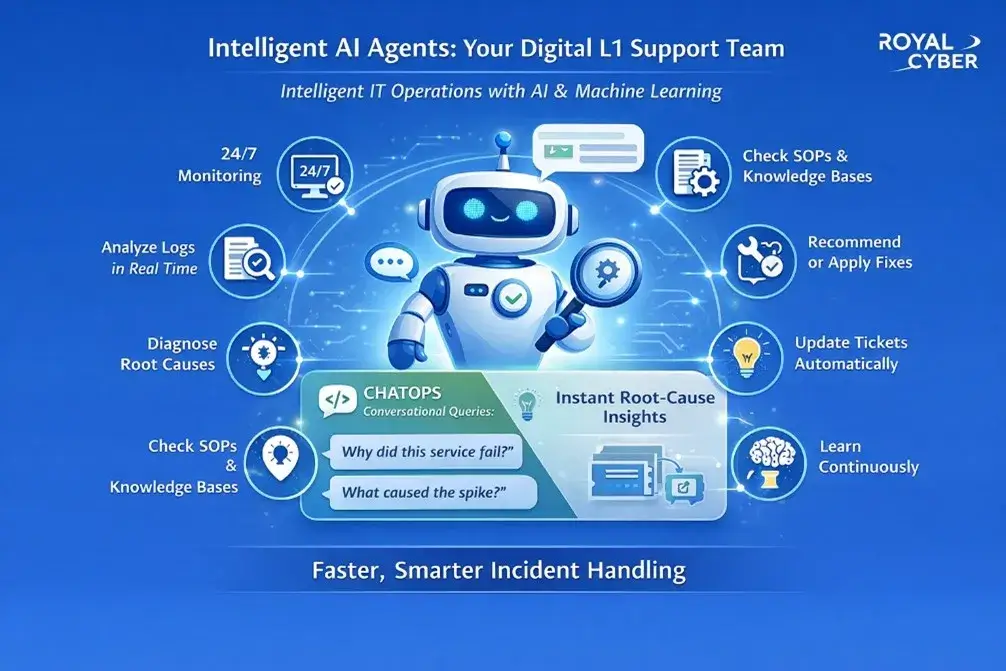
These agents can:
- Monitor systems 24/7
- Analyze logs in real time
- Diagnose root causes
- Check SOPs and knowledge bases
- Recommend or apply fixes
- Update tickets automatically
- Learn continuously from outcomes
They also support ChatOps, allowing teams to query infrastructure in a conversational way, such as “Why did this service fail?” or “What caused the spike?”, and get instant root-cause insights.
The result is faster and smarter incident handling with minimal manual effort.
If you are ready to shift your IT team’s focus from repetitive L1 troubleshooting to strategic innovation, we can help. Discover the impact of the Royal Cyber Enterprise AI Ops Model.
Transition to Predictive Operations Today!
Continuous Learning with a Knowledge Loop
A unique strength of the solution is its self-improving knowledge ecosystem. One of the biggest fears in IT is losing a senior engineer who “just knows” how to fix things. Your model turns that individual expertise into an institutional asset.
Every resolved incident:
- Updates SOPs
- Enhances the knowledge base
- Feeds back into AI training
- Improves future recommendations
Over time, the system becomes more accurate and autonomous.
This feedback loop ensures that:
- Repetitive issues disappear
- Resolutions become standardized
- Expertise is institutionalized (not person-dependent)
Essentially, your operations grow smarter every day.
A unique strength of the solution is its self-improving knowledge ecosystem. One of the biggest fears in IT is losing a senior engineer who “just knows” how to fix things. Your model turns that individual expertise into an institutional asset.
Every resolved incident:
- Updates SOPs
- Enhances the knowledge base
- Feeds back into AI training
- Improves future recommendations
Over time, the system becomes more accurate and autonomous.
This feedback loop ensures that:
- Repetitive issues disappear
- Resolutions become standardized
- Expertise is institutionalized (not person-dependent)
Essentially, your operations grow smarter every day.
Measurable Impact on Time and Effort
Let’s talk outcomes.
- Faster Detection: Real-time monitoring and anomaly detection identify issues instantly instead of waiting for user reports.
- Faster Resolution: Automated diagnostics and suggested fixes eliminate hours of manual troubleshooting.
- Lower MTTR and MTTA: With automated RCA and auto-heal capabilities, incidents resolve in minutes rather than hours
- Reduced Escalations: Most Level 1 issues are handled automatically, minimizing L2/L3 involvement.
- Less Manual Work: Teams spend less time on repetitive tasks like log analysis and ticket updates.
In practical terms, what once required 3–4 engineers and several hours might now resolve autonomously in seconds.
Today vs Tomorrow: A Clear Shift
| Without AI Ops: | With RC Enterprise AI Ops |
| Manual ticket handling | Automated ticket resolution |
| Reactive firefighting | Proactive identification |
| Large support teams | Predictive alerts |
| Repetitive issues | Self-healing systems |
| Slower resolution | Reduced workload |
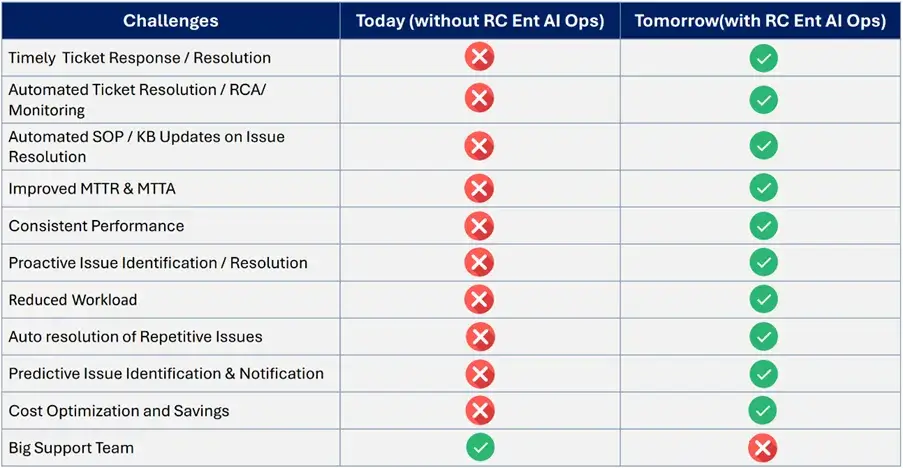
This is not just an incremental improvement. It is a shift toward true operational transformation.
The Bigger Picture: Human & AI Collaboration
AIOps does not replace people. It empowers them.
By automating routine tasks, teams can focus on what truly matters:
- Improving architecture
- Driving innovation
- Strengthening security
- Optimizing systems strategically
Instead of constantly reacting to issues, teams build stronger and more resilient platforms.
That is where true digital maturity begins.
Final Thoughts
It is not a luxury to have predictive analysis. Modern businesses have been compelled to embrace it. Manual operations are unable to keep up with this increasing distributed and complex nature of systems. Enterprise AIOps model by Royal Cyber addresses this issue directly by integrating AI agents, predictive analytics, automation and continuous learning into a whole, integrated system.
The impact is clear:
- Faster detection
- Quicker resolution
- Lower operational costs
- Fewer outages
- Happier teams
- Better user experiences
In short, fewer issues resolved faster and at a lower cost.
The Future of IT is No Longer Reactive
Predictive analysis is no longer a luxury, but rather a necessity to the modern enterprise. The manual nature of the troubleshooting process is simply not scalable as digital ecosystems become more and more complex. By implementing RC Enterprise AI Ops Model, you are not just solving the bugs any quicker; you are altering the very DNA of your IT operations:
- Firefighting to Innovation: Shift the focus of your team members to high value strategic projects, rather than L1-troubleshooting.
- Tribal Knowledge to Institutional Intelligence: Ensure your operations smarter day by day using a self-enhancing knowledge loop.
- From Downtime and Continuity: Find solutions in seconds–in many cases before the end-user will see a glitch in performance.
The choice is clear: continue manual troubleshooting and risk rising costs, or embrace a proactive, self-healing future
Ready to move from firefighting to innovation?
Don’t let legacy processes slow your digital transformation. See the Royal Cyber Enterprise AI Ops Model in action and discover how predictive intelligence can slash your MTTR and empower your team.
Reduce MTTR by detecting and resolving incidents before they impact your users. Explore how the Royal Cyber Enterprise AI Ops Model automates L1 support.
Shift from Firefighting to Prediction
Frequently Asked Questions (FAQs)
What is Predictive Analysis in IT operations?
Predictive analysis involves machine learning to analyze past incident data, find common trends and signals of warning. It has been identified as an alternative to relying on a system to crash and continual failures, it anticipates possible problems such as memory overload or configuration drift and raises an alarm or automatic remedies before users are affected.
How AI Ops Model of Royal Cyber is different than other common monitoring tools?
Common tools inform you of what has failed. Royal Cyber informs you about the things that will not work and why they will not work–then they repair it. Our model will use AI agents as well as generational AI and auto-heal features not only to identify anomalies but also to fix them automatically. It changes the reactive IT teams to proactive and strategic teams.
How do AI agents actually resolve incidents without human intervention?
The AI agents are in the 24/7 monitoring of systems, real-time analysis of logs, and cross-checking of the issues with solved cases in history and SOPs. A detected recurring pattern results in an automated remedy of restarting the services, scales, or updated configurations which, in many cases, fixes the problem within a few seconds before the end user is aware of it.
What kinds of IT problems can be solved automatically?
Reoccurring L1 incidences that include credential renewals, disk space limits, service reboots, and regular configuration drifts are the best ones. The system also educates itself through the knowledge loop of improving on previous resolutions, use of automated scripts to provide fixes and learns on its own.
Does AI Ops replace IT teams?
No. AI Ops empowers them. Your engineers will no longer be on firefighting duty as the repetitive troubleshooting and Level 1 incident resolving is automatically done. They are able to work on more valuable labor such as enhancing system structure, enhancing security, and innovation instead of responding to the alerts.
Talk To Our Experts
Recent Blogs
June 9, 2026
Agentforce and Microsoft Copilot Studio are the two dominant enterprise…
Read More »
June 4, 2026
Websites used to be something you built once and basically…
Read More »
June 4, 2026
Websites used to be something you built once and basically…
Read More »