
Table of Contents
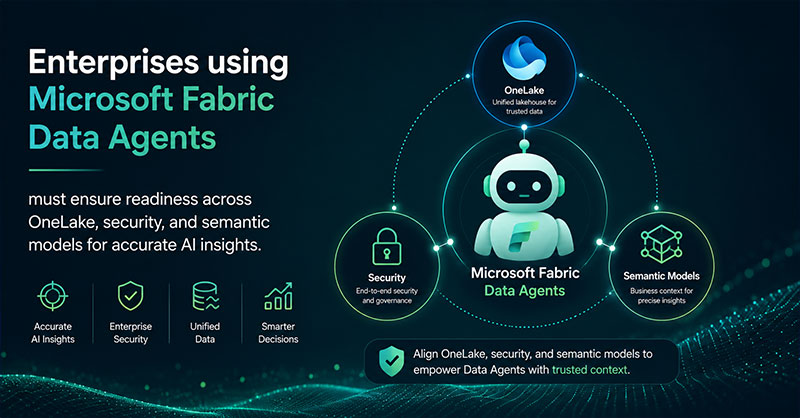
Fabric Data Agents are GA. The model works. Whether your tenant is ready for them is a different question. A technical readiness perspective for CDOs, Heads of Data Platform, and Enterprise Data Architects.
Microsoft Fabric Data Agent readiness is the technical and governance state a Fabric tenant must reach before a Data Agent can be trusted to answer business questions correctly at production scale. It covers five Fabric-specific layers: OneLake structure and domains, certified Power BI semantic models, OneLake Security with RLS and CLS, capacity sizing with Surge Protection, and Purview observability through DSPM for AI.
Readiness is not a generic data-quality program. It is the specific set of Fabric capabilities that govern what an agent can see, what it can resolve, and what it is allowed to return.

Discover What’s New in Microsoft Fabric
Fabric Data Agents Are GA. Your Foundation Decides Whether They Tell the Truth.
The agent picked the Sales table in the regional lakehouse, which excludes returns. The CFO’s mental model expects the Revenue_Net measure in the corporate semantic model, which includes them. Both live in OneLake. Both are technically “revenue.” Neither has a description telling the agent which one a CFO means. By the time the discrepancy surfaces in the close meeting, three downstream decisions have already been made on the wrong number.
Microsoft Fabric Data Agents reached GA on a stack that genuinely works. It is the foundation underneath that produces this outcome, and most enterprise foundations in 2026 are not ready for it.
What Fabric Data Agent GA Actually Unlocks (and What It Does Not)
A Fabric Data Agent is an orchestration layer powered by the Azure OpenAI Assistant API. When a user asks a question, the agent fetches schemas using the user’s own Entra credentials, picks one of up to five connected data sources, and invokes a specific translator: NL2SQL for lakehouses and warehouses, NL2DAX for Power BI semantic models, NL2KQL for KQL databases, plus paths to Microsoft Graph and, post-Ignite 2025, Azure AI Search indexes for unstructured content. The query is validated, executed at the source, and the result is returned.
The query runs with the user’s permissions. RLS, CLS, and OneLake Security roles (also now GA) are all enforced at the source. The agent is genuinely identity-aware, when configured.
What it is not: a reasoning engine that fixes bad data, a tool that does causal inference or ML, or a workspace-aware roamer. Each agent caps at five sources. It only sees tables you explicitly check. It only resolves ambiguity through your descriptions, your example queries, and your instructions. Strip those out and you are left with a confident pattern-matcher with database access.
Two GA-window upgrades raise the stakes. The managed MCP server endpoint (Ignite 2025) lets external systems, including VS Code, Foundry-built multi-agent solutions, and custom apps, consume your Fabric agent as a tool. And Purview DSPM for AI now monitors every Data Agent prompt and response. Whatever your agent says, your security and risk teams are watching.
Why Most Tenants Fail Their Microsoft Fabric Data Agent Readiness Test

Five concrete failure modes explain why so many readiness assessments fail today. Each is rooted in Fabric specifics, not generic data hygiene.
NL2DAX Accuracy Is Bounded by Your Semantic Model's Vocabulary
The agent has no idea “active customers” means three different things to marketing, finance, and ops unless your measures are named, described, synonymized, and certified. Most Power BI tenants today have hundreds of uncertified models with cryptic technical column names. NL2DAX will pick one, confidently.
The Five-Source-per-Agent Cap Is a Forcing Function You Did Not Design For
If your Finance domain has eleven lakehouses and four semantic models, a single agent cannot see them all. Either you rationalize, or you create dozens of narrow agents and lose the unified experience. Most tenants have done neither.
OneLake Security GA Changed the Threat Model
OneLake Security now enforces role-based access down to folders, tables, rows, and columns, but it has to be configured. Agents traversing poorly-scoped lakehouses can surface data through table lookups that were never visible in any report. The Secure tab in OneLake Catalog will show you who has access to what; it will not fix that you never set the roles.
Background-Operation Smoothing Makes Agent Traffic Invisible Until It Is Not
Fabric smooths background operations over 24 hours. An agent spiking to 200% of an F32 capacity at 10am looks fine on the metrics chart at noon, until cumulative carryforward triggers throttling and dashboards start failing across the business. Surge Protection helps, but only if it is configured before the launch event, not after the executive complaint.
Cross-Geo AI Processing Is a Tenant Switch Most Admins Have Not Touched
Data Agents require the cross-geo processing/storing for AI tenant settings to be on. For regulated industries with data residency requirements, that single switch can be the difference between a green-lit pilot and a compliance escalation. Discovering it during a board demo is a bad outcome.
The 5 Pillars of an Agent-Ready Microsoft Fabric Foundation
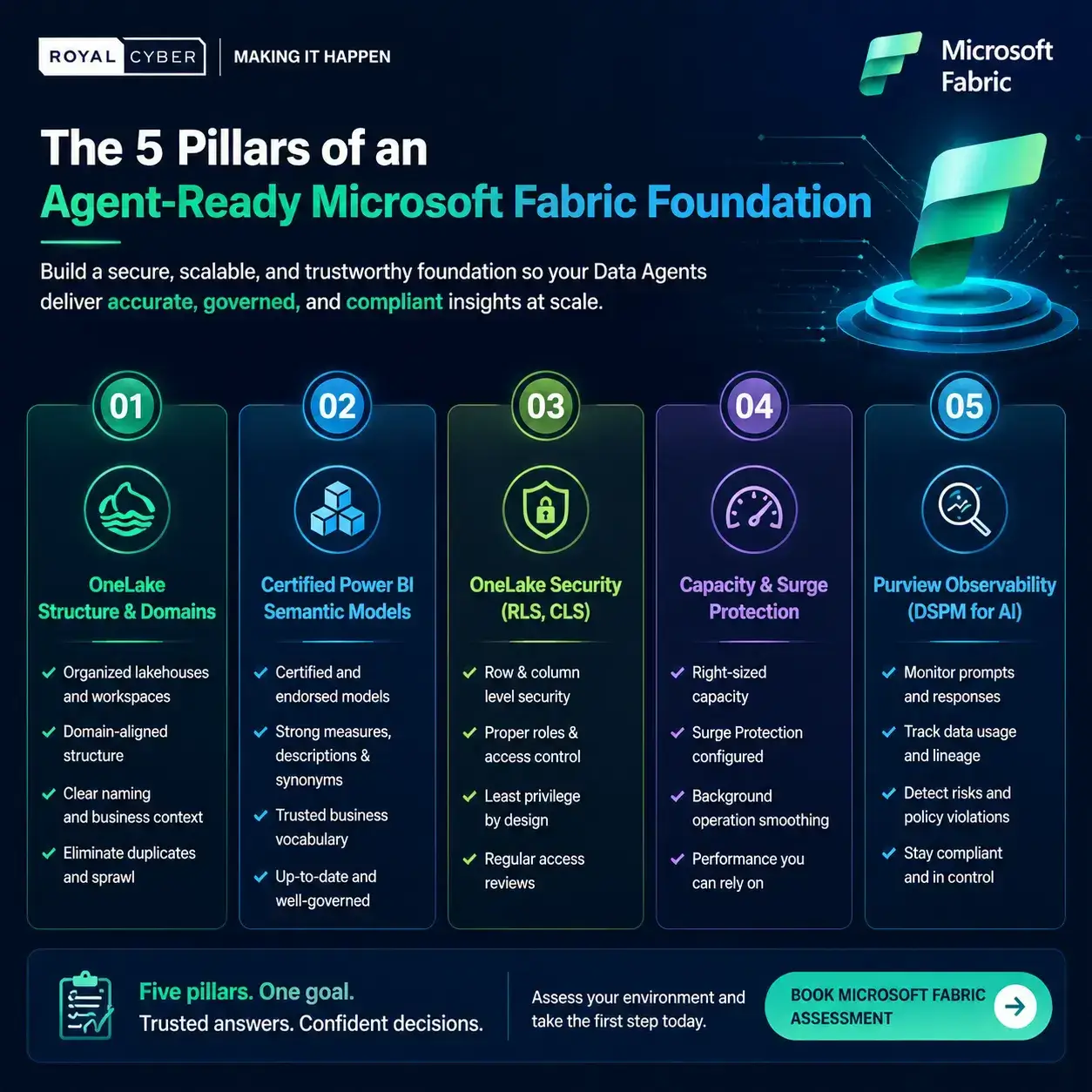
Each pillar maps to specific Fabric capabilities, not generic principles.
Pillar 1: OneLake Structured for Retrieval, Not Just Storage
Fabric domains aligned to business ownership, not IT convenience. Workspace tags (March 2026) used for discovery and FinOps cost-center attribution. Bronze, silver, and gold workspaces with documented promotion criteria. The OneLake Catalog Govern tab, which absorbed the Purview Hub reports in January 2026, actively monitored for sensitivity-label coverage, certified-asset percentage, and orphaned items.
Pillar 2: Semantic Models Treated as the Agent's API
Certified models with explicit business descriptions, synonyms, and hidden technical fields. Q&A linguistic schemas maintained alongside each model. The Prep for AI feature applied to flag agent-readable measures. Crucially, a curated set of example queries seeded into each agent: not optional, since example queries are the single most effective lever for NL2SQL and NL2KQL accuracy. Draft and Published versioning used for safe iteration.
Pillar 3: Security Designed for Natural-Language Access at Scale
OneLake Security roles defined for every gold-zone item. RLS and CLS validated at the agent layer with golden-question test sets, not just in Power BI reports. Sensitivity labels propagated to every Fabric item and monitored via the Govern tab. Purview DLP policies for Fabric Warehouse (GA) and access-restriction policies for KQL, SQL, and Warehouse (preview) configured before the agent goes live. Purview DSPM for AI enabled to monitor prompt and response risk.
Pillar 4: Observability Built Around the Agent's Actual Mechanics
Lineage tracked end-to-end. A maintained set of golden questions with expected answers, run continuously as schemas change. The Fabric Capacity Metrics App monitored, specifically the AI Functions operation type, which was given its own taxonomy precisely because agent traffic patterns differ from refreshes. Draft-vs-Published diffing used to validate every change before publish.
Pillar 5: Capacity and FinOps Modeled for Agent Traffic
F2 is the minimum to enable Data Agents, but realistically F32 or higher for a production-grade agent serving a business unit. Capacity-level Surge Protection configured. Workspace-level Surge Protection used to prevent a single agent from monopolizing CUs. Capacity Overage (preview) evaluated against expected adoption curves; willing to pay 3x for short bursts to protect interactive experience. Reserved-instance plus pay-as-you-go burst combinations modeled for predictable peaks like close week, board prep, and campaign launches.
GA Is the Starting Line, Not the Finish Line
Tenants that flip the tenant switch and call it done will spend 2026 fighting hallucinations, governance gaps, throttling events, and quiet trust erosion. Tenants that treat GA as a forcing function, to rationalize OneLake, certify semantic models, configure OneLake Security and Surge Protection, and seed every agent with example queries, will compound advantage every quarter.
The question for data leaders is not whether to deploy Fabric Data Agents. It is whether your foundation can make them tell the truth.
Royal Cyber's Microsoft Fabric practice
Royal Cyber is a Microsoft Solutions Partner helping enterprises move from “Data Agents enabled” to “Data Agents trusted.” Our Microsoft Fabric and data platform practice runs OneLake rationalization, semantic-model certification, OneLake Security design, F-SKU capacity sizing, and Purview-led observability programs for organizations preparing their foundations for production Fabric Data Agents in 2026.
Next step: Book a Microsoft Fabric Data Agent readiness assessment with Royal Cyber. We will benchmark your tenant against the five-pillar checklist above and ship a prioritized 90-day remediation plan.
GA Is the Starting Line, Not the Finish Line
What is Microsoft Fabric Data Agent readiness?
Microsoft Fabric Data Agent readiness is the configuration state required for a Fabric tenant to deploy Data Agents that return correct, secure, and performant answers. It spans OneLake structure, certified Power BI semantic models, OneLake Security with RLS and CLS, capacity sizing with Surge Protection, and Purview observability via DSPM for AI.
What is the minimum Fabric capacity for Data Agents?
F2 is the minimum SKU that enables Data Agents. For production workloads serving a business unit, F32 or higher is realistic. Capacity-level and workspace-level Surge Protection should be configured before launch to prevent throttling cascades.
How many data sources can one Fabric Data Agent connect to?
A single Fabric Data Agent supports up to five connected data sources. For domains with more than five candidate sources, you either rationalize the data estate or split into multiple narrow agents.
What does Purview DSPM for AI monitor in Fabric Data Agents?
Purview DSPM for AI monitors every Fabric Data Agent prompt and response for risky data exposure, oversharing, and policy violations. Combined with sensitivity labels and DLP, it gives security teams visibility into what natural-language users are pulling out of the data estate.
What is NL2DAX in Microsoft Fabric Data Agents?
NL2DAX is the natural-language-to-DAX translator a Fabric Data Agent invokes when querying a Power BI semantic model. Its accuracy is bounded by the model’s measure descriptions, synonyms, hidden technical fields, and the example queries seeded into the agent.
Do OneLake Security roles apply to Fabric Data Agents?
Yes. Fabric Data Agents execute queries with the calling user’s Entra identity, so OneLake Security, RLS, and CLS are all enforced at the source. Roles must be defined explicitly. Default access is not safe for natural-language exposure.
Book your free Microsoft Fabric assessment
Talk To Our Experts
Recent Blogs
June 9, 2026
Agentforce and Microsoft Copilot Studio are the two dominant enterprise…
Read More »
June 4, 2026
Websites used to be something you built once and basically…
Read More »
June 4, 2026
Websites used to be something you built once and basically…
Read More »