
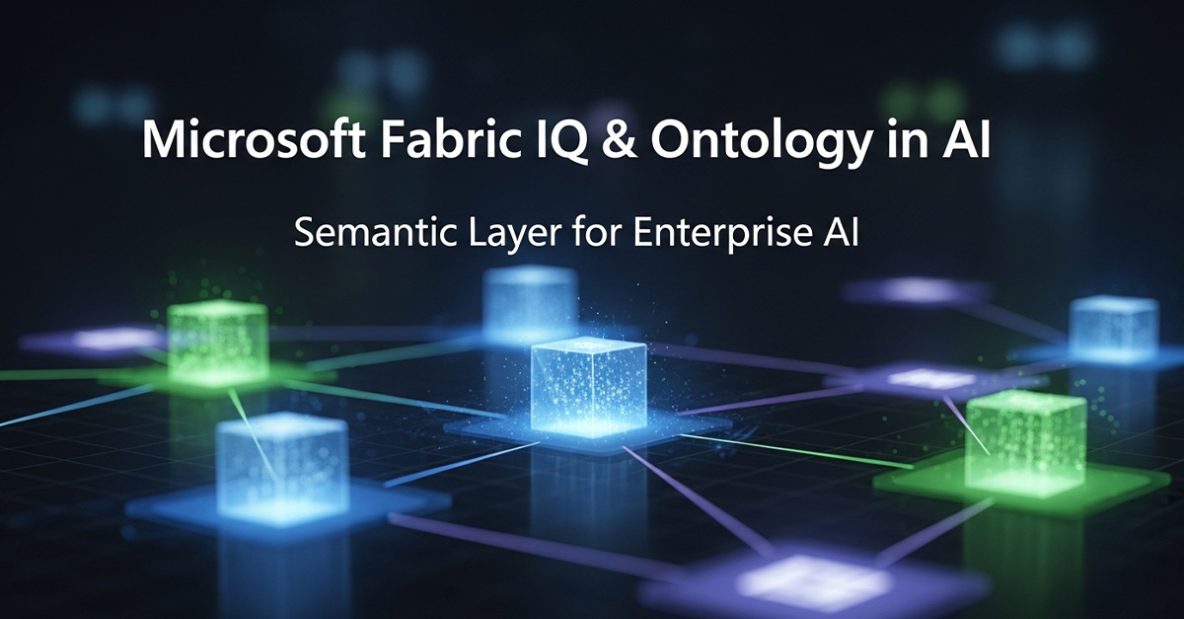
Enterprise AI is moving beyond dashboards and predictive models. Today, organizations are asking a deeper question. How can artificial intelligence genuinely understand the business it supports?
While modern AI systems handle large amounts of structured and unstructured data, they frequently lack contextual awareness. Data without meaning results in fragmented insights, inconsistent outputs, and governance problems.
This is where Microsoft Fabric IQ and ontology in AI introduce a transformative shift. Fabric IQ helps businesses to integrate artificial intelligence with real-world business logic by creating a structured semantic layer in enterprise AI.
Understanding the Role of Ontology in Enterprise AI

In simple terms, ontology in AI defines how concepts relate to each other within a specific domain. It maps entities such as customers, contracts, suppliers, assets, and transactions and clearly defines how they interact.
Humans naturally understand these relationships. AI systems do not.
Without a semantic framework:
- Finance AI may interpret revenue differently than sales AI
- Supply chain AI may miss contract-based constraints
- Customer analytics may ignore hierarchical relationships
An ontology creates a shared vocabulary across systems. Microsoft Fabric IQ operationalizes this concept within the Microsoft Fabric ecosystem by embedding enterprise knowledge into a connected intelligence layer.
What Is Microsoft Fabric IQ?
Microsoft Fabric IQ enhances the Microsoft Fabric platform by introducing semantic modeling capabilities that unify business meaning across data environments.
Rather than treating datasets as isolated tables, Fabric IQ connects them into a structured knowledge graph that represents:
- Organizational roles and hierarchies
- Products and services
- Contracts and compliance rules
- Operational workflows
- Cross-functional dependencies
This structured model serves as the semantic backbone for AI systems as they interpret and reason about enterprise data.
Enterprise Challenges Without a Semantic Layer
Organizations that deploy AI without ontology-driven structure frequently encounter recurring issues. Data silos lead to inconsistent outputs. Governance teams struggle with explainability. AI initiatives remain isolated within departments rather than scaling enterprise-wide.
The absence of a semantic layer results in misalignment between AI insights and business intent. Over time, this reduces executive trust in AI systems and limits long-term scalability.
Microsoft Fabric IQ addresses this gap by creating a unified intelligence foundation.

How Microsoft Fabric IQ Bridges the Gap
The value of Fabric IQ lies in how it connects business meaning with AI reasoning.
Below is a simplified comparison illustrating the difference between traditional AI deployment and ontology-driven enterprise AI powered by Microsoft Fabric IQ:
| Dimension | Traditional AI Models | AI with Microsoft Fabric IQ |
|---|---|---|
| Data Interpretation | Pattern-based analysis | Context-aware reasoning |
| Cross-Department Consistency | Often fragmented | Unified semantic understanding |
| Governance & Explainability | Limited traceability | Structured, explainable relationships |
| Scalability | Department-specific | Enterprise-wide alignment |
| Business Context | Implicit or inconsistent | Explicit ontology-driven mapping |
Use Cases of Microsoft Fabric IQ in Enterprise Environments

Financial Intelligence & Predictive Planning
- Contracts and revenue streams
- Payment terms and receivables
- Cost centers and profitability
- Compliance requirements across regions
Supply Chain Optimization & Risk Management
- Tier-1, Tier-2 supplier dependencies
- Inventory-to-demand relationships
- Geographic and geopolitical risk exposure
- Logistics constraints
Customer 360° Intelligence & Revenue Acceleration
Business Challenge
Customer data exists across CRM, support, billing, and marketing platforms — often inconsistent and disconnected.
How Microsoft Fabric IQ Helps
Fabric IQ unifies customer data into a shared semantic model, enabling AI to:
- Detect churn signals
- Identify upsell/cross-sell patterns
- Segment customers dynamically
- Align engagement strategies across channels
Measurable Impact
10–20% increase in cross-sell revenue, 15–25% reduction in churn, 30% improvement in campaign targeting precision, 40% faster insight generation for marketing and sales teams.
Royal Cyber created unified customer models, integrated CRM and marketing platforms, and built AI-driven churn and opportunity scoring dashboards. This provided a single source of truth for customer intelligence, driving revenue growth.
How Royal Cyber Implements Microsoft Fabric IQ
Successful implementation of ontology-driven enterprise AI necessitates both technical architecture and business alignment.
Royal Cyber addresses Microsoft Fabric IQ implementation with a disciplined technique.
The first step of the process is semantic discovery, which maps key business entities and relationships. This guarantees that the ontology represents actual operational operations rather than theoretical models.
After that, semantic modeling is set up to combine structured and unstructured data, and data sources from many departments are incorporated into Microsoft Fabric.
Knowledge graphs are then created to express enterprise interactions directly. This ontology ensures explainability and contextual reasoning in AI models.
Finally, governance structures are created to ensure ontological consistency as the business grows.
This staged strategy guarantees that Microsoft Fabric IQ provides long-term company value, rather than isolated AI exploration.

Business Impact of Ontology-Driven Enterprise AI
When Microsoft Fabric IQ is implemented effectively, organizations experience measurable improvements:
- Higher AI output accuracy
- Faster cross-functional decision-making
- Reduced data ambiguity
- Improved regulatory compliance
- Greater Improved executive trust in AI-powered recommendations.
Most crucially, AI advances from reactive analytics to proactive enterprise intelligence.
Conclusion
Enterprise AI success depends not just on data volume, but on data meaning.
Microsoft Fabric IQ introduces the semantic foundation required to bridge the gap between raw data and intelligent enterprise reasoning. By embedding ontology into the AI architecture, organizations create a shared language that allows AI systems to operate with contextual awareness and business alignment.
In the future of enterprise AI, meaning will be the differentiator. And semantic architecture will be the foundation.
Frequently Asked Questions (FAQs)
What is Microsoft Fabric IQ?
What is ontology in AI?
Why is a semantic layer important in enterprise AI?
How does Microsoft Fabric IQ improve AI scalability?
How can organizations start implementing ontology-driven AI?
Agentforce and Microsoft Copilot Studio are the two dominant enterprise…
Read More »
Websites used to be something you built once and basically…
Read More »
Websites used to be something you built once and basically…
Read More »