
Table of Contents
Modern data stack maintenance is consuming your senior engineers. Here’s the architectural root cause and what Microsoft Fabric, Databricks, and Snowflake each do about it.
Key Takeaways
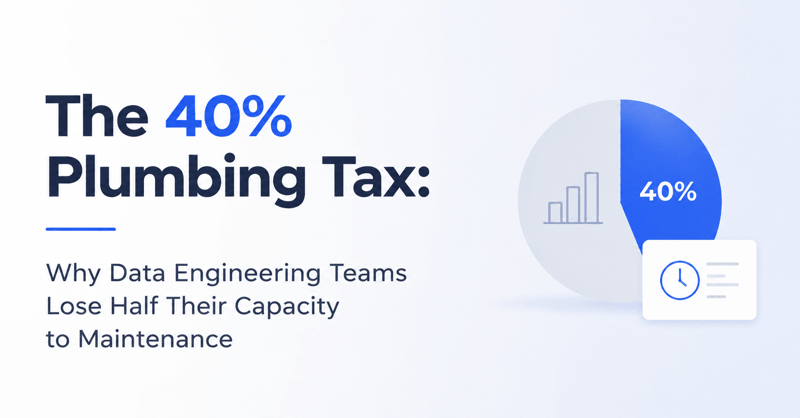
- The 40% plumbing tax refers to the 30–45% of data engineering capacity consumed by pipeline maintenance, integration glue, and schema reconciliation — producing zero business-specific value.
- This is an architectural problem, not a productivity problem. It stems directly from multi-vendor “modern data stack” tool proliferation (2015–2022).
- Integration costs scale quadratically (n×(n−1)/2) as vendor count rises, making more tooling a self-defeating strategy.
- Microsoft Fabric, Databricks, and Snowflake each pursue unification from different starting points, collapsing integration layers without eliminating engineering work entirely.
The metric to track is the differentiated engineering ratio — business-specific hours as a percentage of total engineering hours. Best-in-class: 75–85%. Typical enterprise: 50–60%.

Discover What’s New in Microsoft Fabric
The pager goes off at 3:17 AM. The same ingestion job that failed Tuesday, failed last Thursday, and failed twice the week before. By the time the on-call engineer has logged in, traced the upstream schema change, patched the transformation, and re-run the dependent jobs, it’s 5:42 AM. They message the team channel — “fixed, going back to bed” — and that fix is the third most valuable thing they’ll do this quarter, by the metric their organisation actually tracks.
This is the work that consumes between 30 and 45 percent of a typical enterprise data engineering team’s capacity. The surveys call it data engineering maintenance, pipeline overhead, or integration toil. Engineers call it plumbing.
For an enterprise data team of thirty people, a 40% plumbing tax means twelve full-time engineers whose sole job is to keep the lights on, not building models, not shaping decisions. Just the cost of having a data stack at all.
Data Engineering Maintenance: By the Numbers
30–45%
of typical enterprise data engineering capacity is consumed by pipeline maintenance, integration overhead, and plumbing work.
Industry survey range across enterprise teams.
12
FTE engineers on a 30-person team spend their full capacity on integration maintenance at 40% tax.
Equivalent to $1.5–2M+ in loaded engineering cost per year at typical senior rates.
75–85%
differentiated engineering ratio achieved by best-in-class teams on unified platforms.
Compared to 50–60% for typical enterprise data stacks.
<4 hrs
time for data pipeline failures to cascade into downstream BI and product surfaces without proactive lineage governance.
Common SLA breach window observed in multi-vendor architectures.
What “Plumbing” Actually Means in Data Engineering
Plumbing is a collective term for data engineering work that produces zero business-specific value. It falls into four observable categories:
- Cross-System Data Movement: Ingestion pipelines move data from operational systems into a lake, into a warehouse, into a semantic layer, and back out to reverse-ETL targets (tools like Hightouch or Census that push analytical data into Salesforce or HubSpot). Each hop is an independent failure point requiring its own retry logic, monitoring, alerting, and on-call rotation.
- Schema Reconciliation: When the same customer record exists in five shapes across five systems, somebody maps between them — and rewrites that mapping every time an upstream team ships a change. Schema drift is the single most common cause of 3 AM pipeline pages.
- Identity Propagation and Permission Stitching: Access control in a multi-vendor stack is hand-stitched across tools. A new data product requires provisioning permissions in the lake, the warehouse, the BI layer, and often the catalogue independently. Audit compliance becomes a reconciliation project.
- Orchestration Glue and Lineage Stitching: Refresh orchestration, format translation, lineage stitching across tool boundaries, and disaster recovery runbooks are all defensible engineering. None produces a single insight, model, or product feature the business will pay for.
Why the Plumbing Tax Exists: The Modern Data Stack Inheritance
The 40% is not a productivity failure. It is the predictable consequence of the architectural pattern most enterprises adopted between 2015 and 2022.
Best-of-breed at every layer a separate ingestion tool, transformation engine, warehouse, semantic layer, catalogue, and BI platform was a defensible choice in isolation. The problem is what happened at the seams. Every tool boundary became a location where integration engineering lived permanently.
Architecture Principle

Integration cost grows as n(n−1)/2 where n = number of vendors. Six vendors produce 15 integration surfaces. Adding more observability platforms, catalogues, or reverse-ETL tools doesn’t reduce the plumbing tax — it compounds it.
This is why the cure has become indistinguishable from the disease: adding tooling adds integration surface area, which requires more engineers, which costs more than the tool saves.
Why This Is a Strategic Problem, Not an Operational One
Every hour spent on plumbing is an hour not spent on what makes a data organisation a competitive asset – fraud models, marketing segmentation, supply chain forecasting, pricing optimisation.
Three compounding effects make this strategic rather than operational:
- Talent attrition: Senior data engineers don’t remain long in roles where 40% of their work is integration babysitting. The cost of replacing a senior engineer is 1.5–2× annual salary.
- Competitive lag: Competitors who consolidated earlier ship data products in weeks instead of quarters. A team operating at 85% differentiated ratio delivers 1.4× the feature output of a team at 60%.
- Compounding debt: Each new data product adds integration surface area, worsening the ratio over time without deliberate architectural intervention.
Over a three-year horizon, that gap is the difference between leading a category and defending one.
How Unified Platforms Address the Plumbing Tax
The honest version of the unification story is more nuanced than any vendor pitch. Unified platforms don’t eliminate engineering — they eliminate the integration layer between engineering tasks. Those are different things.
- Microsoft Fabric: OneLake stores data once in open Delta-Parquet format, accessed natively by all Fabric workloads — Data Factory, Engineering, Warehouse, Real-Time Intelligence, Power BI — without copies or movement. Direct Lake mode lets Power BI query that data directly at in-memory performance, eliminating the import-and-refresh cycle that has defined BI engineering for two decades. Identity, governance, and billing unify through Microsoft Entra, Microsoft Purview, and a single CU-based capacity model. What this collapses: most cross-system movement, schema reconciliation, permission propagation, and orchestration glue. What it doesn’t collapse: building data products, modelling business logic, ensuring quality — which is where differentiated value lives.
- Databricks: Databricks pursues unification through the Lakehouse pattern: Unity Catalog provides cross-workspace governance, Delta Sharing enables open data exchange, and MLflow integrates model lifecycle within the same platform. Its strongest differentiation is advanced ML/AI workloads and Python-native workflows. Integration overhead is lower than a fragmented stack, but Databricks customers still frequently pair it with external BI layers (Tableau, Power BI), maintaining some integration surface.
- Snowflake: Snowflake’s unification approach centres on separating storage and compute, with Snowpark enabling Python/Java workloads inside the warehouse. Its Marketplace and data sharing capabilities reduce integration across organisations. Like Databricks, most Snowflake deployments still connect to external BI tools and orchestration layers, preserving some plumbing surface.
| Capability | Microsoft Fabric | Databricks | Snowflake |
|---|---|---|---|
| Unified storage layer | ✓ OneLake (Delta-Parquet) | ✓ Delta Lake | ⚠ Partial (Iceberg/Delta) |
| Native BI integration | ✓ Direct Lake / Power BI | ⚠ External BI common | ⚠ External BI common |
| Unified governance | ✓ Purview + Entra | ✓ Unity Catalog | ⚠ Separate setup |
| ML / AI workloads | ⚠ Developing | ✓ Best-in-class | ⚠ Improving |
| Single billing model | ✓ CU-based | ⚠ DBU-based | ⚠ Credit-based |
| Plumbing reduction | Highest | High | Moderate |
The Real Opportunity Behind Platform Consolidation
Platform consolidation is not about eliminating complexity — it’s about relocating it to where it can be managed strategically.
Each unified platform brings strengths, and the real challenge for enterprises is not choosing a “winner,” but aligning the right capabilities to their business priorities.
- Capacity planning becomes a strategic lever Models like Fabric’s CU, Databricks’ DBU, and Snowflake’s credit system introduce new optimization opportunities. With the right architecture, organizations can actively control cost-performance trade-offs rather than react to them.
- Vendor concentration vs. integration efficiency is a design choice. Some enterprises prioritize multi-vendor flexibility; others prioritize reduced integration overhead. The most effective architectures intentionally balance both — not accidentally inherit them.
- Workload specialization still matters
- Databricks continues to lead in advanced ML/AI workloads
- Snowflake excels in data sharing and cross-organization collaboration
- Microsoft Fabric simplifies end-to-end analytics and BI integration
- The highest-performing enterprises don’t force a single-tool strategy — they design for fit-for-purpose usage with minimal integration overhead.
- Migration is an investment — but also a reset point Consolidation initiatives (often 6–18 months) create a rare opportunity to modernize not just tooling, but operating models, governance, and data product strategy.
Where Execution Becomes the Differentiator
This is where most organizations struggle, not in understanding the architecture, but in executing it effectively. The difference between a 60% and 80% differentiated engineering ratio is rarely the platform alone. It’s how well the platform is implemented, integrated, and governed.
That’s where experienced partners play a critical role.
Organizations working with teams like Royal Cyber accelerate consolidation by:
- Identifying the highest-impact integration layers to eliminate first
- Designing hybrid architectures where necessary — without reintroducing sprawl
- Implementing governance, cost controls, and data product models alongside the platform
- Reducing migration risk while maintaining business continuity
The outcome is not just a new platform but a measurable shift in engineering capacity toward business value. The question is no longer which platform is best.
It’s how quickly you can translate platform capability into differentiated outcomes.
Where Execution Becomes the Differentiator
What is the data engineering plumbing tax?
The data engineering plumbing tax is the portion of engineering capacity typically 30–45% in enterprise organisations consumed by pipeline maintenance, integration overhead, and schema reconciliation rather than business-specific data products. The term “plumbing” refers to the infrastructure-keeping work (ingestion, movement, permission stitching, orchestration glue) that produces no direct business value but must be done to keep a multi-vendor data stack operational.
Why do data engineering teams spend so much time on maintenance?
The root cause is architectural, not motivational. Multi-vendor “modern data stack” architectures (2015–2022) created integration boundaries between every tool layer. Integration cost scales as n(n−1)/2 with vendor count, meaning six tools produce 15 integration surfaces to maintain. Each surface requires dedicated engineering: monitoring, retry logic, schema mapping, and on-call coverage.
Does Microsoft Fabric actually reduce data engineering maintenance?
Yes, meaningfully, for the right workloads. Fabric’s OneLake eliminates most data-movement pipelines between lake, warehouse, and BI layers. Direct Lake mode removes the BI import-refresh cycle. Unified governance via Purview and Entra eliminates permission stitching across tools. The trade-off is new disciplines in capacity planning (CU model) and some workload-fit gaps in advanced ML relative to Databricks.
How does integration cost scale with the number of data tools?
Integration cost scales quadratically as n(n−1)/2, where n is the number of tools or vendors. Three tools produce 3 integration surfaces; six tools produce 15; ten tools produce 45. This is why adding observability platforms, data catalogues, or reverse-ETL tools to an already complex stack rarely reduces the maintenance burden ,each addition multiplies the integration surface area.
Talk To Our Experts
Recent Blogs
June 9, 2026
Agentforce and Microsoft Copilot Studio are the two dominant enterprise…
Read More »
June 4, 2026
Websites used to be something you built once and basically…
Read More »
June 4, 2026
Websites used to be something you built once and basically…
Read More »