

Home > Blogs > Databricks > Databricks vs Snowflake in the Age of AI
January 16, 2026
Databricks vs Snowflake in the Age of AI
Table of Contents
Executive Summary
In the era of generative AI and real-time analytics, both Databricks and Snowflake have evolved from their origins into unified data platforms. The choice is no longer about “lake vs. warehouse” but about which platform’s philosophy aligns with your AI and data strategy. Snowflake offers a “buy & apply” approach with turnkey AI capabilities, while Databricks provides a “build & differentiate” strategy for organizations seeking maximum flexibility and custom AI development.
Want a quick 15-minute breakdown of which platform fits your current tech stack better?
Introduction: The Great Convergence
The competitive boundary between Databricks and Snowflake—once clearly defined as “warehouse vs. Spark”—is rapidly eroding. Both vendors now champion a unified platform vision that spans the full spectrum of modern data workloads: ETL/ELT pipelines, streaming data, advanced analytics, machine learning, and generative AI applications.
For C-suite executives and senior data leaders, this convergence means the decision isn’t simply about technical capabilities—it’s about which platform’s philosophy aligns with your organization’s AI strategy, talent profile, and operational DNA.
Platform Visions: Two Philosophies, One Goal
Databricks: The Open Lakehouse
Databricks positions itself as the Lakehouse that natively combines data lake flexibility with data warehouse reliability on open formats. Its DNA is rooted in big data and ML: an open, code-first ecosystem that emphasizes flexibility and custom AI development.
Key developments include the open-sourcing of Unity Catalog’s framework and the integration of MosaicML (acquired in 2023), which by 2025 has surfaced as Mosaic AI—offering tools for custom LLM training, AI functions in SQL, and integrated AI workflows. Think of it as an “Android-like” open ecosystem for AI.
Snowflake: The AI Data Cloud
Snowflake, known for its Data Cloud, has rebranded in 2025 to the “AI Data Cloud,” indicating that AI is now central to its platform’s future. Through Snowflake Cortex, the company introduced built-in AI capabilities (LLM-powered functions, vector search, AI chat interfaces) directly in SQL and via simple APIs.
This “low-code” strategy prioritizes quick value and safety—analogous to an “Apple-like” curated experience for AI. Snowflake’s vision is to let you “buy & apply” AI on your data with minimal engineering.
Data Engineering and ETL/ELT Pipelines
Modern data engineering demands handling both batch ETL/ELT and streaming feeds with reliability. Here’s how the platforms compare:
| Capability | Snowflake | Databricks |
|---|---|---|
| Batch ETL/ELT | Dynamic Tables with declarative SQL; automatic dependency management | Lakeflow (Delta Live Tables) with SQL/Python; Spark-powered at scale |
| Real-Time Streaming | Snowpipe Streaming (sub-second ingestion); serverless and auto-scaling | Spark Structured Streaming + Auto Loader; millisecond latency possible |
| Best For | SQL-focused teams; minimal ops overhead | Extreme scale; custom processing logic |
Analytics & Business Intelligence
Snowflake has its roots in enterprise BI, excelling at concurrent, interactive SQL queries with sophisticated optimization for complex analytics. Its architecture allows dedicated query clusters for BI users, and it integrates seamlessly with Tableau, Power BI, and other leading tools.
Databricks has significantly improved its data warehousing capabilities with the Photon query engine and Databricks SQL interface. The platform also released Genie—a conversational AI assistant allowing business users to query data using natural language.
Data Science, ML & AI Engineering
This is where the platforms historically diverged most significantly—and where the choice matters most for AI-forward organizations.
Databricks: The AI Factory
Databricks offers an end-to-end ML platform tightly integrated with its lakehouse. Key capabilities include:
- MLflow 3.0 with GenAI features (prompt versioning, agent observability)
- Model serving with 250K+ QPS throughput for real-time AI applications
- Feature Store and Unity Catalog governance for ML models
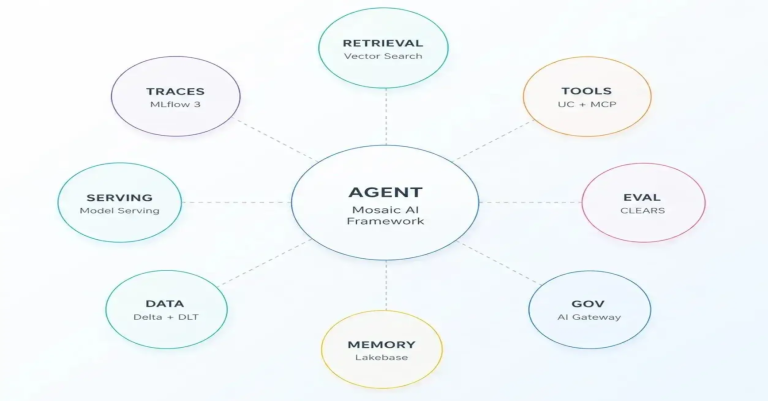
- Mosaic AI for custom LLM training and AI agent development
Snowflake: AI Democratization
Snowflake has made significant strides toward bringing ML inside its platform:
- Snowpark for Python: In-database data science and model training
- Native Model Registry: First-class model objects with versioning and access control
- Snowpark Container Services (SPCS): Run GPU workloads and custom containers
- Cortex AI: Built-in AI functions accessible directly in SQL
Generative AI: Mosaic AI vs. Snowflake Cortex
This is the battleground that will define enterprise AI in 2025 and beyond. Both platforms have invested heavily in enabling LLM-powered applications.
- Snowflake Cortex: A managed, turnkey approach to GenAI. Includes AI_COMPLETE, AI_EXTRACT, AI_TRANSLATE, and AI_SENTIMENT functions. Announced GA in November 2025 for text, image, audio, and video analysis—all in SQL with no external API calls. Also includes Cortex Search (managed vector search), Document AI (unstructured parsing), and Copilot/Analyst (natural language querying).
- Databricks Mosaic: AI An open, flexible platform for custom GenAI solutions. Supports any open-source or proprietary model via the Model Marketplace. Includes fine-tuning capabilities for LLMs (Llama-2, etc.) on proprietary data with managed serverless GPU clusters. Features Agent Bricks for multi-step AI agents, optimized vector search (billions of embeddings), and deep MLflow integration for LLMOps.
Real-World Example: Enterprise Q&A Chatbot
Consider an HR department building a chatbot to answer employee questions from 5,000 internal policy documents:
With Snowflake Cortex: Upload PDFs, let Document AI extract and embed text, use AI functions for Q&A—largely through SQL. Build the interface with Streamlit in Snowflake. Result delivered in a day with decent accuracy.
With Databricks: More hands-on setup with custom PDF parsing, embeddings in vector store. Fine-tune an LLM for the domain, use MLflow evaluation to iterate on fidelity. Takes longer but is highly tunable, extensible, and optimizable for reducing hallucinations.
Governance, Security & Ecosystem
Make sure that the Service Catalog is operational and usable on mobile devices. ServiceNow does offer mobile-friendly views, but usability and performance testing on various devices is essential since most employees will be using their mobiles while on the move.
| Aspect | Snowflake Horizon | Databricks Unity Catalog |
|---|---|---|
| Philosophy | “Walled garden” with secure-by-default policies | Open, multi-cloud with extensibility |
| Scope | Tables, views, ML models, apps within Snowflake | Tables, files, models, features, external data (Iceberg) |
| Data Lineage | Built-in within platform | Column-level lineage across data & ML |
| Access Control | Dynamic masking, row access, tag-based policies | Fine-grained RBAC, attribute-based controls |
Cost and Operational Considerations
Snowflake uses a consumption-based credit system—a “utility model” with predictability and ease. Cost-efficient for bursty, on-demand usage but can be expensive for continuous heavy workloads. AI functions in Cortex are metered by usage (per token).
Databricks pricing is based on Databricks Units (DBUs), rewarding high-throughput workloads. Can be very cost-effective for large-scale processing with proper optimization. AI costs are infrastructure-based—running your own model on dedicated nodes may cost less than per-query API pricing at scale.
Practical Decision Scorecard
The choice between platforms should align with your organization’s goals, culture, and use cases. Here’s a practical guide:
CHOOSE SNOWFLAKE IF,
- Speed to value is critical—you need immediate results with minimal setup.
- Governance and compliance are non-negotiable (finance, healthcare, government).
- Your talent leans SQL/Analytics rather than Python/Scala.
- Primary use cases: BI, dashboards, and AI-augmented analytics.
CHOOSE DATABRICKS IF,
- AI/ML is core to your business or product—you need custom models.
- You deal with massive scale and diverse data (petabytes, unstructured).
- Engineering culture values flexibility and open-source integration.
- Primary use cases: Advanced ML, real-time decision engines, AI automation.
The Hybrid Approach
Many enterprises adopt both platforms in a complementary fashion: Databricks as the heavy-duty data and AI engine (the “factory” for data processing and model development) and Snowflake as the “showroom” where curated data and insights are easily accessed by business users. This dual approach delivers the best of both worlds: open-choice innovation and rock-solid analytics delivery.
Conclusion: Unified Platforms, Strategic Choice
The competition between Databricks and Snowflake has spurred each to become more comprehensive. Snowflake is no longer just a data warehouse, but an AI-infused data cloud. Databricks is no longer just a Spark platform, but a true lakehouse blending reliable data warehousing with state-of-the-art ML/AI development. Both are converging toward a similar vision from opposite directions.
The good news: there’s no wrong choice in absolute terms. Both platforms are leaders, and each can likely meet 80–90% of your needs. The best choice is the one that aligns with your strategic goals, team skills, and workload emphasis.
Sources & Citations
- Snowflake Documentation – Cortex AI Functions – docs.snowflake.com
- Snowflake Documentation – Dynamic Tables – docs.snowflake.com
- Snowflake Documentation – Model Registry – docs.snowflake.com
- Databricks Documentation – Lakeflow Declarative Pipelines – docs.databricks.com
- Databricks Blog – MLflow 3.0 and Model Serving Updates – databricks.com
- Addepto – Databricks vs Snowflake: Build vs Buy Strategy Analysis – addepto.com
- Medium – Snowflake AI Data Cloud Vision 2025 – medium.com
- Evolv Consulting – Dynamic Tables Deep Dive – evolv.consulting
- ChaosGenius – Snowpark Container Services Analysis – chaosgenius.io
Royal Cyber: Your Partner for Either Path
As a digital transformation partner, Royal Cyber has extensive experience implementing both Snowflake and Databricks for global enterprises. We help CDOs and CTOs craft a pragmatic roadmap—whether accelerating Snowflake’s AI capabilities for quick wins or harnessing Databricks for a custom AI factory. Our team ensures a seamless, governed data foundation and successful AI outcomes on your chosen platform. Contact us to discuss your data and AI strategy →
Author
Zainab Batool
Content Writer
Talk To Our Experts
Recent Blogs
June 9, 2026
Agentforce and Microsoft Copilot Studio are the two dominant enterprise…
Read More »
June 4, 2026
Websites used to be something you built once and basically…
Read More »
June 4, 2026
Websites used to be something you built once and basically…
Read More »