
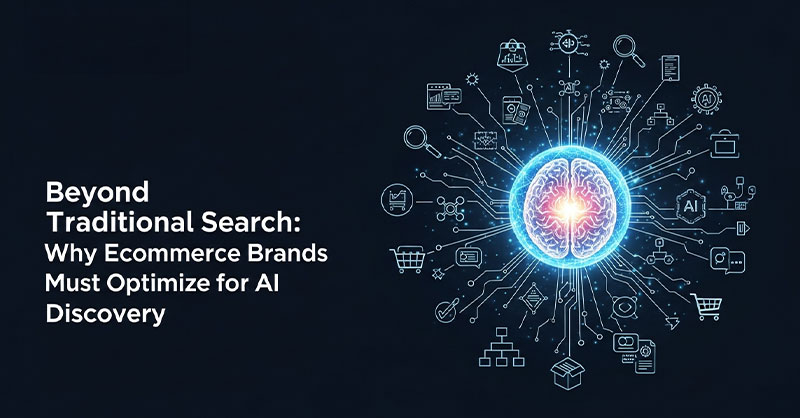
Google is no longer the only gatekeeper of online discovery. AI assistants, voice search, and location-aware platforms are reshaping how customers find and buy products — and most ecommerce brands aren’t set up for it.
When a customer wants a product recommendation today, many of them aren’t typing into Google and scrolling through ten blue links. They’re asking an AI assistant and getting a single, direct answer — a brand name, a product description, sometimes a price. One brand appears in that answer. The question worth asking is whether it’s yours.
For ecommerce businesses, this shift has real consequences. Traditional SEO was built around ranking signals: backlinks, keywords, page authority. AI-driven discovery works differently. It’s built around structured data, content consistency, and geographic relevance. Brands that understand this are investing in two disciplines: Answer Engine Optimization (AEO) and Generative Engine Optimization (GEO). Together, they determine how visible your brand is in the channels where modern purchase decisions happen.
How AI Systems Decide What to Recommend
When a customer asks an AI platform “which running shoes are best for flat feet,” the system isn’t browsing websites in real time. It’s drawing on data it has already indexed — product descriptions, brand definitions, category structures, and structured content signals. Brands with clean, well-organized, consistently formatted information are far more likely to be cited. Brands that haven’t invested in this are simply absent from the answer.
Three gaps routinely disqualify ecommerce brands from AI recommendations:
Inconsistent product data. If your product descriptions vary across your website, marketplace listings, and partner pages, AI systems treat your brand as an unreliable source.
Unclear brand identity. AI systems need to understand what your brand sells, who it serves, and what makes it different. Vague or generic positioning gets passed over in favor of brands that answer these questions clearly.
Missing structured markup. Schema and structured data help AI categorize your products accurately. Without it, even strong content can be misinterpreted or ignored entirely.
Fixing these gaps doesn’t require a full content overhaul. For most brands, it starts with a data audit and a clear set of content standards applied consistently across every customer-facing channel.
What AEO Requires in Practice
Answer Engine Optimization is fundamentally about preparing your content to serve as a reliable source for AI responses. That means writing product descriptions and category pages that answer real customer questions — not just descriptions that describe a product, but content that explains how it works, what it’s best for, and how it compares to alternatives.
For ecommerce teams, this typically involves four areas:
Product data standardization. Every product needs a clear name, accurate category, concise description, and consistent specifications across all channels. Gaps or inconsistencies in this data are the most common reason brands miss AI citations.
Question-based content. Customers ask AI assistants questions, not keyword strings. Content that directly addresses how, why, and which questions performs significantly better in AI-generated results than traditional product copy.
Cross-channel consistency. Your website, marketplace listings, social profiles, and support content should all describe your brand and products the same way. Discrepancies are treated by AI systems as unreliability signals.
Structured data implementation. Schema markup helps AI systems categorize and understand your products at scale. It’s one of the most direct technical inputs into AI citation quality — and one of the most consistently overlooked.
None of this requires new technology to get started. Most of it is a content and data discipline problem — one that pays off across SEO, AI discovery, and conversion at the same time.
GEO: Why Location Still Matters for Online Brands
Many ecommerce brands treat local optimization as something that applies only to retail stores. That assumption is costing them traffic. Customers regularly search for products with geographic qualifiers — not because they want to visit a store, but because location affects delivery timelines, shipping costs, availability, and trust.
Searches like “organic supplements available in the UK” or “electronics delivery near Chicago” are answered by AI systems that understand geography. If your brand has no location signals, you don’t appear in those results — regardless of how good your product is.
GEO for ecommerce means building a location-aware presence without a physical storefront:
Directory consistency. Business listings, descriptions, and contact details should match exactly across every platform where your brand appears.
Regional landing pages. Pages that address specific markets — mentioning shipping availability, local pricing, and regional relevance — are strong GEO signals.
Location-tagged content. Blog posts, product guides, and social content that reference geographic markets help AI systems associate your brand with those regions.
Local citations and reviews. Being mentioned in regional publications, location-based directories, and local forums builds the authority signals GEO depends on.
The goal isn’t to pretend you’re a local business. It’s to give AI systems enough geographic context to confidently recommend your brand when location is part of the customer’s query.
Why AEO and GEO Work Best Together
A brand with strong GEO but weak AEO may appear in local results, but lack the content authority to convert that visibility into a recommendation. Together, they create a complete discoverability footprint:
- AEO builds content authority. AI systems learn to trust your product data and cite your brand confidently.
- GEO builds geographic relevance. AI systems learn to surface your brand when customers search within specific regions or delivery contexts.
The Distribution Problem Most Brands Overlook
Optimized content that sits on your website and doesn’t reach the platforms AI systems pull from is wasted effort. AEO and GEO only deliver results when your structured product data is actively distributed to the channels that matter.
For most ecommerce brands, this means pushing product feeds to:
- AI discovery platforms like ChatGPT, Gemini, and Perplexity
- Commerce platforms including Google Merchant Center and major marketplaces
- Social platforms where product search increasingly begins
- Directories and citation sources that support GEO authority
Distribution also needs to stay current. Pricing updates, inventory changes, and promotional offers should reflect accurately across every platform in real time. Stale data undermines the freshness signals that both AEO and GEO reward. Building a reliable distribution infrastructure is what separates brands that optimize once from brands that maintain a sustainable visibility advantage.
How MetafyAI Makes This Measurable — and Scalable
When Royal Cyber set out to solve the AI visibility problem for ecommerce brands, we didn’t build another analytics dashboard. We built MetafyAI — a platform designed to make brand visibility inside AI platforms something brands can measure, act on, and scale with confidence.
MetafyAI is built around three core capabilities:
Citation discovery. MetafyAI scans brand websites, social platforms, partner pages, and directories to surface where a brand is already being mentioned — and where it’s inconsistent or missing entirely. This gives brands their first honest picture of how AI systems actually see them today.
AI-ready content generation. Using AI, MetafyAI creates structured product descriptions, localized content, and brand summaries formatted for multi-platform distribution — the kind of content AI systems are built to cite. Brands get AEO-ready copy without rewriting everything from scratch.
Gap-based recommendations. MetafyAI analyzes the full AEO and GEO picture and surfaces specific, prioritized actions: missing citations, weak local signals, inconsistent product descriptions, and opportunities for answer-ready content.
Beyond optimization, MetafyAI’s Agentic Feed Hub solves the distribution problem directly — pushing AI-ready product feeds across AI platforms, commerce platforms, and social channels, with real-time pricing intelligence, inventory sync, and promotion logic built in. Your optimized product data is always seen, indexed, and fresh.
Brands that have gone through this process report measurable improvements in how frequently they appear in AI-generated search results and stronger performance in location-based discovery.
How Royal Cyber Helps
Royal Cyber helps ecommerce businesses navigate the shift to AI-driven discovery through practical AI/ML solutions that address the full visibility challenge — from structuring and enriching product data to distributing it across the platforms AI systems actually use.
Whether the goal is improving how AI assistants describe your products, ensuring your brand appears in location-qualified searches, or building the analytics infrastructure to prove the impact of both, Royal Cyber brings the technical depth and ecommerce specialization to make discoverability measurable and repeatable.
The brands we work with don’t treat AEO and GEO as marketing initiatives — they treat them as infrastructure. That distinction is what makes the results durable.
The Window to Build AI Visibility Is Now
The ecommerce brands building AI visibility today are doing so while the advantage is still meaningful. As more brands recognize the shift and invest in AEO and GEO, the cost of establishing early authority will rise and the window to become the default answer will narrow.
The question at the start of this post remains the right one to end with: when a customer asks an AI assistant for a product recommendation in your category, is your brand the answer they get?
Ready to find out where your brand stands in AI search? Contact Royal Cyber to get a complimentary AEO + GEO audit.
Frequently Asked Questions
AEO (Answer Engine Optimization): This refers to the process of organizing your content to ensure it is cited by AI systems as a direct answer to your brand. In the case of ecommerce, it can assist your products in appearing in an AI-powered shopping search as opposed to being hidden among the standard search results.
GEO expands the capabilities of local SEOs, which optimize based on the location-aware AI experiences, rather than on map listing. It has geo-tagged content, location-based landing pages, and standardized mentions throughout the directories – so that your brand is visible when a customer searches locally on even AI-powered platforms.
Yes. Even purely online brands benefit from GEO because customers frequently use location-qualified search terms like “best skincare brands in Springfield.” GEO ensures you’re part of those results, even without a brick-and-mortar presence.
Perfectly optimized content still needs to reach the right platforms. Metafy AI’s Agentic Feed Hub pushes AI-ready product feeds to ChatGPT, Gemini, Google Merchant, social platforms, and more — keeping data fresh with real-time pricing, inventory, and promotion logic.
Royal Cyber develops AI-based systems such as MetafyAI, which search current brand citation, create structured content, recognize avenues of visibility, and share optimized data on AI and commerce systems – transforming AEO and GEO into strategy instead of results that can be measured and scaled.
Agentforce and Microsoft Copilot Studio are the two dominant enterprise…
Read More »
Websites used to be something you built once and basically…
Read More »
Websites used to be something you built once and basically…
Read More »