

Home > Blogs > ServiceNow > ServiceNow Problem Management Best Practices: How to Prevent Recurring IT Issues
March 24, 2026
ServiceNow Problem Management Best Practices: How to Prevent Recurring IT Issues
Table of Contents
Recurring IT issues can cause significant disruptions to business operations, impacting productivity and the overall quality of service delivery for users. IT operations can become less efficient, leading to increased operational costs if the same issues keep occurring, while IT staff may be seen as less productive.
This is where ServiceNow Problem Management comes in. ServiceNow’s Problem Management module is used for identifying, analyzing, and eliminating the root cause of incidents, ensuring that recurring incidents are completely eliminated. This can be achieved by implementing ServiceNow Problem Management best practices, which can significantly improve the quality of service delivery, reduce downtime, and improve IT service management performance.
Discover What’s New in ServiceNow
What is ServiceNow Problem Management?
ServiceNow’s Problem Management is a key component of IT Service Management (ITSM). It is concerned with identifying problems and implementing long-term solutions to prevent problems from recurring. Unlike incident management, which is concerned with resolving problems as quickly as possible, problem management is concerned with analyzing problems and implementing long-term solutions.
There are two key ways in which ServiceNow’s Problem Management is achieved.
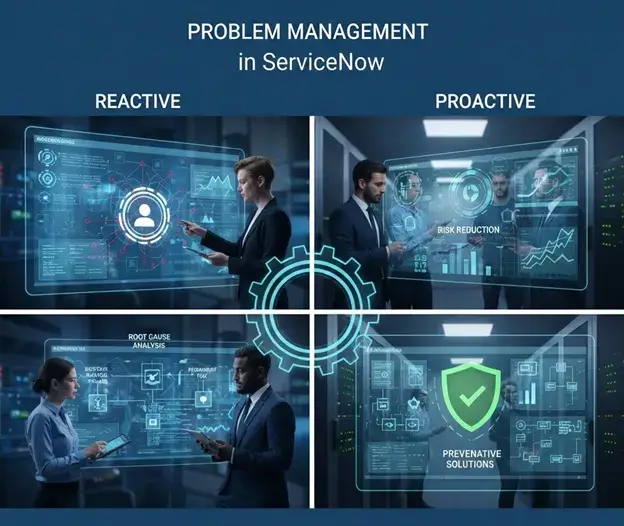
Reactive Problem Management
Reactive problem management is concerned with identifying problems that have occurred in the system. This is usually done when a major incident or a number of similar incidents occur in an IT environment. The IT team is then concerned with identifying the cause of the problem and implementing a long-term solution to prevent a similar problem from recurring in the system.
Proactive Problem Management
Proactive problem management, on the other hand, aims at preventing problems from occurring. For instance, the analysis of trends related to incidents, system performance, and recurring problems helps in the early detection of problems, which can be addressed before they occur.
Both reactive and proactive approaches are important in IT service management.
Why ServiceNow Problem Management is Important
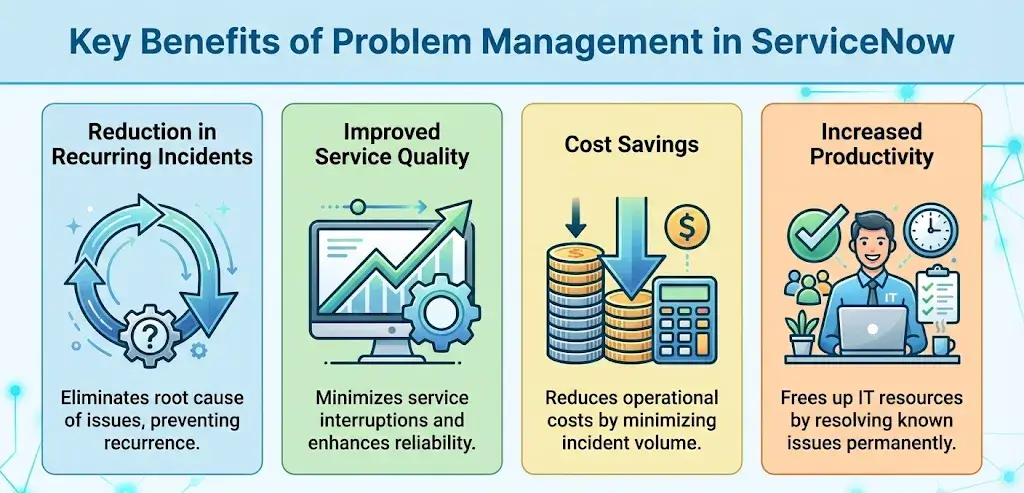
Organizations that are successful in managing their problem management processes are able to improve their IT operations significantly.
Some of the benefits that an organization is likely to achieve by implementing problem management are discussed in the following paragraphs.
- Reduction in Recurring Incidents The main aim of problem management is to completely eliminate recurring incidents in the organization.
- Improved Service Quality When problems are completely eliminated in the systems, the quality of service is improved.
- Lower IT Operational Costs When there are no recurring incidents, the costs of operations are reduced.
- Increased IT Team Productivity The IT team will be more productive when the problems are completely eliminated.
- Better User Experience The quality of service will improve the experience of the customers.
How ServiceNow Problem Management Works
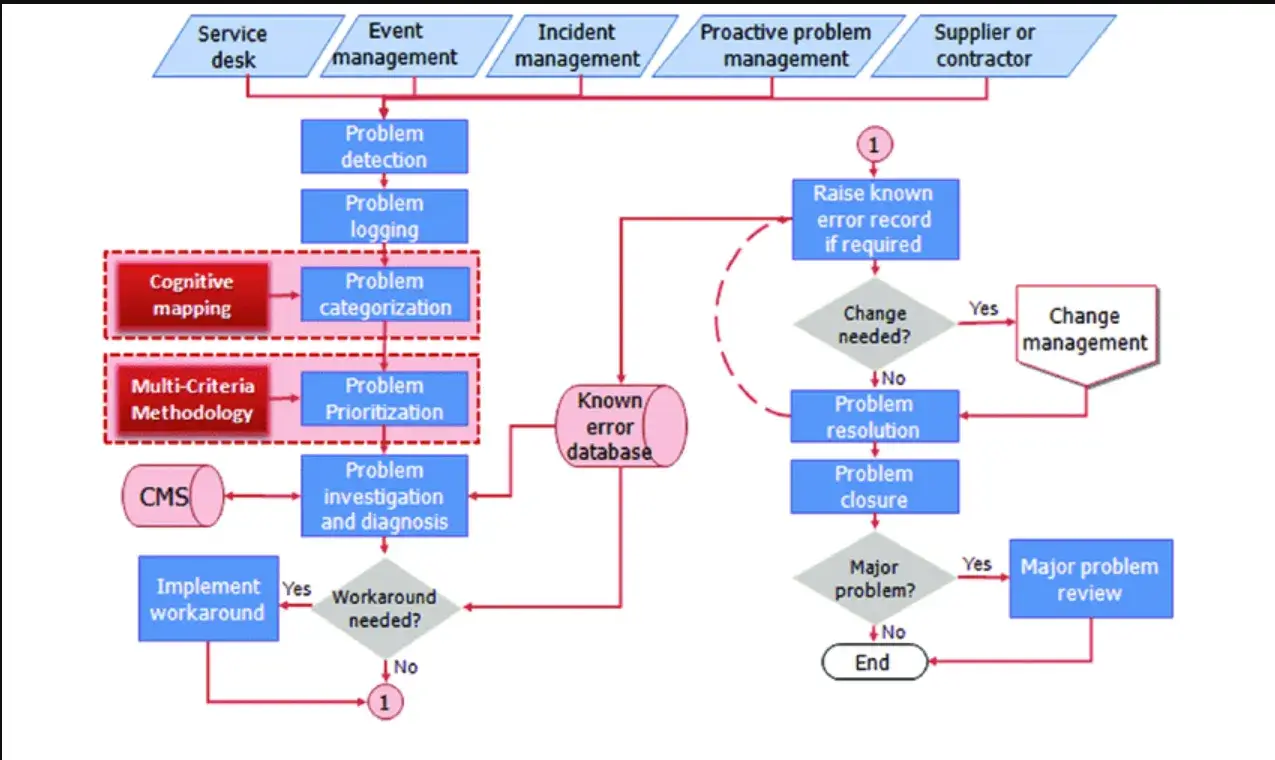
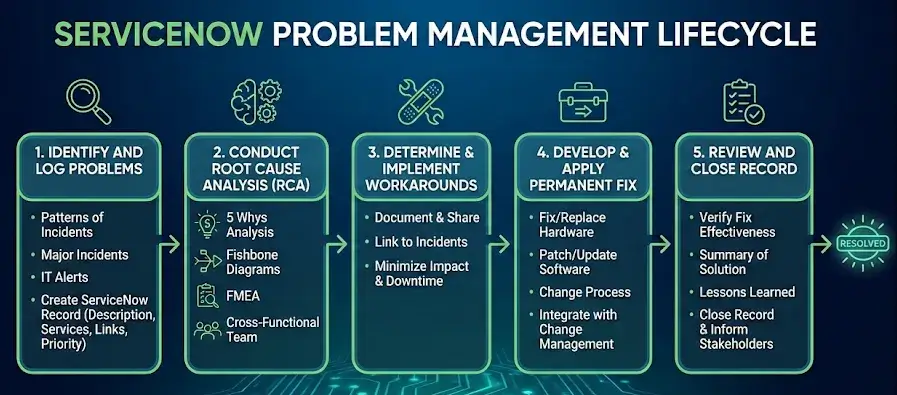
ServiceNow provides a structured workflow for identifying and resolving problems. Below are the essential steps involved in implementing an effective problem management process.
Step 1: Identify and Log Problems
In ServiceNow’s Problem Management process, the first step is to identify problems that need to be investigated.
Problems are usually identified by:
- Occurrences of recurring incidents related to the same service
- Major incidents that need to be investigated for root cause resolution
- Monitoring tools that send out alerts for problems
- Input from IT support groups
Once problems are identified, they are documented in ServiceNow as problems.
A well-documented problem should include information such as:
- Description of the problem
- Services affected by the problem
- Related incidents
- Priority and severity of the problem
- Business impact of the problem
Step 2: Root Cause Analysis (RCA)
Root Cause Analysis (RCA) is one of the most important features of ServiceNow’s Problem Management. The purpose of this is to identify the cause of the incident and the problem that led to the cause. There are several Root Cause Analysis techniques that ServiceNow supports.
5 Whys Method
The 5 Whys technique is a method used in Root Cause Analysis.
The method asks “Why” five times to identify the root cause of the problem.
For example:
- Why did the server crash?
- Because it ran out of memory.
- Why did it run out of memory?
- Because a background process consumed excessive resources.
Fishbone Diagram
A Fishbone Diagram, also called an Ishikawa Diagram, is a method used in Root Cause Analysis. A Fishbone Diagram is a method used to identify the potential cause of a problem.
The method includes the following steps:
.
- People
- Processes
- Technology
- Infrastructure
Failure Mode and Effects Analysis (FMEA)
FMEA is a method used in Root Cause Analysis.
FMEA is a method used to analyze the potential failures in a system and assess the effects of the failures on the system.
Step 3: Implement Temporary Workarounds
There are instances when the solution cannot be implemented permanently. The temporary workaround is then used to ensure that the services are not impaired.
ServiceNow helps IT teams to:
- Record workarounds in problem records
- Record workarounds associated with incidents
- Record workarounds and share with support teams
Workarounds help the service desk teams to quickly resolve the problems until the solution is developed.
Step 4: Implement a Permanent Solution
The key objective of ServiceNow’s Problem Management is to apply a permanent fix.
Permanent fixes can be:
- Software patching
- Software upgrading
- Infrastructure improvements
- Configuration changes
- Process improvements
ServiceNow has integrated Problem Management with Change Management, enabling organizations to launch a change request directly from the problem.
This is to ensure that the fix is applied through a structured and controlled approach, thereby avoiding new problems from being created.
Step 5: Review and Close the Problem Record
The problem needs to be reviewed to ensure that the problem is completely fixed.
The problem record should include:
- Root cause summary
- Brief description of the implemented solution
- Verification of the problem resolution
- Lessons learned
The problem should be closed when the problem is verified as fixed.
Proactive Problem Management in ServiceNow
Reactive problem management deals with issues as they arise, whereas proactive problem management deals with issues before they arise and impact the user.
ServiceNow offers several features to support proactive problem management.
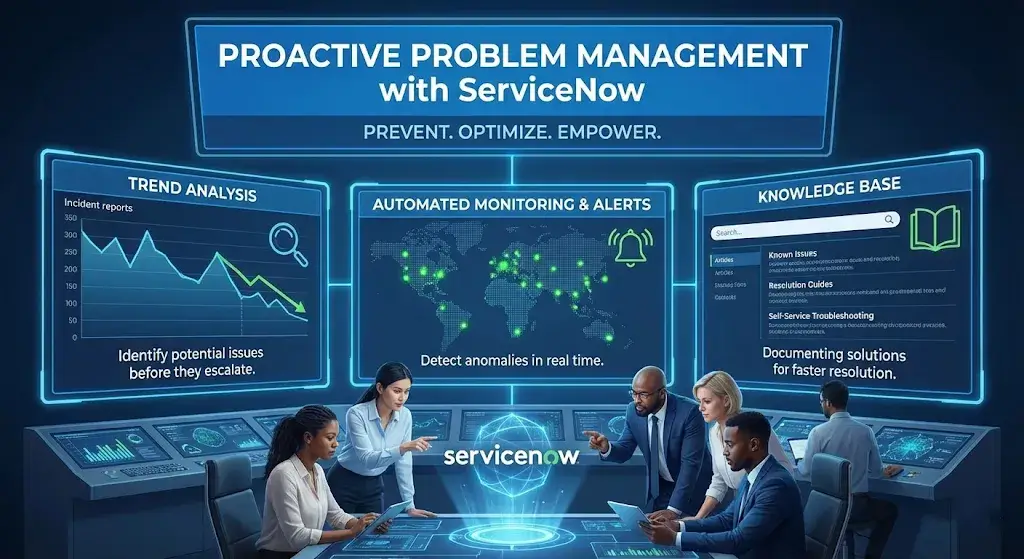
- Incident Trend Analysis: Incident data is used to analyze and identify trends. For instance, if several incidents are related to a single application or component, it may indicate a problem with the application or component, and further investigation may be necessary.
- Automated Monitoring and Alerts: ServiceNow also allows for automated monitoring, which helps identify anomalies and failures in the system in real time. This helps IT staff to deal with issues proactively, rather than waiting for incidents to arise.
- Knowledge Management: Knowledge management helps to store known issues and solutions, thus providing faster resolution of incidents.
Support staff can use this information to quickly apply solutions and improve efficiency in providing services.
Key Metrics to Measure Problem Management Success
For the success of the problem management process, it is necessary to track the following metrics.
- Mean Time to Resolve (MTTR): MTTR is a measure of the average time taken to resolve problems. A low MTTR ensures a higher level of efficiency in problem resolution.
- Recurring Incident Rate: This is a measure of the reduced number of recurring incidents after implementing permanent fixes.
- Problem Resolution Rate: Measures the percentage of problems resolved within service level agreements (SLAs).
- Customer Satisfaction (CSAT): A reduction in service interruptions will lead to higher customer satisfaction.
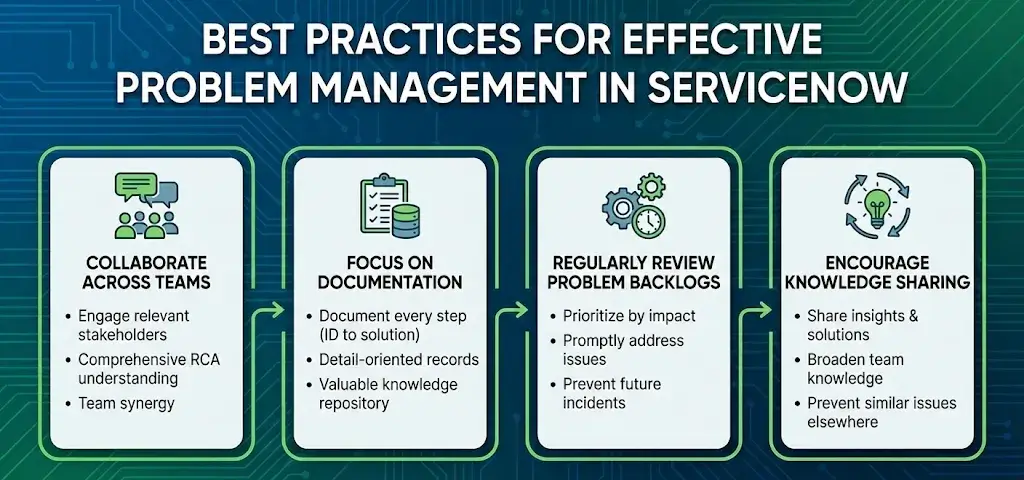
Implementing the right ServiceNow Problem Management best practices is essential to ensure long-term value and improved IT service reliability. This includes encouraging cross-team collaboration during root cause analysis so that infrastructure, application, and security teams can identify all possible causes of recurring issues. Maintaining detailed documentation throughout the problem management lifecycle helps build a valuable knowledge base that accelerates future resolutions. Organizations should also prioritize high-impact problems that affect critical business operations, regularly review problem backlogs to address unresolved issues promptly, and promote knowledge sharing across teams to prevent similar incidents. With deep expertise in ServiceNow and IT Service Management, Royal Cyber helps organizations implement these best practices effectively, enabling businesses to reduce recurring incidents, streamline workflows, and build a proactive, efficient problem management framework.
The Future of Problem Management with ServiceNow
With the advent of modern IT infrastructure like cloud computing, microservices architecture, and the use of automation tools, the field of problem management is changing for IT organizations.
ServiceNow is improving the capabilities of the product with tools like:
- Artificial Intelligence for analyzing incidents
- Predictive analytics tools
- Machine learning for root cause detection
- Observed tools in the product
Conclusion
ServiceNow problem management is an important aspect of efficient IT service management. By identifying the root cause of the problem, organizations can take permanent measures to eliminate the problem, which helps in reducing the number of recurring problems.
ServiceNow problem management best practices help organizations avoid service outages, reduce operational costs, and improve the user experience. A proactive problem management approach not only helps improve the efficiency of IT services, but also the entire organization.
FAQ's
What is Problem Management in ServiceNow?
Problem Management in ServiceNow is an IT service management process that aims to identify and resolve the root causes of incidents to prevent them from recurring.
What is the difference between Incident Management and Problem Management in ServiceNow?
Incident Management in ServiceNow aims to restore service quickly, whereas Problem Management aims to identify and resolve the root cause of incidents.
What are the benefits of ServiceNow Problem Management?
The benefits of ServiceNow Problem Management include reduced recurring incidents, better service availability, lower operational costs, and higher productivity of IT service management teams.
What tools can be used for root cause analysis in ServiceNow?
The tools used for root cause analysis in ServiceNow include 5 Whys, Fishbone Diagrams, and Failure Mode and Effects Analysis (FMEA).
How does ServiceNow support proactive problem management?
ServiceNow supports proactive problem management by providing incident trend analysis, monitoring, and knowledge capabilities.
Author
Pooja Reddy Sodum
Executive-Marketing
Talk To Our Experts
Recent Blogs
Websites used to be something you built once and basically…
Read More »Websites used to be something you built once and basically…
Read More »
June 9, 2026
Agentforce and Microsoft Copilot Studio are the two dominant enterprise…
Read More »