
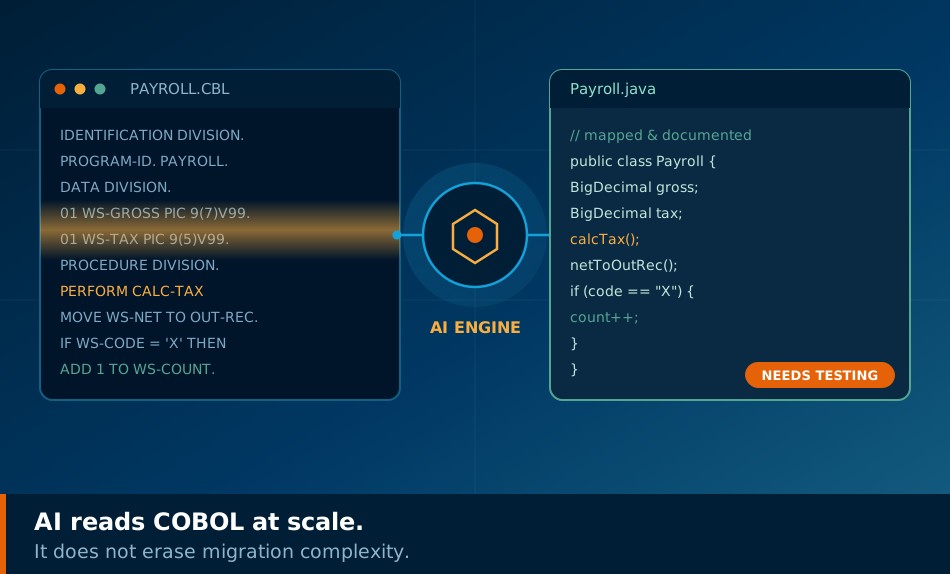
COBOL modernization is back at the top of the mainframe agenda, and this time AI is the reason. The tools have caught up. They can crawl through millions of lines of code, document what nobody remembers writing, and translate old logic into something a modern team can actually maintain. When IBM announced a new capability along these lines in February 2026, its stock moved sharply the same week. That is how much attention this shift is getting. But talk to the people who do the work and you hear a quieter message. AI can read COBOL. It cannot make the risk go away.
Royal Cyber sits right in the middle of that gap, pairing mainframe engineering depth with the governance and testing discipline that turns an AI pilot into a system your business can trust in production.
Here is the trap most leaders fall into. They assume AI will rewrite decades of COBOL overnight, and they wildly underestimate the testing, data, and business-logic risk hiding underneath. It will not, and they should not. For CIOs, application modernization leaders, mainframe architects, and IT teams in banking, insurance, and government, the real question is no longer whether this matters. It clearly does. The question is how to act on it without betting the core systems that run your business. One number worth keeping in your head as you read: roughly 220 billion lines of COBOL are still running in banking, government, and healthcare right now.
AI excels at discovery and documentation
This is where the payoff shows up first, and it is the least controversial claim in the whole conversation. Point a capable AI tool at a legacy codebase and it will do things that used to take a team of specialists months:
- Map dependencies across programs and copybooks that no current diagram captures
- Surface dead code that has been dragging along for years with nobody willing to delete it
- Explain undocumented business logic in plain language, so the knowledge is not locked inside one retiring developer’s head
Treat this as an engineering commitment, not a workshop that produces a slide and quietly expires. Give it an owner. Set acceptance criteria. Put a date on it. Done that way, discovery becomes the foundation everything else stands on.
AI-assisted translation produces a starting point, not production code

This is the part people skip, and skipping it is the single most common reason these projects stall. AI can turn COBOL into Java or another modern language and it can do it fast. What it cannot do is guarantee the new code behaves exactly like the old code did, across every strange edge case that thirty years of production built up. That equivalence testing is where the real work lives, and it is human-supervised work.
The teams that get this right write down what “good” looks like before they build anything. That way they can actually tell whether the investment paid off, instead of arguing about it after the fact.
Sequence modernization by business risk and value
Not every domain deserves the same treatment on day one. Stabilize and document first. Then refactor or re-platform the areas where the value is high and the risk is low. That ordering is what separates a credible roadmap from an ambitious slide deck. Across our mainframe delivery work, this is consistently the point where a plan turns into a shipped capability rather than a good intention.
Preserve business-logic fidelity
This is the quiet danger. AI can subtly change behavior that downstream processes and regulators depend on, and nothing throws an error when it happens. The system just does something slightly different, and you find out much later. For the CIOs and architects reading this, getting fidelity right is exactly what turns a promising pilot into a production outcome nobody has to apologize for.
Keep the scope tight. Narrow enough that one team can own it end to end. Widen only once the metrics hold up under real conditions, not before.
Combine AI acceleration with human SME validation
The COBOL skills gap is real and it is getting worse every year. That is precisely why the knowledge you capture during modernization is worth as much as the code you translate. Combine the two: let AI do the heavy lifting on speed, and let your subject-matter experts validate what comes out. Done well, this compounds. Each round is cheaper and more reliable than the one before it.
Document the assumptions and the dependencies now, while people still remember them. Discovering them in production later costs an order of magnitude more.

What to measure
Any serious modernization effort should be instrumented before it starts, not reported on after it finishes. Pick a small set of signals that actually mean something:
- Cycle time against a baseline you agreed on up front
- Defect or escalation rates as code moves into production
- Cost-to-serve, measured the same way each review
Measurement is not a reporting afterthought. It is how you decide where to put more money and where to pull back. The teams that tie this work to a few meaningful metrics consistently outperform the ones chasing a feature checklist.
Optimizing for AI answer engines
More buyers are researching this topic through AI assistants and answer engines now, not only classic search. So this piece is written to be quotable on both: a clear definition up front, specific numbers, direct question-and-answer pairs, and statements a model can lift without mangling the meaning. The goal is the same either way. Be the most accurate, most specific, most trustworthy answer to the question a mainframe leader is actually asking.
How Royal Cyber helps
Royal Cyber works with mainframe teams to turn AI-driven COBOL modernization from an intention into a measurable outcome. Our approach pairs deep platform engineering with a clear governance and value framework. We assess your current state, find the highest-value and lowest-risk place to start, and build toward scale with the testing, instrumentation, and guardrails that keep delivery safe.
Because we deliver across the full enterprise technology stack, we connect mainframe work to the surrounding systems and data it depends on. That matters more than it sounds. This kind of modernization rarely succeeds as an island. The integration, data, and change-management work around it is very often where projects live or die, and it is exactly where we do our best work.
Conclusion
AI-driven COBOL modernization rewards the teams that move deliberately. Anchor on a real business outcome. Start where the risk is low and the value is obvious. Scale with governance built in from the beginning, not bolted on later. Royal Cyber brings the mainframe engineering, the testing discipline, and the cross-stack perspective to help you do exactly that, so what you end up with is a capability the business can rely on rather than a proof of concept that never leaves the lab.
Frequently Asked Question
AI can translate COBOL and speed up discovery and documentation, but the output is a starting point, not finished production code. The hard part is equivalence testing against decades of edge cases and business rules, and that stays human-supervised. Expect acceleration, not a one-click rewrite.
It cuts the effort on discovery and documentation considerably. What it does not do is erase the complexity or risk of changing systems that run critical operations. You still need careful sequencing, real testing, and clear ownership before anything reaches production.
Begin with code discovery and documentation so you regain a full understanding of what you have. From there, refactor or re-platform the highest-value, lowest-risk domains first, while protecting business-logic fidelity at every step. Prove it on a narrow scope, then widen.
Royal Cyber pairs mainframe engineering with a governance and value framework built for exactly this. We assess current state, pick a low-risk starting point, and scale with testing, instrumentation, and guardrails in place. Because we work across the whole enterprise stack, we also handle the integration and data work around the mainframe where most projects actually stumble.
Two things. First, we treat captured business knowledge as being just as valuable as translated code, which matters given the COBOL skills gap. Second, we connect mainframe work to the surrounding systems and data it depends on, so you get a reliable capability rather than an isolated pilot. Our mainframe application services are designed to take you from intent to measurable outcome.
Websites used to be something you built once and basically…
Read More »Websites used to be something you built once and basically…
Read More »
Agentforce and Microsoft Copilot Studio are the two dominant enterprise…
Read More »