
Home > Blogs > ServiceNow > AI-Powered CMDB: The Future of ServiceNow
February 10, 2026
AI-Powered CMDB: The Future of ServiceNow
Table of Contents
The Configuration Management Database (CMDB) is the foundational system of record for IT Service Management, Security Operations, and Software Asset Management. Managing CMDB data in ServiceNow has never been easy, especially as IT environments get more complicated. Manual updates, outdated records, and inconsistent data might make the CMDB difficult to trust. This is changing as AI-powered CMDB automates data updates, improves accuracy, and provides real-time insights. AI increases the dependability, manageability, and value of ServiceNow CMDB for asset management, security, and IT teams.
Royal Cyber, a trusted ServiceNow Solutions Partner, assists enterprises in realizing the full potential of their CMDB. We create and deploy AI-powered solutions that help the IT, security, and SAM teams by automating data collecting, increasing accuracy, and offering real-time insights. We convert the CMDB from a static repository into a smart, dynamic system that facilitates quicker decision-making, automatically enforces compliance, and boosts operational efficiency by connecting platforms like Databricks, MuleSoft, IBM, and Microsoft with ServiceNow. Royal Cyber transforms your CMDB into a strategic tool that not only maintains assets but also provides your teams with actionable intelligence for the future.
Explore Royal Cyber’s ServiceNow Consulting Services to see how we implement these intelligent automations.
Transform your CMDB into a strategic asset.
This content outlines practical, real-world AI agent use cases that:
- Demonstrates how to reduce average CMDB workload. explains how to use AI agents to automate repetitive CMDB task and cut down on 40–70% of the manual effort.
- explains how to maintain the accuracy and reliability of CMDB data.
- Shows how AI agents can detect and replace missing, outdated, or wrong CI data, allowing teams to rely on the CMDB.
- Shows how compliance can be handled automatically.
- Explains how AI agents monitor policies and identify compliance issues early on, reducing audit stress and manual checks. Facilitates faster and better decision-making among teams.
- Demonstrates how real-time CMDB insights enable IT, Security, and SAM teams to immediately evaluate impact, risk, and dependencies.
- Provides real-world direction rather than theory. Instead of generic AI, the focus is on actual CMDB use cases that you can relate to and apply
Common CMDB Challenges (Observed in Real Implementations)
The common Challenges while implementation process in CMDB includes:
- Stale CI records not updated after system or configuration changes.
- Duplicate or orphaned CIs caused by multiple discovery tools.
- Missing relationships that affect impact and dependency analysis.
- Manual audits required to maintain internal compliance.
- Inaccurate CI data leading to unreliable reports and dashboards.
- Time-consuming reconciliation between discovery sources and CMDB.
Traditional CMDB health dashboards show the problem, but do not fix the problem.
What Does an AI Agent Mean in CMDB?
An AI Agent is within ServiceNow CMDB is an autonomous or semi-autonomous entity that creates a self-enhancing data integrity system by:
- Continuously scans CMDB for outdated or missing data.
- Identifies anomalies, duplicates, and relationship gaps.
- Suggests corrective actions using rules and AI/ML insights.
- Automatically updates records via workflows, Discovery, or integrations.
- Learns from previous corrections to improve accuracy over time.
High-Level AI Agent Loop
Discover → Analyse → Decide → Act → Learn
Use Case 1: AI-Driven CI Lifecycle Governance
The Problem:
CI lifecycle states (e.g., Installed, In Maintenance, Retired) are often manually updated, incorrect, or misaligned with reality. This leads to inflated asset counts, inaccurate financial reporting, and security risks from unmanaged retired assets.
The Solution: Autonomous Lifecycle State Management
An AI Agent governs CI lifecycles automatically by analyzing multiple telemetry signals, not just manual input.
Signals Used:
- Discovery last-seen date, incident/change activity, cloud provider state (running/stopped), and software deployment data.
Agent Logic Example:
- IF a server has not been discovered for 90 days AND has no related incident or change activity,
- THEN the agent proposes a lifecycle state change to “Retired.”
The agent can auto-update low-risk CIs or route high-impact proposals for managerial approval, maintaining a complete audit trail.
Execution:
- The agent can auto-update low-risk CIs or route high-impact proposals for managerial approval, maintaining a complete audit trail.
Business Value
Accurate lifecycle data forms the foundation for reliable Software Asset Management (SAM Pro), cost optimization, and reduced security exposure.
Use Case 2: Autonomous CI Data Quality Remediation
The Problem:
CMDB Health dashboards show the presence of problems, such as missing owners, missing attributes, wrong classifications, but remediation efforts are purely manual, extremely slow, and subject to backlog.
The Solution: Continuous, Rule-Based Hygiene Automation
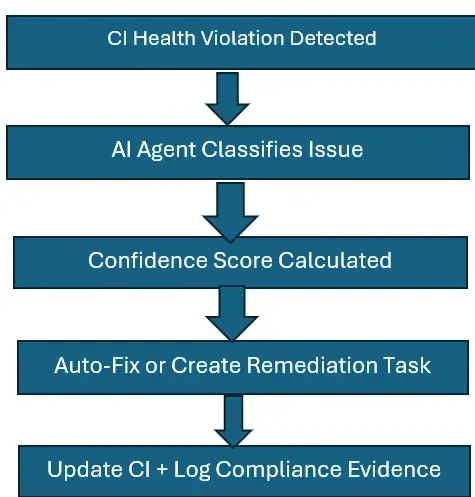
This AI Agent can be viewed as an auto-remediation engine that scans the indicators of health and runs fixes according to pre-established confidence limits and regulations.
How It Works:
- The agent integrates with Now Assist for ITOM, Predictive Intelligence, and Flow Designer to execute corrections.
Automated Actions:
- Populate a missing “CI Owner” by querying Active Directory or Azure AD.
- Correct the “Lifecycle State” based on discovery patterns.
- Trigger a targeted re-discovery for CIs with missing critical attributes.
- Flag stale CIs for decommissioning review.
Business Value
Reduces CMDB administrative effort by up to 60%, ensures continuous data hygiene, and keeps the CMDB audit-ready without manual intervention.
Use Case 3: Relationship Intelligence & Dependency Correction
The Problem
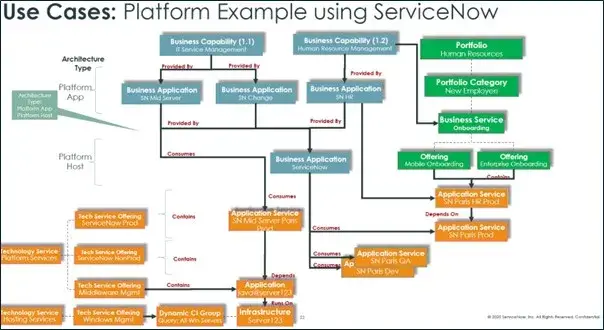
Missing or broken relationships between CIs render impact analysis useless, leading to failed change risk assessments, prolonged incident triage, and unexpected outage blast radii.
The Solution: Dynamic Relationship Discovery and Validation
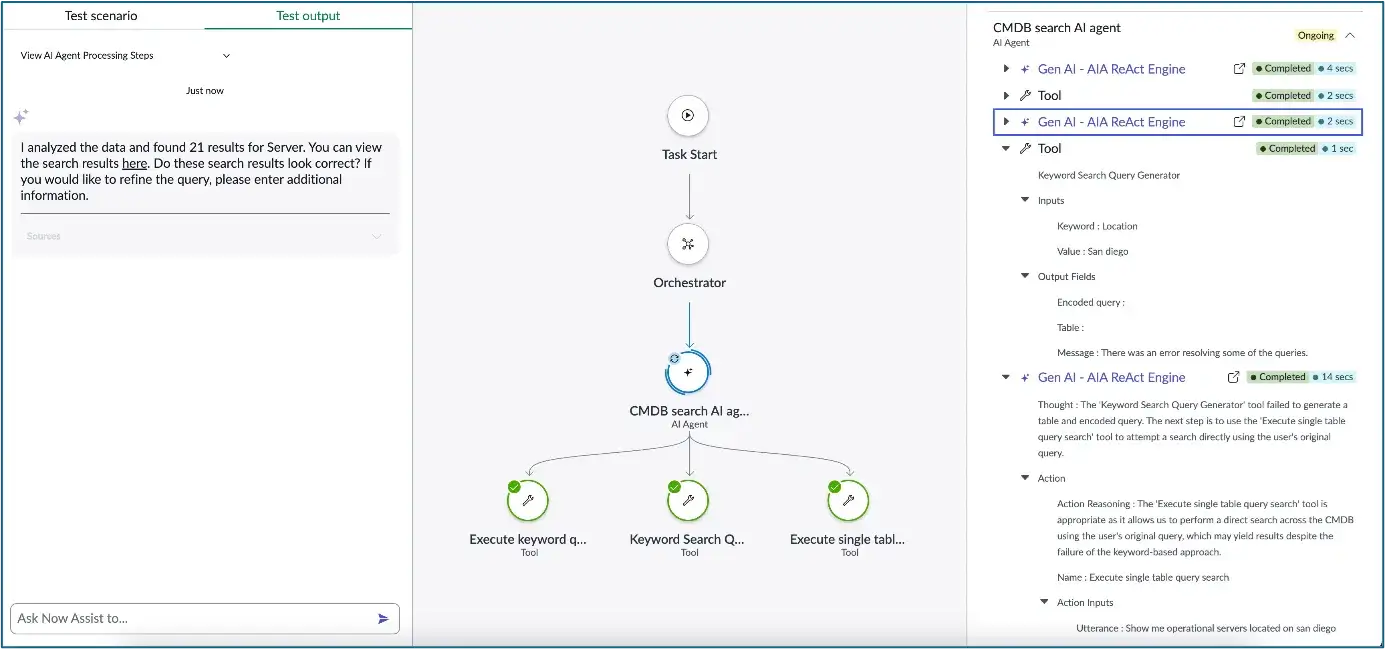
This agent analyzes operational data to infer and validate dependencies that Service Mapping may miss or that degrade over time.
Agent Analysis Sources:
- Service Mapping outputs, network traffic flow logs, and historical incident correlation data.
Business Value
Enables reliable impact analysis for changes and incidents, reduces outage scope, and builds trustworthy service maps for business continuity planning.
Use Case 4: Continuous CMDB Compliance Enforcement
The Problem
Compliance audits (ISO 27001, internal governance) are periodic, manual, and stressful, forcing teams into “fire-drill” mode to remediate gaps under pressure.
The Solution: Proactive, Embedded Compliance Monitoring
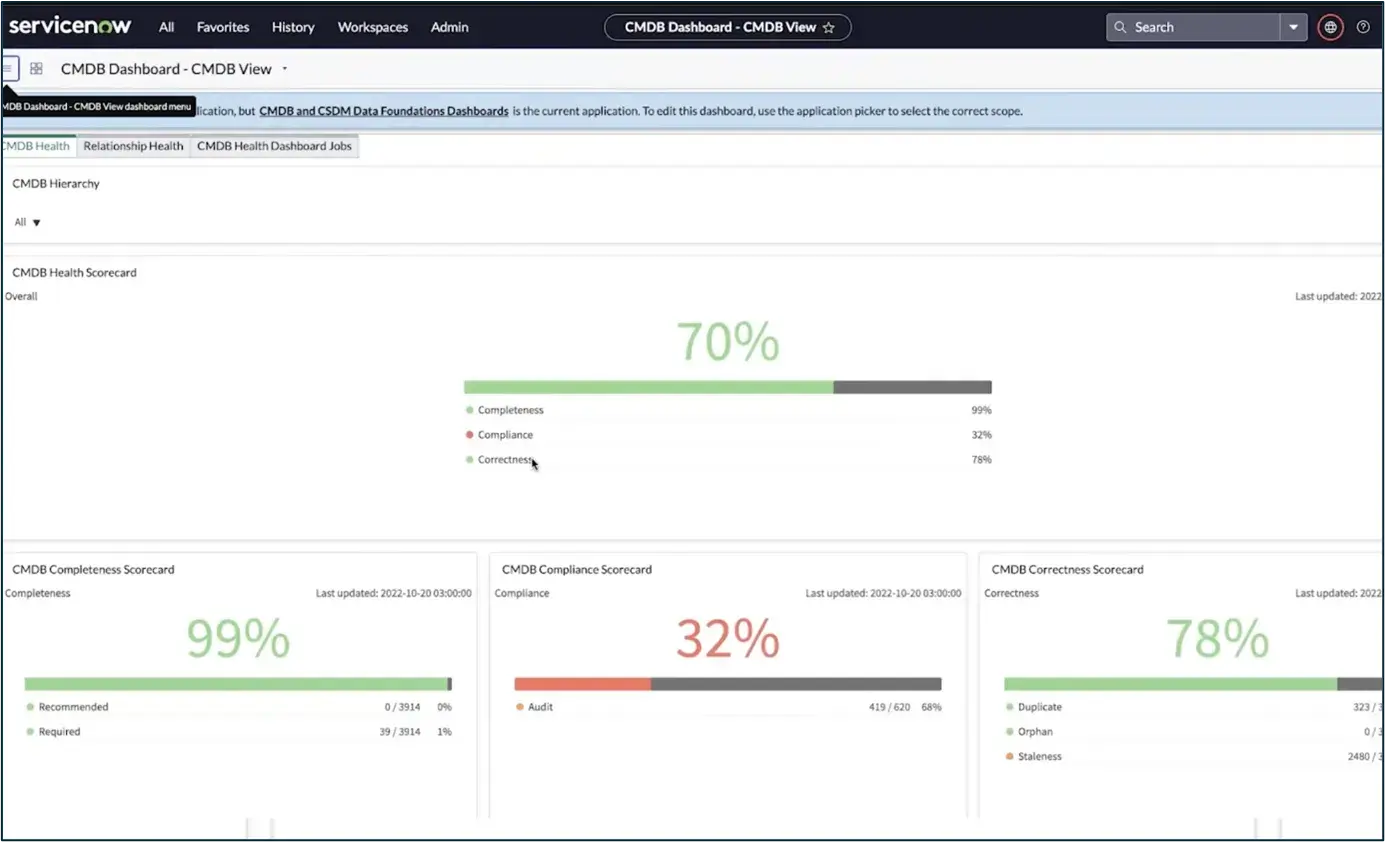
Instead of periodic checks, an AI Agent enforces compliance standards continuously by monitoring the CMDB in real-time.
Compliance Areas Covered:
- Mandatory attribute completeness, accurate CI classification and ownership, adherence to naming conventions, and prevention of unauthorized CI creation.
How It Works:
- The agent validates CIs against policy rules, auto-remediates simple violations (e.g., adding a mandatory field from a trusted source), and escalates complex violations via service management workflows. All actions are logged as audit evidence.
Business Value
Ensures the CMDB is perpetually audit-ready, eliminates last-minute remediation panic, and embeds governance into daily operations.
Use Case 5: Intelligent CI De-Duplication & Source Arbitration
The Problem
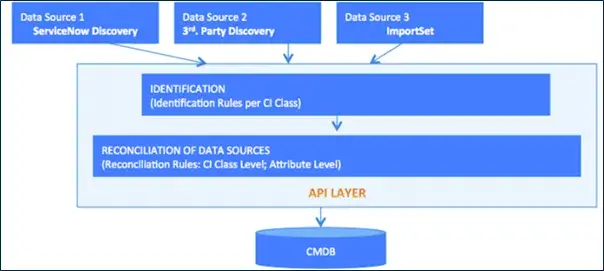
Multiple discovery sources (SCCM, cloud APIs, agent-based tools) create duplicate CIs and attribute conflicts (e.g., different names for the same asset), eroding trust in the data.
The Solution: Smart Merge and Trust Arbitration
This AI Agent identifies duplicate CIs by analyzing fingerprints (serial numbers, MAC addresses, IPs) and employs a trust scoring system to decide the authoritative data source for merging.
Agent Process:
- It detects probable duplicates, evaluates the reliability of each source (e.g., cloud API may be more trusted for a cloud VM than an older network scan), and executes a merge strategy that preserves a complete audit history.
Example:
- Two CIs with identical serial numbers and MAC addresses are flagged as a high-confidence duplicate. The agent merges them, retaining the most accurate attributes from the highest-trust source.
Business Value
Eliminates reconciliation work, creates a single source of truth, and increases data trust across IT, security, and finance teams.
Use Case 6: Predictive CMDB Risk Identification
The Problem
CMDB data issues are often discovered after an incident occurs, making the database reactive rather than a tool for proactive risk prevention.
The Solution: Predictive Risk Scoring for CIs and Services
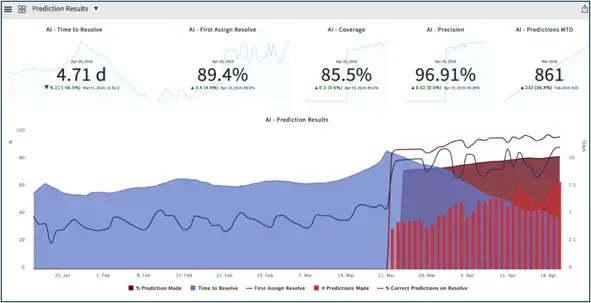
Leveraging historical trends and machine learning, this AI agent predicts potential failure points and data weak spots before they cause disruption.
- The agent assesses CIs for high-risk indicators: aging hardware, missing critical relationships, a history of frequent incidents, or poor data quality scores.
- The agent assesses CIs for high-risk indicators: aging hardware, missing critical relationships, a history of frequent incidents, or poor data quality scores.
Output:
- It assigns risk scores to CIs and services, generates proactive remediation tickets (e.g., “Improve dependency mapping for high-risk service X”), and provides enriched data for Change Risk Assessment modules.
Business Value
Transforms IT operations from reactive to proactive, reduces outages, and strengthens AIOps initiatives with higher-quality foundational data.
Conclusion: From Manual Database to Autonomous Intelligence Hub
Implementing AI Agents within ServiceNow CMDB moves the organization beyond mere dashboard monitoring. It establishes a self-correcting, compliant, and intelligent foundation that actively supports IT, security, and business objectives. The shift is from maintaining data to leveraging autonomously governed data for strategic advantage.
Partnering with an expert can accelerate this transformation. Royal Cyber’s ServiceNow consultants bring deep expertise in designing and implementing intelligent CMDB frameworks, integrating AI Agents, and ensuring your platform delivers measurable ROI.
Transform your CMDB into a strategic asset.
Frequently Asked Questions (FAQs)
Q: Why is using AI Agents better than conventional CMDB maintenance?
The fundamental advantage is the transformation of problem identification to automatic resolution. This removes the backlog of data manually, maintains data health continuously, and frees IT personnel to do strategic work.
Q: Are AI Agents used to substitute human CMDB administrators?
No. They augment them. Agents do repetitive and rule-bound work (e.g. data cleanup, duplicate merging), whereas administrators deal with the definition of governance policies, exception management and the management of strategic integrity.
Q: What is the Royal Cyber approach to ServiceNow CMDB AI Agent implementation?
We begin with CMDB Health Assessment to determine major areas of pain and sources of data. Then we focus on high-impact, rule use cases (such as auto-remediation or deduplication) to implement in a staged implementation, so that we can achieve quick wins and easy to measure ROI before moving to more complex predictive cases.
Q: Do these AI Agent use cases require an ideal clean CMDB to begin with?
Not at all. Indeed, these agents are meant to assist in attaining a clean CMDB. Implementation The implementation can start with agents continuing to fix particular, high-volume problems (such as filling in missing owners or combining apparent duplicates) to create an initial improvement.
Q: What is the integration of AI Agents with current ServiceNow Discovery and Service Mapping?
These tools interact with AI Agents to work together. They take data in Discovery (e.g., last seen dates), Service Mapping (relationship data), analyse it and make decisions, and may instigate new discovery probes or service map updates as part of their automated behavior.
Author
Zainab Batool
Content Writer
Talk To Our Experts
Recent Blogs
Websites used to be something you built once and basically…
Read More »
July 21, 2026
Websites used to be something you built once and basically…
Read More »Websites used to be something you built once and basically…
Read More »