
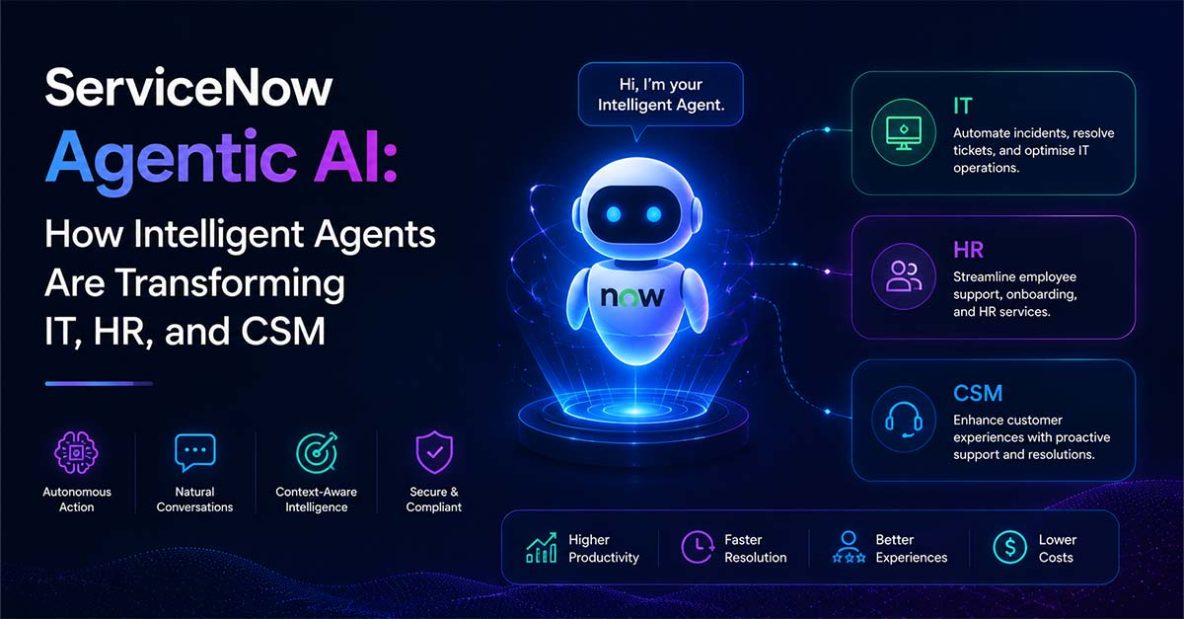
As of upcoming age of enterprise modernization, the enterprise software landscape has undergone a fundamental transformation. We have moved past the era of “GenAI as a sidekick” where AI merely summarized text or suggested code into the era of Agentic AI. On the ServiceNow Now Platform, this shift represents the transition from a system that helps humans work, to a system that orchestrates a digital workforce of autonomous agents capable of reasoning, adapting, and executing with minimal human intervention.
Agentic AI on ServiceNow is defined by its ability to reason, plan, and execute. Unlike traditional workflows that follow rigid “if-this-then-that” logic, these agents are goal-oriented. They leverage the full context of the enterprise from the CMDB to HR profiles to make real-time decisions, resolve complex issues, and collaborate with both humans and other AI agents without constant supervision.
At Royal Cyber, we work at the intersection of enterprise innovation and practical implementation. As a certified ServiceNow partner with deep expertise in AI-driven transformation, Royal Cyber helps organizations architect, deploy, and govern Agentic AI solutions on the Now Platform turning cutting-edge capabilities into measurable business outcomes for IT, HR, and Customer Service teams alike.
Royal Cyber’s ServiceNow practice helps you design, configure, and govern AI Agent Studio, Orchestrator, and Fabric deployments tailored to your enterprise needs.
The Core Pillars of the Agentic Platform
ServiceNow’s Agentic AI is not a single feature ; it is an architecture. Three foundational components work together to enable agents that are powerful, collaborative, and safe.

1. AI Agent Studio: The Development Sandbox
The AI Agent Studio is where the digital workforce is built. Introduced in the Yokohama release, it is the development environment for creating, configuring, and managing autonomous AI agents:
- Specialties & Goals: Rather than scripting every step, creators define what the agent is responsible for such as “Optimize Cloud Spend” or “Onboard Global Employees.”
- Skill Sets: Agents are equipped with tools Integration Hub spokes, Flow actions, or the ability to query the Knowledge Graph allowing them to interact with both digital systems and physical logistics.
- Instructional Guardrails: Using natural language instructions grounded in enterprise policy, creators define the boundaries of what an agent can and cannot do.
Introduced in the Yokohama release, AI Agent Studio is the environment where teams create, configure, and deploy autonomous agents. Rather than scripting every step, you define what the agent is accountable for its specialties, the tools it can access (Integration Hub spokes, Flow actions, the Knowledge Graph), and the natural language guardrails that keep it operating within enterprise policy.
For example, an “Optimize Cloud Spend” agent can be configured to query your CMDB for underutilized assets, cross-reference against active service contracts via Integration Hub, flag candidates for decommission, and raise a change request for approval; all triggered by a scheduled goal, not a human instruction. This is the difference between a tool that waits to be used and a workforce that gets to work.
2. The AI Agent Orchestrator: The Air Traffic Controller
In a mature environment, an organization may have hundreds of specialized agents. The AI Agent Orchestrator is the intelligence layer that prevents these agents from working at cross-purposes. When a multi-domain request enters the system such as a facility expansion requiring IT, Security, and HR coordination the Orchestrator breaks the goal into sub-tasks, managing handoffs and sequencing to ensure proper order of execution.
As your agent footprint grows, the Orchestrator becomes the intelligence layer that stops agents from working at cross-purposes. When a multi-domain request arrives say, a facility expansion touching IT, Security, and HR the Orchestrator decomposes it into sub-tasks, manages the handoffs, and enforces the right sequence. The SecOps agent clears badge access before the Workplace agent assigns the desk. Every time.
3. AI Agent Fabric
AI Agent Fabric is what turns a collection of individual agents into a coherent, enterprise-wide digital workforce. It is the integrated layer that enables agents to share data, collaborate across domains, and execute complex workflows autonomously the foundation that makes the whole greater than the sum of its parts.
How Agent Fabric Works in Practice
Fabric operates through shared context and event-driven triggers between agents. When the ITOM agent resolves an incident and updates the CMDB, that state change can automatically trigger the SecOps agent to re-evaluate affected access policies without a human initiating either step. Fabric connects this chain of events to the Now Platform’s data layer and Integration Hub, meaning agents are always working from a single, consistent source of truth rather than siloed data snapshots.
Agentic Workflows in Action: Use Cases
I. Hyper-Automated IT Operations (ITOM)
In the ITOM space, agents have evolved into “Self-Healing Specialists”:
- Autonomous Triage:When a network anomaly is detected, an agent doesn’t just open a ticket. It automatically correlates the event with recent changes, runs diagnostic scripts via Integration Hub, and checks the CMDB for dependencies.
- Predictive Remediation:If the agent identifies a known fix, it can initiate a change request, wait for the automated risk assessment to clear, and execute the repair. The human engineer only steps in if the agent encounters an “out-of-bounds” scenario.
Traditionally, a network anomaly would generate a P2 incident, sit in a queue for 30 to 40 minutes, and require two or three engineers to coordinate a diagnosis, a fix, and a change approval across separate tools. The cost is not just time it is compounded risk while the issue sits unresolved.
II. The Proactive Employee Experience (HRSD)
The shift from reactive to proactive HR is one of the most tangible benefits of Agentic AI. An agent notices an employee approaching a five-year milestone and autonomously coordinates the reward with their manager, updates payroll for a bonus, and queues a career-growth recommendation without anyone raising a request.
Human Resources has transitioned from a ticket-based department to an outcome-based one:
- Life-Cycle Management:AI Agents now proactively manage employee milestones. An agent might notice an employee is approaching a five-year anniversary and autonomously coordinate with the manager for a reward, update the payroll system for a bonus, and send a career-growth recommendation.
- Context-Aware Support:Instead of a bot saying “Search our KB,” the agent reasons: “I see you’re traveling to Tokyo. I’ve pre-cleared your corporate card for international use and updated your mobile data plan.”
III. Customer Service Management (CSM)
When a customer reports a faulty product, the agent does not route them through a queue. It verifies the warranty, checks real-time inventory, schedules a return courier, and triggers a replacement shipment resolved end-to-end in a single autonomous interaction. What once took days of back-and-forth now takes minutes. Customer satisfaction rises; support costs fall. That is the compounding value of agentic CSM.
Across all three domains, the pattern is the same: the agent handles the sequence of steps that previously required human coordination, leaving your teams to focus on exceptions, strategy, and the work that genuinely cannot be automated. That is not a marginal efficiency gain it is a structural shift in how your organisation operates.

Governance, Security, and the Human Element
The AI Control Tower
The AI Control Tower gives administrators a live, centralized view of every active agent and its reasoning log. Every decision is traceable, you can inspect exactly why an agent took a specific action, which matters enormously for regulated industries that need a complete, auditable trail of AI-driven activity.
- Transparency & Explainability: Every action an agent takes is traceable. Administrators can inspect the thought process of an agent to understand why a specific decision was made.
- Auditability: For regulated industries, the platform maintains a complete audit trail of all AI-driven actions, ensuring compliance with global AI regulations.
In practice, that means an administrator can see that at 09:41, the ITOM agent matched Incident INC-00421 to KB0018843, raised CHG-9002, passed the automated risk threshold of the change advisory process, and executed the fix ; with every step timestamped, attributed to the agent, and exportable for internal audit or regulatory review. There is no black box. Every action has a traceable reason.

Security and Guardrails: Protecting the Agentic Core
- Prompt Injection Protection: Built-in filters prevent “goal-jacking” attempts to trick an agent into bypassing security protocols through manipulated inputs.
- Role-Based Access for AI: Agents operate within the same access control model as human users. A Benefits Agent cannot read Security Logs. A SecOps Agent cannot touch Payroll. Permissions are explicit and auditable.
- Human-in-the-Loop (HITL): Organizations set thresholds for high-stakes oversight. Any action above a defined financial or operational limit pauses for human approval before execution giving you the efficiency of autonomy without surrendering control where it matters most.
Conclusion: The Future of Agentic Collaboration
The organisations that will define their industries over the next five years are not waiting for Agentic AI to mature further. They are building the foundations now the Agent Studio configurations, the Orchestrator logic, the governance frameworks so that when the next release drops new capabilities, they can adopt them in weeks, not quarters.
ServiceNow Agentic AI is not about replacing your people. It is about removing the work that was never worthy of them; the coordination, the data entry, the routine triage so that your teams can focus on the decisions, relationships, and innovations that only humans can deliver. That is the enterprise the Now Platform is built to power.
For most organisations, the right starting point is an honest assessment of where your current Now Platform configuration stands relative to agentic readiness; what is already in place, what is missing, and what the fastest path to value looks like. That assessment does not need to take months. With the right partner, it takes days.
Royal Cyber stands ready to be your strategic partner on this journey. With certified AI architects, a proven delivery track record across enterprise-scale ServiceNow deployments, and a practice built specifically around agentic and AI-driven transformation, we help you move from evaluation to production ; confidently, quickly, and with the governance your organisation demands. The question is not whether to start. It is whether you start before your competitors do.
Frequently Asked Questions (FAQs)
Standard automation follows a rigid, predefined script. Agentic AI is autonomous and adaptive ; agents handle complex multi-step workflows, dynamically make decisions, seek necessary approvals, and learn from previous interactions to continuously improve service resolution; all without human handoff. This enables true 24/7 autonomous service delivery.
The AI Control Tower is the single system of record for all AI activity on the Now Platform. It ingests real-time telemetry from every agent, model call, and policy enforcement event — triggering alerts, initiating ITSM workflows, and blocking non-compliant actions. It provides the audit artefacts required by regulators or internal audit teams.
HITL allows organizations to define thresholds at which autonomous agents must pause and seek human approval — for example, any action with a financial impact above a set limit, or changes to security policies. This ensures high-stakes decisions remain under human control while routine tasks run fully autonomously.
Absolutely. Royal Cyber’s certified experts specialize in non-disruptive platform upgrades from older releases (Rome, San Diego, Utah) to the latest release. We provide a clear upgrade roadmap so you can immediately benefit from Agentic AI and GenAI capabilities while maintaining the stability of your existing workflows. Clients with existing GRC footprints typically achieve 30–40% faster time-to-value.
Our initial ServiceNow AI Strategy Session is a free, focused 30-minute consultation. Following this, Royal Cyber typically delivers a preliminary actionable AI Roadmap outlining the top 3–5 opportunities for your enterprise within 3–5 business days.
Author
Content Writer
Websites used to be something you built once and basically…
Read More »
Websites used to be something you built once and basically…
Read More »Websites used to be something you built once and basically…
Read More »