Comparing Salesforce Storefronts: PWA Kit vs SFRA vs SGJC – A Performance Benchmarking Blog

Salesforce PWA Kit vs SFRA vs SGJC
Comparing Salesforce Storefronts: PWA Kit vs SFRA vs SGJC – A Performance Benchmarking Blog
lala-asif
Lala Asif Allana
Director of Technology - Salesforce

June 2, 2025

Salesforce Storefront Performance Benchmarking

Introduction

In today’s digital landscape, speed and performance can make or break an eCommerce experience. With Salesforce B2C Commerce offering multiple architectural choices, selecting the right framework is critical to building a responsive and scalable storefront.
In this blog, we dive into a side-by-side performance comparison of three prominent Salesforce architectures—SiteGenesis JavaScript Controller (SGJC), SiteGenesis Reference Architecture (SFRA), and the Composable Commerce architecture using PWA Kit and Retail React App. Leveraging data from GTmetrix and Chrome Profiler, we analyze key performance metrics including load times, page size, JavaScript efficiency, and Core Web Vitals.
We also take a closer look at first vs. repeat load performance, to understand how each architecture utilizes modern caching mechanisms like Service Workers to deliver a faster, smoother user experience. If you’re exploring the best path forward for your Salesforce storefront, this benchmarking blog is your go-to guide.
Discover Our Salesforce Solutions Today!

Performance Comparison – SGJC vs SFRA vs PWA Kit

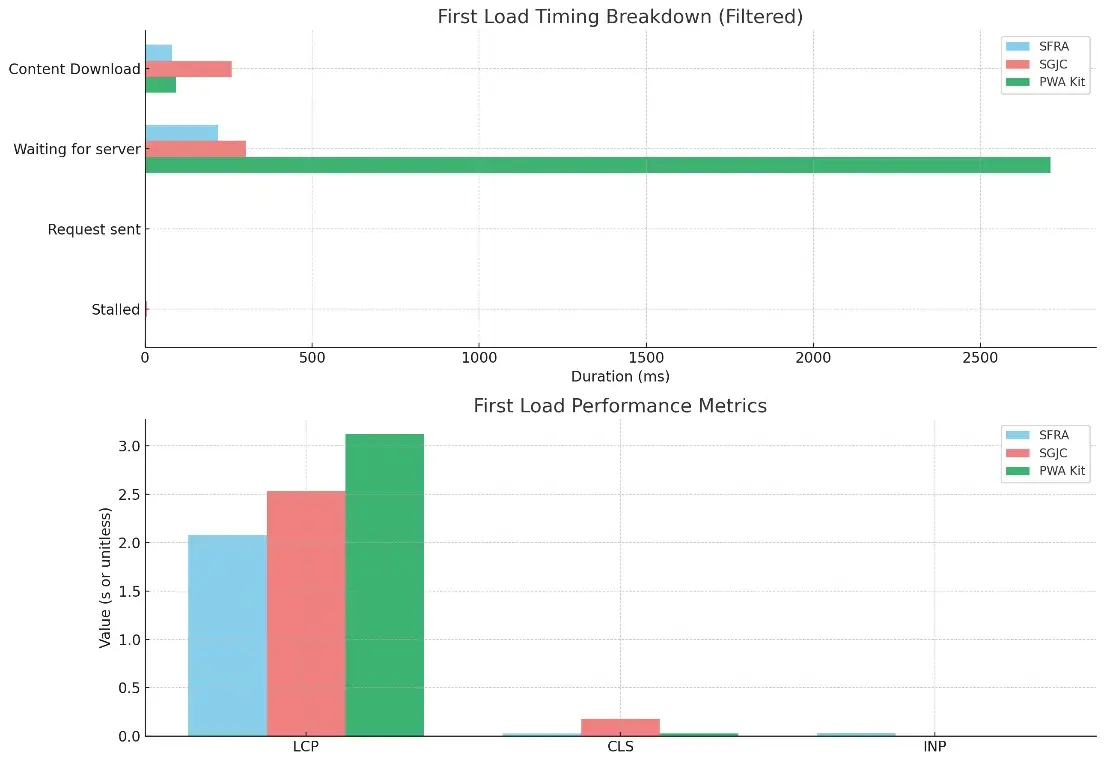
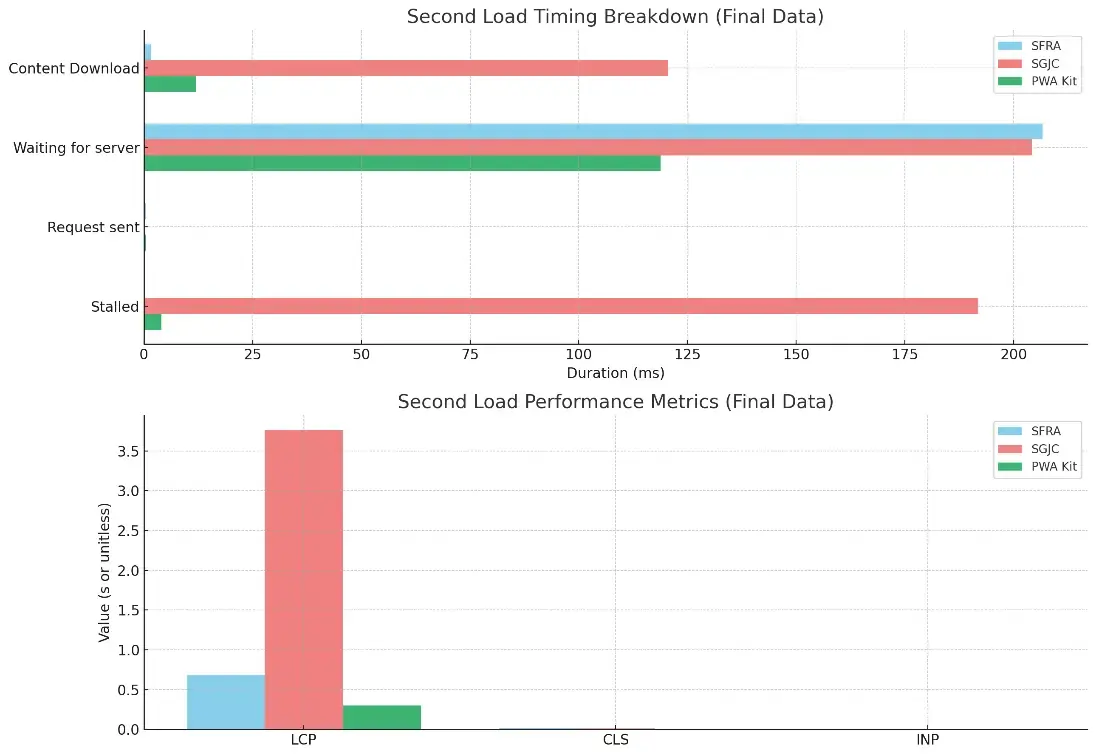
In this section we will compare the performance of each site, using data of timing snapshots on first load and second load of the sites as well as other standard parameters required to measure performance.

First vs Repeat Load – Impact of Caching & Service Workers:

The following graphs compare the timing and performance of each site when loaded the first time with no cache or service worker etc., versus the second load time after refresh while cache/service worker comes into play. This comparison is crucial because it highlights how well each architecture leverages caching and modern web technologies improve user experience on repeat visits, which is a key factor in overall site performance and customer retention.
AI-Driven Enterprise Chatbot Implementation

Results

There is a drastic decrease in time and increase in performance for PWA kit as evident from these graphs. PWA Kit leverages a Service Worker to turn a slow, script-heavy first load into a lightning-fast second visit.
It pre-caches the app shell, static assets, and even API responses so the browser can render the next page in a snap, often without hitting the network at all. This is core to why PWAs feel “instant” after the first load, and a major UX win for returning users.

Performance Parameters Comparison:

Homepage

Metric SFRA Homepage Composable Homepage
Structure Score 88% 95%
Largest Contentful Paint 1.3s 446ms
Total Blocking Time 0ms 520ms
Cumulative Layout Shift 0.04 0
First Contentful Paint 1.1s 446ms
Time to Interactive 1.1s 2.2s
Speed Index 1.3s 591ms
Onload Time 1.8s 681ms
Fully Loaded Time 2.5s 4.3s
TTFB (Server Response) 488ms 188ms
Total Page Size 586KB 569KB
Uncompressed Size 1.02MB 2.17MB
Total Requests 35 34
Image Weight 360KB 104KB
JS Weight 81.7KB 382KB
Font Weight 91.5KB 59.5KB
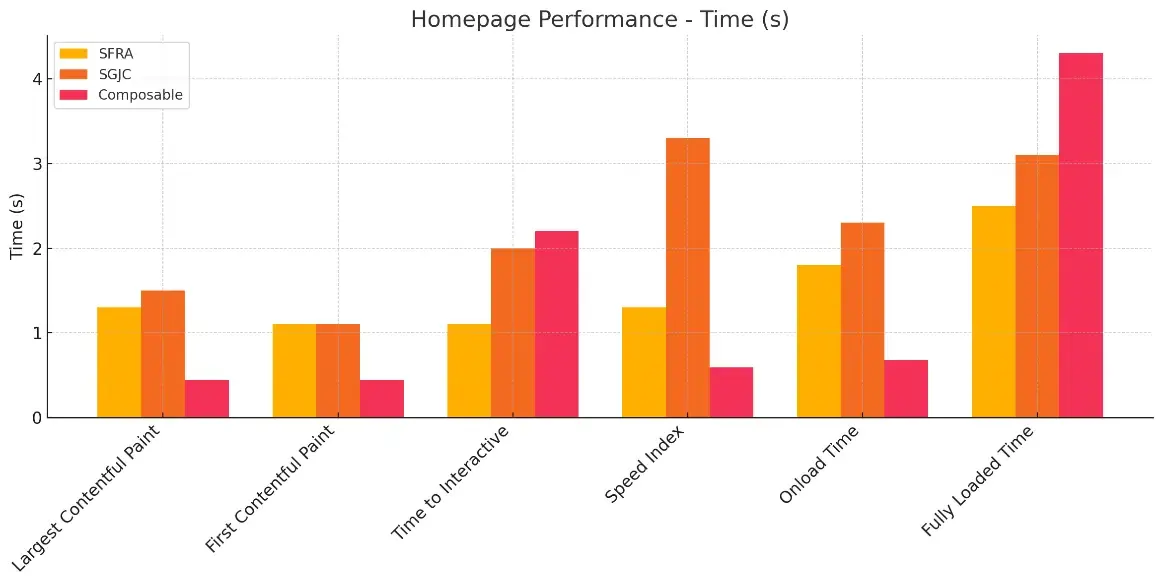
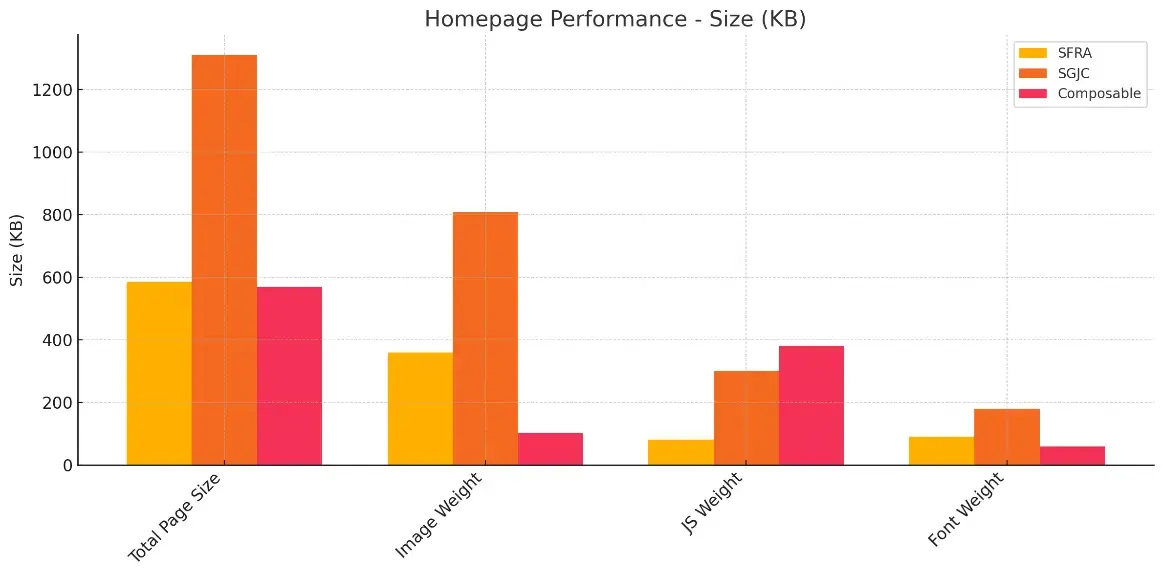
The following graphs represent a visual comparison of key values:
AI-Driven Enterprise Chatbot Implementation

Results

  • LCP Advantage: Composable performed best on Largest Contentful Paint (446ms), offering faster visual load experiences.
  • Blocking Time: SFRA and SGJC had 0ms TBT, while Composable showed 520ms—likely due to client-side JS hydration.
  • CLS Challenge on SGJC: SGJC had the highest layout shift (0.54) and Composable scored a perfect 0.
  • Speed Index: Composable again led here, showing faster rendering than both SFRA and SGJC.
  • JS-Heavy Nature of Composable: It had the highest JavaScript weight (382KB), indicating reliance on frontend logic.

PLP Performance Comparison

Metric SFRA PLP SGJC SFRA PLP Composable PLP
Structure Score 88% 88% 94%
LCP 1.3s 1.3s 458ms
TBT 0ms 0ms 1.3s
CLS 0.28 0.28 0
First Contentful Paint 1.1s 1.1s 284ms
Time to Interactive 1.1s 1.1s 3.4s
Speed Index 1.3s 1.3s 566ms
Largest Contentful Paint 1.3s 1.3s 458ms
Fully Loaded Time 1.9s 1.9s 4.7s
Total Page Size 560KB 560KB 723KB
Total Page Requests 20 20 71
The following graph represents a visual comparison of key values:
AI-Driven Enterprise Chatbot Implementation

Results

  • SFRA PLP (SGJC and General) offers fast TTI (1.1s), zero blocking time, and low requests — making it highly efficient and responsive.
  • Composable PLP shines in early paint metrics (FCP and LCP under 500ms), but suffers heavily in TBT (1.3s) and TTI (3.4s). Despite faster visual load, it delays usability due to JS execution.
  • The CLS score of 28 in SFRA PLPs indicates visual layout instability, which is well-handled in Composable (CLS = 0).

Overall Insight

SFRA PLP is currently better optimized for interaction and load performance. Composable excels in rendering speed but must address script optimization and reduce main thread blocking for parity or superiority. JS-heavy payloads continue to limit composable’s runtime experience. Action items include reducing third-party scripts, leveraging async/defer strategies, and tuning hydration in the composable frontend.
Modern web development prioritizes perceived user experience over raw performance metrics like Total Blocking Time (TBT), Time to Interactive (TTI), and Fully Loaded Time. In Salesforce Composable Storefront (PWA Kit), a lower First Contentful Paint (FCP) ensures content appears quickly, creating a fast and responsive feel even if TBT or TTI are higher due to post-load JavaScript.
These metrics are more pronounced in demo environments because of client-side rendering and heavier scripts, but real-world implementations benefit from optimizations like server-side rendering, caching, and lazy loading. While Composable may report higher technical metrics than SFRA, it handles real user interactions, personalization, and scaling far more efficiently—making the trade-off negligible and the user experience significantly better.

Real Site Considerations

Factor Composable Advantage SFRA Limitation
Integrations Composable loads only what’s needed using API-first delivery. Can be optimized via CDN, caching, and lazy loading. SFRA often loads heavier templates and legacy logic (controllers, templates) that don’t scale as well.
Personalization Composable can defer or optimize personalization via edge functions or async APIs. SFRA personalization is baked into the page server-side, increasing payload and complexity.
3rd Party Scripts Easier to defer/load asynchronously in modern frameworks. Often baked in or inlined in SFRA, which increases TTI and CLS.
Runtime Adaptability React-based apps can adapt in real time to network and device conditions. SFRA delivers static pages that are the same regardless of device performance.
Hydration Optimization Developers can use partial hydration or SSR in composable to lower TTI. Not applicable — SFRA is monolithic and template-rendered.

Real Customer Site Comparison

As an example of improved performance, here is a real-time solution we implemented on a current clients project, where we noted a commendable increase in performance on some key pages after migrating them to Composable from SGJC:
Moving from SGJC to Composable – Performance Improvement
Metric SGJC (SiteGenesis) Composable
PLP Avg Time (on the 95th percentile) 2259ms 1047ms
PDP Avg Time 1383ms 189ms

Results for Real Customer Site

The composable storefront shows significant performance improvement over the SiteGenesis (SGJC) storefront:
  • PLP (Category Page): Reduced from 2259ms to 1047ms~54% improvement
  • PDP (Product Detail Page): Dropped drastically from 1383ms to 189ms~86% improvement
These improvements are especially impactful on the PDP, likely due to composable architecture enabling faster rendering, API efficiency, and more focused content delivery. The reduced load times result in smoother user experience and open doors for better engagement and conversion on product-heavy pages.

Conclusion

The performance results are clear—Composable Commerce with PWA Kit outperforms traditional architectures like SGJC and SFRA by a significant margin. With faster load times, better use of modern web technologies like Service Workers, and an overall smoother experience for users, the PWA Kit sets a new benchmark for high-performing Salesforce storefronts.
While SGJC and SFRA have served many brands well, the shift toward Composable Architecture reflects a broader industry trend toward flexibility, scalability, and speed. If you’re considering upgrading your Salesforce storefront or optimizing performance, now is the time to explore what composable can offer.
At Royal Cyber, we specialize in guiding organizations through this transformation. From strategic consulting and architecture assessment to implementation and optimization, our Salesforce Commerce Cloud experts are ready to help you unlock the full potential of your digital storefront. Get in touch with us to future-proof your eCommerce experience and deliver the speed your customers expect.

Author

Poonam Chandersy
Talk To Our Experts

    [recaptcha]

    Recent Blogs

    Agentforce and Microsoft Copilot Studio are the two dominant enterprise…

    Read More »
    copilot-azure-logic-apps-workflow-automation

    Websites used to be something you built once and basically…

    Read More »

    Websites used to be something you built once and basically…

    Read More »