
Home > Blogs > Salesforce > Salesforce Agentforce vs. Microsoft Copilot Studio: How Enterprises Can Choose the Right AI Agent Platform
February 11, 2026
Salesforce Agentforce vs. Microsoft Copilot Studio: How Enterprises Can Choose the Right AI Agent Platform
Table of Contents
The enterprise landscape of 2026 is rapidly evolving with the emergence of autonomous agent platforms. These advanced AI systems are redefining digital transformation by automating complex workflows an augmenting human capabilities. This blog delves into a comprehensive comparison of two leading platforms: Salesforce Agentforce and Microsoft Copilot Studio.
We will look at their integration ecosystems, architectural foundations, and fundamental competencies. Understanding these differences is essential for business executives, digital transformation managers, and corporate IT leaders to make strategic decisions. Royal Cyber, with its proven expertise in implementing both platforms for global enterprises, provides an authoritative and practical analysis to guide your organization’s autonomous agent strategy.
Get personalized guidance on choosing between Salesforce Agentforce and Microsoft Copilot Studio.
Talk to an AI Agent Expert
Understanding Salesforce Agentforce: Core Capabilities and Architecture
Salesforce Agentforce is an AI-native platform designed to empower autonomous agents to execute complex business processes, particularly within CRM-centric environments. Its architecture is deeply integrated within the Salesforce ecosystem, leveraging the power of Einstein AI and Data Cloud.
- Autonomous Workflows: Agentforce agents, powered by the Atlas Reasoning Engine, can independently handle multi-step processes like lead qualification and service requests, analyzing real-time metadata and retrieving live data from Salesforce Data Cloud .
- CRM-Embedded Intelligence: Agents are “born with context” by directly integrating into systems where customer data resides, eliminating the need to search for information .
- Einstein AI Foundation: Agentforce integrates within the Einstein 1 Platform, combining Data Cloud for unified data and Einstein Copilot for conversational interfaces. The Einstein Trust Layer ensures data security by masking sensitive information before LLM processing.
Ideal use cases for Agentforce span customer service automation, sales acceleration, and service operations. For instance, reMarkable deployed an AI agent named “Mark” in just three weeks, handling over 18,000 service conversations with improving customer satisfaction scores. Deployment requires enabling Agentforce and Einstein Generative AI, activating the Einstein Trust Layer, and using sandboxes with masked data .

Understanding Microsoft Copilot Studio: Core Capabilities and Architecture
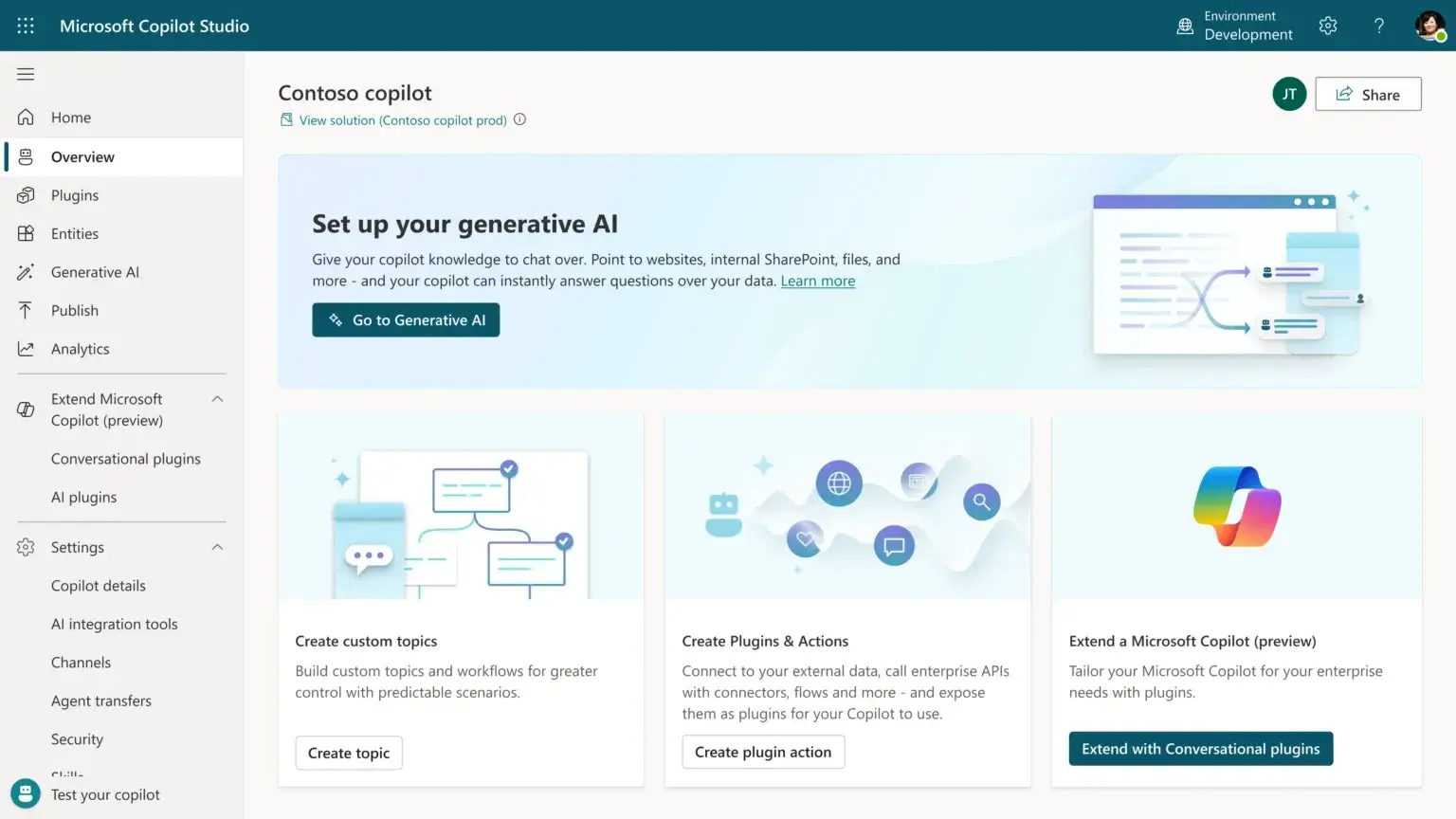
- Microsoft Copilot Studio is a low-code platform for developing conversational AI and autonomous agents that is tightly connected with the Microsoft 365 ecosystem. This platform expands Microsoft Copilot’s capabilities by allowing businesses to design custom copilots based on their own business requirements.
- Conversational AI Builder: Copilot Studio makes it possible to develop unique copilots with sophisticated reasoning and multi-step automation for use with Dynamics 365, Microsoft 365, and external systems.
- Power Platform Connectivity: Strong workflow automation and data management are made possible by the Power Platform’s smooth interface with Power Apps, Power Automate, and Dataverse.
- Azure AI Services: For enhanced AI capabilities and extensibility, Copilot Studio integrates with Azure AI services, such as big language models. For real-time CRM data, Azure AI Foundry connects with the Model Context Protocol (MCP).
Ideal applications include increasing staff productivity, automating internal operations, and streamlining knowledge management. For instance, Microsoft reported notable increases in productivity after implementing Microsoft 365 Copilot for more than 300,000 employees. To securely manage agents during deployment, Power Platform admin controls like connector guardrails and DLP policies must be applied.
Direct Platform Comparison: Features, Scalability, and Integration
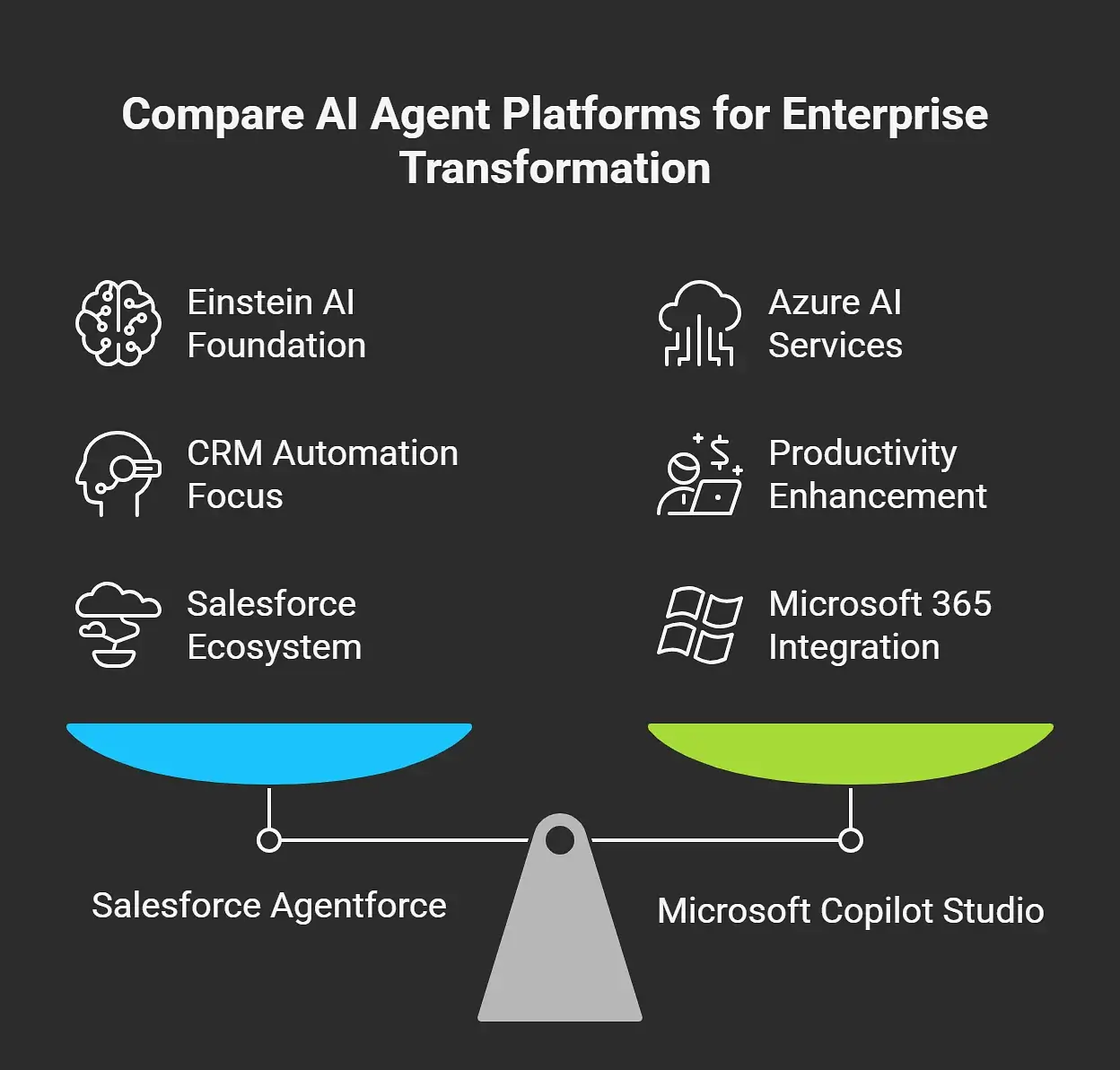
When comparing Microsoft Copilot Studio and Salesforce Agentforce, it becomes clear that each has unique advantages based on its environment. Copilot Studio concentrates on overall enterprise efficiency within the Microsoft platform, whereas Agentforce is best at CRM-centric automation.
Salesforce Agentforce, with its Einstein AI basis, provides pre-built agents for advisers and bankers, indicating a shift toward autonomous front-office automation. It allows multimodal inputs and outputs, as well as “Zero-Copy” federated data grounding with no replication. In contrast, Microsoft Copilot Studio uses Power Platform and Azure AI for enhanced extensibility; features like generative document processing and human-in-the-loop approvals will be available through March 2026.
Both platforms have strong scalability and are intended for operations at the enterprise level. Agentforce’s Atlas Reasoning Engine is designed to orchestrate complex, multi-step actions autonomously. Copilot Studio benefits from Microsoft’s global Azure infrastructure and Power Platform’s scalability. For security and compliance, Agentforce uses the Einstein Trust Layer, offering certifications like ISO 27001 and SOC2 Type II. Copilot Studio provides enterprise-grade controls via the Copilot Control System and Microsoft 365 integration, adhering to GDPR, HIPAA, and SOC standards.
This comprehensive comparison helps enterprises evaluate critical platform differences across AI capabilities, integration ecosystems, pricing models, deployment complexity, and ideal use cases to determine which autonomous agent platform aligns with their strategic objectives.
| Feature/Criteria | Salesforce Agentforce | Microsoft Copilot Studio |
|---|---|---|
| Primary AI Foundation | Einstein AI (Atlas Reasoning Engine, Data Cloud) | Azure AI (LLMs, Power Platform, Microsoft Fabric) |
| Best Suited For | CRM automation, customer service, sales acceleration | Internal productivity, employee support, process automation |
| Integration Ecosystem | Salesforce, MuleSoft, Slack, external systems via RAG | Microsoft 365, Dynamics 365, Power Platform, Azure AI |
| Pricing Model | Flex Credits (pay-as-you-go, pre-commit, pre-purchase) | Copilot Credit capacity packs, pay-as-you-go, pre-purchase |
| Implementation Complexity | Low-code for business users; requires Salesforce expertise for advanced customization | Low-code for citizen developers; Power Platform familiarity accelerates adoption |
| Scalability for Global Enterprises | High, built on Salesforce’s global infrastructure with Atlas Engine for autonomous orchestration | High, leverages Microsoft’s global Azure infrastructure and Power Platform for broad enterprise deployment |
Cost Analysis: Licensing Models and Total Cost of Ownership
Understanding the pricing structures and total cost of ownership (TCO) for autonomous agent platforms is critical for enterprise budget planning in 2026. Both Salesforce Agentforce and Microsoft Copilot Studio employ consumption-based models, but their core licensing and ecosystem integration impact TCO significantly.
Salesforce Agentforce offers two main licensing tiers: Agentforce Add-ons starting at $125 per user/month and Agentforce 1 Editions at $550 per user/month, which include 1 million Flex Credits annually. Flex Credits, costing $500 per 100,000 credits, can be purchased via pay-as-you-go, pre-commit, or pre-purchase models. The Flex Agreement allows budget reallocation between traditional seat licenses and Flex Credits, addressing concerns about unused capacity.
Microsoft Copilot Studio is priced with Copilot Credit capacity packs of 25,000 credits for $200 per pack per month. Additional options include pay-as-you-go and pre-purchase plans with up to 20% discounts. The TCO for Copilot Studio can be substantial, with examples ranging from ~$244,000/year for 500 knowledge workers to $2–3 million for 10,000-seat enterprises, including licenses, Studio usage, and training. Experts warn that “Copilot Studio pricing isn’t just $30 per user — real-world usage can make costs spike fast”.
Hidden costs often include implementation, training, and ongoing maintenance. Organizations deeply invested in the Salesforce ecosystem may find Agentforce’s TCO lower due to native integration and data co-location, while Microsoft 365-centric enterprises will benefit from Copilot Studio’s seamless integration with their existing infrastructure. Royal Cyber assists enterprises in calculating comprehensive TCO and maximizing ROI for both platforms.
Implementation Considerations: Time to Value and Change Management
Enterprise AI agent platform implementations require careful planning to ensure rapid time to value and effective change management. Typical implementation timelines for enterprise AI agent platforms span 2-4 months for pilots and 6-12+ months for full enterprise-grade deployments.
Salesforce states that organizations such as reMarkable implemented an AI agent in 3 weeks, exhibiting speedy initial setup for specific use cases. However, teams with Salesforce expertise and possibly Apex knowledge are needed for complicated integrations and advanced customisation inside the Salesforce ecosystem. Change management for Agentforce often involves retraining customer service and sales teams to work alongside AI agents, focusing on human-AI collaboration and escalation protocols.
There is a 70–75% skill overlap between Power Apps and Power Automate users, which speeds up agent adoption. Simple, well-defined agents can be implemented more quickly, but expanding across a big business necessitates careful security and governance design. The goal of Copilot Studio’s change management is to empower citizen developers and incorporate AI into everyday processes across Microsoft 365 applications. To encourage adoption, new training initiatives and internal champions are frequently needed.
Royal Cyber employs proven methodologies to accelerate deployment success for both platforms. This includes:
- Strategic Assessment: Clearly defining KPIs and use cases.
- Phased Rollout: Gradually expanding from pilot programs.
- Skill Development: Providing platform capabilities training to internal teams.
- Governance Framework: Putting safety and legal boundaries in place.
- User Adoption Programs: Implementing strategies to increase user involvement.
Making the Right Choice: Decision Framework for Your Organization
The decision between Microsoft Copilot Studio and Salesforce Agentforce depends on the use cases, strategic priorities, and current technology investments made by your company. Although both systems are strong, their advantages are tailored to distinct business environments.
Royal Cyber recommends Agentforce for Salesforce-centric organisations. Agentforce provides native integration, utilizing your current data and processes for independent customer support, sales acceleration, and marketing automation if your primary business operations center around Salesforce CRM, Sales Cloud, or Service Cloud. Its key strength is deep CRM integration and a focus on customer-facing agents.
Royal Cyber recommends Copilot Studio for Microsoft 365 enterprises. Organizations that have invested extensively in Microsoft 365, Azure, and the Power Platform will find Copilot Studio to be a logical expansion for increasing employee productivity, automating internal procedures, and streamlining knowledge management. It is particularly good at developing embedded assistants for Word, Excel, Teams, and Outlook.
Additionally, hybrid scenarios—in which businesses use Copilot Studio for internal operational efficiency and Agentforce for external consumer engagement—are becoming more and more prevalent. To handle the challenges and guarantee consistency with your business goals, strategic planning and choosing a knowledgeable implementation partner like Royal Cyber are crucial.
Speak with Royal Cyber experts experienced in both Agentforce and Copilot Studio.
Need Help Choosing the Right AI Agent Platform?
Frequently Asked Questions (FAQs)
Q. What is the main difference between Salesforce Agentforce and Microsoft Copilot Studio?
Salesforce Agentforce is CRM-native, designed for autonomous customer-facing workflows like service automation and sales acceleration within the Salesforce ecosystem. Microsoft Copilot Studio is productivity-focused, built for employee automation and internal process optimization within Microsoft 365 environments. Their primary differentiator lies in their core integration ecosystems and target use cases.
Q. Which platform is more cost-effective for enterprise deployments in 2026?
Cost-effectiveness largely depends on an organization’s existing technology stack. Enterprises deeply invested in Salesforce will likely find Agentforce more economical due to native integration and shared data infrastructure. Conversely, Microsoft 365-centric organizations will benefit from Copilot Studio’s bundled licensing and seamless integration with their existing Microsoft services. Total Cost of Ownership (TCO) should consider licensing, implementation, training, and ongoing maintenance, not just upfront costs.
Q. How long does it take to implement Salesforce Agentforce versus Microsoft Copilot Studio?
Typical implementation timelines for both platforms for enterprise-grade deployments range from 6-12+ months, with pilots taking 2-4 months. Copilot Studio’s low-code approach can accelerate simple use cases, especially for teams familiar with the Power Platform. Agentforce, while also offering low-code options, can provide faster time-to-value for complex CRM-integrated scenarios due to its native data context. Factors like data readiness, integration complexity, and organizational change management significantly influence timelines.
Q. Can I use both Salesforce Agentforce and Microsoft Copilot Studio together?
Yes, hybrid approaches are increasingly common. Organizations can leverage Agentforce for customer-facing automation (e.g., autonomous customer service) and Copilot Studio for internal productivity (e.g., employee support, HR automation). Integrating the two platforms would require strategic planning, potentially using middleware like MuleSoft, to ensure data flow and harmonious operation, adding a layer of complexity to the overall solution.
Q. Which platform has better AI capabilities for autonomous agents?
Both platforms offer enterprise-grade AI capabilities, but they are optimized for different domains. Agentforce is powered by Einstein AI and its Atlas Reasoning Engine, excelling in autonomous, multi-step actions within CRM contexts. Copilot Studio leverages Azure AI services, including large language models, for advanced conversational AI and broader extensibility across the Microsoft ecosystem. The “better” platform depends on the specific use case and the customization options, training approaches, and domain-specific optimizations required.
Q. What skills does my team need to develop agents on these platforms?
For Salesforce Agentforce, teams typically require Salesforce expertise, including knowledge of the CRM platform, Data Cloud, and potentially Apex for advanced customizations. Copilot Studio emphasizes low-code development, making it accessible to citizen developers with Power Platform familiarity. For both platforms, understanding AI principles, prompt engineering, and data governance is crucial. Royal Cyber offers comprehensive training and implementation support services to upskill your team and ensure successful agent development.
Author
Pooja Soddum
Marketing Executive
Talk To Our Experts
Recent Blogs
Websites used to be something you built once and basically…
Read More »Websites used to be something you built once and basically…
Read More »
June 9, 2026
Agentforce and Microsoft Copilot Studio are the two dominant enterprise…
Read More »