
Practice Lead
Mainframe
May 20, 2025

Since digital change is happening rapidly today, modernizing software configuration management (SCM) systems is essential. Many organizations that use Endevor suffer from integration difficulties, sluggish development processes, and problems with team collaboration. This is why many enterprises are now pursuing an Endevor to GitLab migration strategy to streamline operations and embrace DevOps practices. This comprehensive guide outlines a step-by-step enterprise transition plan for migrating from Endevor to GitLab.
Why Modern Enterprises are Migrating from Endevor to GitLab
Older SCM systems, including Endevor, weren’t made to support the needs of today’s CI/CD workflows, distributed teams, and agile development. GitLab is a unified DevOps platform that helps teams work together, automate development processes, and become more flexible.
Key Benefits of Migrating from Endevor to GitLab:
- Enhanced collaboration across teams with Git-based workflows
- Integrated CI/CD pipelines for faster and more reliable releases
- Advanced version control and auditing features
- Scalability to support modern, cloud-native applications
Step-by-Step Plan to Migrate from Endevor to GitLab
A successful Endevor to GitLab migration requires meticulous planning, stakeholder alignment, and tools. Here is a detailed transition roadmap tailored for enterprise environments:
Step 1: Assess Your Current SCM Landscape
Begin by auditing your existing Endevor environment. This includes identifying:
- Applications and components currently managed
- Custom scripts and exit routines
- Dependencies and integration points with other tools
Also, existing mainframe testing tools must be evaluated to determine compatibility with GitLab-based pipelines.
Step 2: Define Migration Goals and KPIs
Establish clear objectives:
- What are business and technical drivers?
- Are you aiming for full or partial migration?
- What metrics define success (e.g., reduced deployment time, error rates, etc.)?
Align stakeholders on a unified vision and define KPIs that will help track post-migration ROI.
Step 3: Choose the Right Tools and Partners
Migration from Endevor to GitLab isn’t just a technical endeavor—it requires domain expertise and powerful automation tools. Partnering with experienced firms like Royal Cyber ensures a smoother transition with fewer disruptions.
Royal Cyber offers:
- SCM modernization assessment
- Custom migration accelerators
- Integration with mainframe testing tools
Step 4: Prepare the Environment
This includes setting up:
- GitLab repositories
- CI/CD pipelines
- User access and role configurations
A sandbox environment will be created to test the migration strategy without impacting production.
Step 5: Inventory and Prioritize Artifacts
Not everything needs to be migrated at once. Prioritize codebases and artifacts based on:
- Business criticality
- Interdependencies
- Ease of migration
Automated tools can help catalog and classify Endevor artifacts for a smoother transition.
Step 6: Data and Metadata Extraction
Extract source code, element history, and metadata from Endevor. Maintain historical versioning and tagging to ensure audit readiness and traceability post-migration.
Step 7: Code and Configuration Migration
Move the code into the corresponding GitLab repositories. This includes:
- Structuring repositories logically
- Mapping Endevor stages to GitLab branches
- Rewriting or replacing build scripts for compatibility
Step 8: Set Up CI/CD Pipelines
Use GitLab’s built-in CI/CD features to automate build, test, and deployment processes. Integrate with mainframe testing tools to validate migrated applications in real-time.
Read Our Case Study: Dynamic Service Endpoint Lookup with DataPower & GitLab for a Leading FinServ
Step 9: Conduct Validation and Testing
Run both automated and manual tests to:
- Validate build integrity
- Confirm environment compatibility
- Verify business logic and performance benchmarks
Leverage mainframe testing tools to perform regression and performance testing during this phase.
Step 10: Go Live and Post-Migration Support
Once all validations are successful, plan a phased rollout to production. Provide post-migration support, including:
- User training
- Documentation
- Performance monitoring
Ongoing support from Royal Cyber ensures your new GitLab setup continues to deliver value.
Common Challenges in Endevor to GitLab Migration
Following are the most common challenges in Endevor to GitLab migration:
Resistance to Change
Many development teams are comfortable with legacy systems and may resist new workflows. A strong change management plan and hands-on training can mitigate this.
Tool Compatibility
Not all mainframe tools are natively compatible with GitLab. Integration may require custom connectors or third-party tools.
Data Fidelity
Ensuring no loss of historical data, dependencies, and metadata during the migration is critical.
Security and Compliance
Ensure your GitLab environment meets enterprise-grade security and compliance standards, especially in regulated industries.
Watch Our Webinar: Mainframe Source Code Management Migration to GitHub
Best Practices for a Smooth Transition
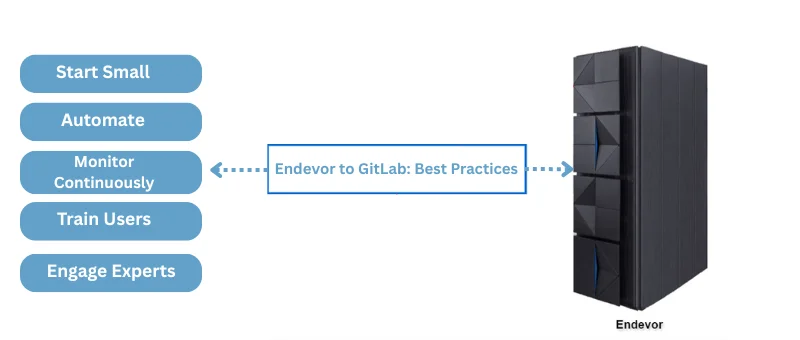
Follow the given best practices (well-recommended by Royal Cyber’s Experts) for Endevor to GitLab migration
- Begin with a pilot project to identify challenges early.
- Use automation for data extraction, migration, and CI/CD setups.
- Use observability tools to monitor build health and performance.
- Conduct workshops and create documentation for new workflows.
- Collaborate with Royal Cyber to leverage domain expertise and minimize risk.
How Royal Cyber Accelerates Your Endevor to GitLab Journey
Royal Cyber is a trusted leader in mainframe modernization and DevOps transformations. Their holistic approach covers assessment, execution, and post-migration support. Our services include the following:
- End-to-end SCM migration solutions
- Prebuilt automation tools for artifact extraction and transformation
- Integration with leading mainframe testing tools
- Continuous support and optimization
With a deep understanding of legacy and modern platforms, Royal Cyber ensures that your Endevor to GitLab migration is fast, secure, and future proof.
Conclusion: The Future of SCM is Agile and Cloud-Native
Enhancing your software configuration management system keeps you ahead of rivals. Migrating from Endevor to GitLab not only streamlines your DevOps processes but also empowers your teams to innovate faster and more efficiently. Observing the details of the plan and drawing on Royal Cyber’s expertise allows your business to move to the cloud easily and smoothly.
Ready to migrate from Endevor to GitLab? Learn more about Royal Cyber’s SCM Modernization Services today.
Author
Numra Haroon
 Websites used to be something you built once and basically forgot about. That doesn’t work …Read More »
- Websites used to be something you built once and basically forgot about. That doesn’t work …Read More »
- Websites used to be something you built once and basically forgot about. That doesn’t work …Read More »