
Home > Blogs > Databricks > How Databricks Data Governance Enhances Enterprise Security and Compliance
March 17, 2026
How Databricks Enhances Enterprise Data Security and Compliance
Table of Contents
The average cost of data breach was 4.88 million in 2024 which is 10 percent higher than it was in the previous year. Ventures that operate large data estates on hybrid clouds, the conventional governance approaches cannot just scale as rapidly as required to protect themselves against the changing threats. Under regulations such as GDPR, regulatory breaches are capable of attracting fines up to 4% of the annual revenue.
However, to have a safe and controlled Lakehouse, it needs to be implemented well by skilled personnel to avoid misconfiguration and to ensure ROI is achieved maximum. Here, Databricks governance changes the enterprise security.
Royal Cyber, a Databricks Partner Consulting firm, is a certified specialist that can improve the distance between platform potential and production-ready reality. At Royal Cyber, consultants provide end-to-end solutions, such as migration and Lakehouse design to deployment of Unity Catalog governance to the creation of production AI agents, which incorporate security and compliance by design. Their accelerators have been proven, and they have over 1,500 success stories in projects that enable organizations to realize faster time-to-value, optimized performance, and willingness to control costs at the outset.
Turn Databricks complexity into governed, production-ready reality.
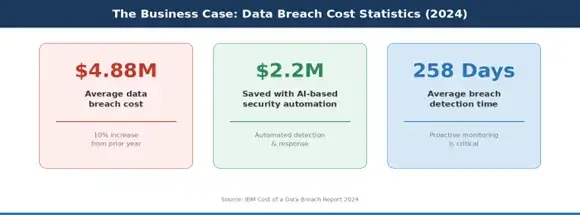
Figure 1: Data Breach Cost Statistics (2024)
Why Databricks Governance Matters
Databricks data governance goes far beyond basic access control. Built on Unity Catalog — the industry’s only unified governance layer for both data and AI assets — it delivers intelligent, automated security controls that scale with your data while maintaining compliance with HIPAA, SOC 2, GDPR, and other critical frameworks.
Recent studies reveal that 40% of technology executives feel their organization’s AI governance programs are insufficient to ensure safety and compliance, while 53% of enterprise architects rank data privacy breaches as their top concern.
Unity Catalog Core Capabilities
Unity Catalog provides a comprehensive set of governance capabilities that work together to secure your entire data estate:
- Single Pane of Glass – Full transparency of data and AI assets in all cloud environments one interface.
- Fine-Grained Access Control– Row-level, column level and attribute based access control (ABAC) to exact security policy.
- Automated Data Discovery Automated classification of sensitive data (PII and PHI) using AI.
- Full Lineage Tracking – Full visibility of data transformations, dependencies and patterns of usage.
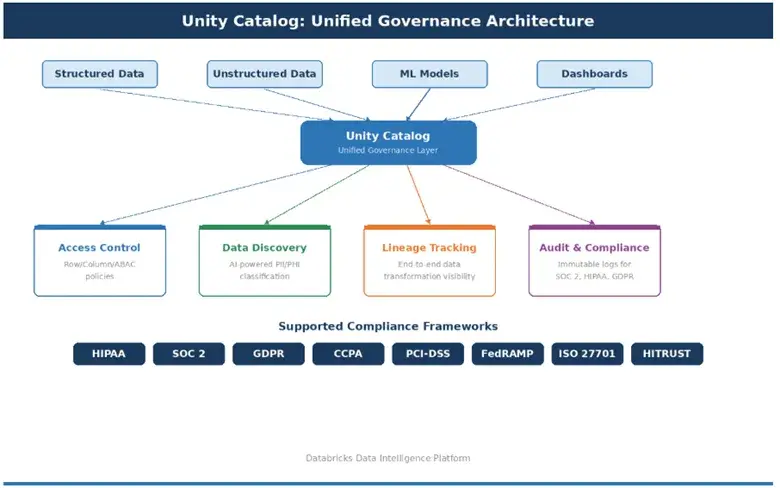
Figure 2: Unity Catalog — Unified Governance Architecture
Advanced Security Features
Databricks governance uses a defense-in-depth approach to data security, using multiple layers of protection to achieve complete coverage.
- Multi-Layered Encryption: Databricks will encrypt all data at rest by default using cloud-managed keys. Customer Managed Keys (CMKs) give finer control for those enterprises who need it. Data in transit is secured using the protocols, https and TLS. For highly-regulated industries, Databricks supports FIPS 140-2 Level 1 certified encryption modules.
- Attribute Based Access Control (ABAC): Role-based access control can get unwieldy at scale. Databricks overcomes this using ABAC which uses tags to define flexible access policies at the catalog, schema, or table level. This makes dynamic policy enforcement possible, which adapts to changing classifications of data.
- Real Time Security Monitoring: Databricks governance features automated threat detection, CIS Level 1 hardened host OS images, automatic updates of clusters with the most recent security patches & detailed audit logs of all data access operations. Organizations that discover breaches themselves save about $1 million as compared to breaches reported by attackers.
- Data Masking/ Pseudonymization: To secure PII and comply with GDPR, Databricks has dynamic data masking, column-level encryption, and pseudonymization. These capabilities allow organizations to leverage production data for analytics but to uphold strict privacy requirements.
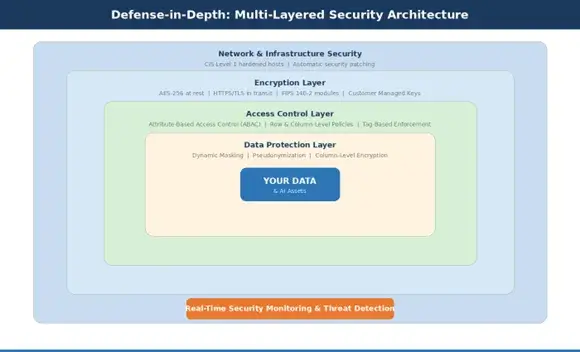
Figure 3: Defense-in-Depth Security Architecture
Don't let misconfiguration put your data at risk
Compliance and Certifications
Databricks compliance is a governing framework that allows an organization to comply with a wide range of compliance certifications that are applicable to various industries.
- Healthcare: HIPAA & HITRUST: Databricks offers HIPAA-compliant Protected Health Information (PHI) de-identification, fine-grained access control, end-to-end audit recording and certification to the HITRUST CSF.
- Financial Services: SOC 2, PCI-DSS, FedRAMP: In the case of financial institutions, Databricks provides security control SOC 2 Type II certification, payment card data PCI-DSS compliance and FedRAMP authorization Moderate and High of Federal systems. Financial services data breaches in 2024 were to the tune of averages of 6.08 million dollars – twice the global average.
- Privacy of Data: GDPR, CCPA and ISO 27701: Databricks ensures the privacy complies with maximum delete operations in the right to be forgotten, webhook in GDPR operations, ISO /IEC 27701 certification, and cross-border data transfer frameworks.
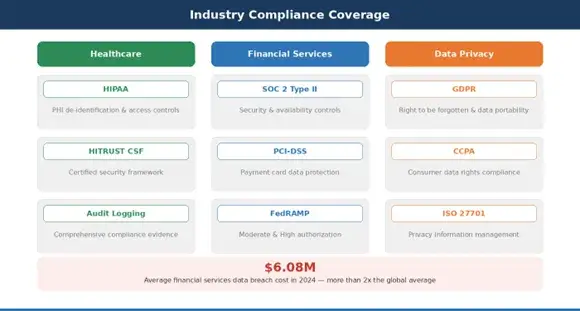
Figure 4: Industry Compliance Coverage
AI and ML Governance
As enterprises accelerate AI adoption, governance challenges multiply According to Gartner, the top strategic technology trend of 2024-2026 is the AI trust, risk, and security management. Databricks incorporates these issues by having AI Governance Framework (DAGF) and Unity Catalog.
- Governing ML Models and AI Assets: Unity Catalog also brings governance to machine learning models including version control and lineage tracking, fine-grained model access control, automated data drift monitoring and detection, and securely encrypted serving endpoints.
- Databricks AI Governance Framework (DAGF): DAGF offers official regulation of AI in four pillars, such as AI organizational strategy, legal and regulatory compliance, ethics and transparency, and comprehensive AI security. This system makes it possible to deploy AI responsibly at an enterprise level.
- Databricks Assistant: AI-Native Governance: The Databricks Assistant, integrated with Unity Catalog, generates security-aware SQL queries, summarizes data pipelines while respecting access controls, and automatically applies appropriate security controls — all in alignment with organizational governance policies.
- Governing Unstructured Data: Unity Catalog Volumes allow organizations to govern unstructured data — images, videos, PDFs, and more — with the same policies as structured data, including unified metadata management, consistent access policies, and end-to-end lineage tracking. This is especially critical given that 35% of data breaches involve shadow data in unmanaged sources.

Figure 5: Databricks AI Governance Framework (DAGF)
The Bottom Line: Security in Competitive Advantage
With a strong Databricks governance, data security becomes a compliance burden that turns into a strategic asset. Organizations that have AI-powered governance repeatedly have smaller and less expensive data breaches. Important business outcomes include:
- Reduced Breach Costs – Automated detection contributes to the recovery of millions of dollars by catching threats early and responding quickly.
- Faster Time-to-Compliance – Pre-built frameworks and automated audit logs reduce the time to comply with regulations for the regulatory audit.
- Scalable AI Initiatives – Build and deploy AI with confidence, with a sound governance foundation from the get-go.
- Unified Data Access – Eliminate the existence of data silos while preserving strong and consistent access controls across all environments.
With breaches taking an average of 258 days to detect and contain, proactive Databricks governance is not just a best practice — it’s a business necessity.
Partnering with Royal Cyber
The translation of platform potential into governance that is production-ready takes enormous expertise. Royal Cyber, a certified Databricks Partner, delivers end-to-end solutions — from migration and Lakehouse design to Unity Catalog deployment and AI agent governance. With over 1,500 successful projects and proven accelerators like Lakebridge, they help organizations achieve faster time-to-value, optimized performance, and cost control from day one.
Ready to Operationalize Your Databricks Security Strategy? Contact Royal Cyber today to arrange a personalized evaluation and take advantage of their free 3-week Databricks optimization assessment. A certified partner is the fastest path from strategy to secure, governed implementation.
1,500+ projects. Proven accelerators. Faster time-to-value.
Frequently Asked Questions
How does Royal Cyber help implement Databricks security faster?
Royal Cyber uses proven accelerators like Lakebridge for migration and pre-built governance blueprints. Their certified consultants ensure Unity Catalog and security controls are configured correctly from day one, dramatically reducing rollout time and misconfiguration risks.
What’s the biggest challenge with Unity Catalog governance?
The primary challenge is designing a scalable data model (catalogs and schemas) and translating complex business access rules into effective ABAC policies. An experienced partner ensures the structure is both secure and practical for all teams.
Does Databricks provide the capability of governing data and AI/ML models?
Yes. Unity Catalog is a unified platform to regulate permissions, lineage, and metadata of tables, files, dashboards, and ML models – allowable governance of all types of assets.
What is Databricks used to do in preparing an audit?
Unity Catalog automatically provides fine-grained, non-writeable audit logs of all data and AI asset access, alterations and lineage. The ability to consolidate evidence is a drastic simplifier and accelerator of SOC 2, HIPAA, and other compliance audit frameworks.
Can we govern existing on-premises data with Databricks?
Yes. Using Databricks Lakehouse Federation and Unity Catalog, you can apply governance policies and query data in external systems like SQL Server or MySQL without immediate migration, creating a unified governance layer.
Talk To Our Experts
Recent Blogs
Websites used to be something you built once and basically…
Read More »Websites used to be something you built once and basically…
Read More »
June 9, 2026
Agentforce and Microsoft Copilot Studio are the two dominant enterprise…
Read More »