salesforce-mcp-headless-360
Salesforces Logo
On-Demand Webinar

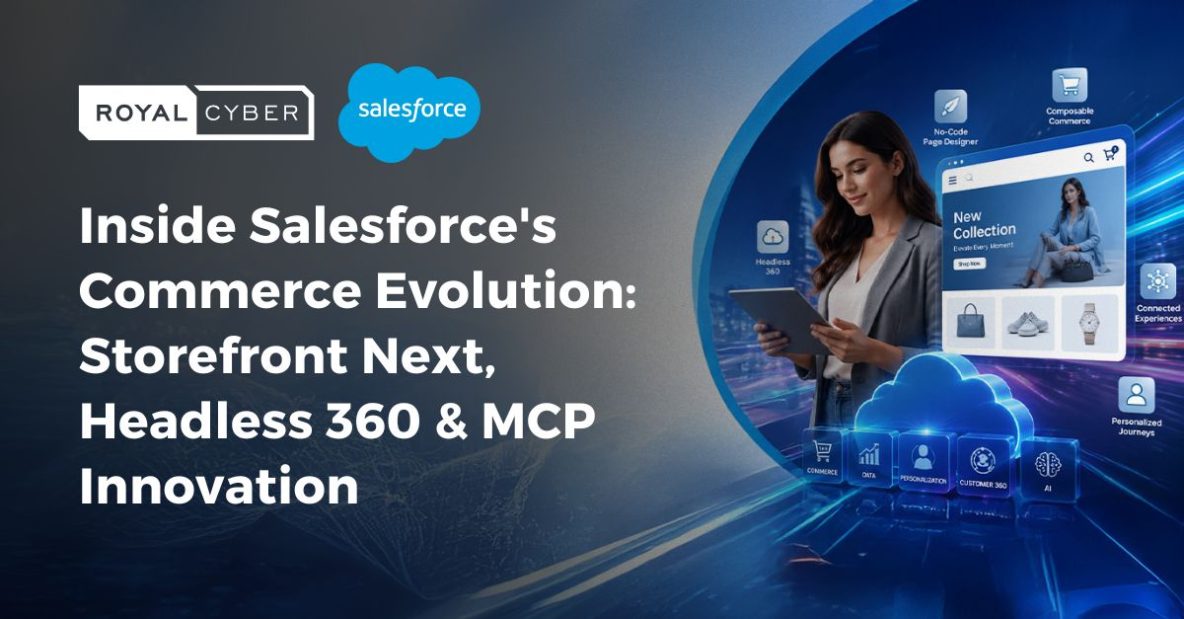
Inside Salesforce's Commerce Evolution: Storefront Next, Headless 360 & MCP Innovation

Why Composable Commerce Is Redefining Salesforce

Salesforce is accelerating its shift toward composable and headless commerce, introducing powerful innovations that are redefining how modern digital storefronts are built and managed. Enterprise B2C brands can no longer afford rigid, monolithic architectures that slow down time-to-market and limit business-user autonomy.

From Native Page Designer in PWA Kit to Storefront Next and the broader Headless 360 vision, these advancements enable faster innovation cycles, reduced development complexity, and future-ready architecture that seamlessly combines commerce, data, and personalization.

In this on-demand webinar, Royal Cyber offers actionable guidance to modernize your architecture and unlock measurable business outcomes, regardless of where you stand on your composable journey.
Agenda
  • Evolution from SFRA to PWA to Composable – What’s driving the shift to headless

  • Native Page Designer (no-code storefront management) + 26.3 Release Highlights
  • How they differ from SFRA / traditional PWA – Connecting commerce, data, and personalization
  • Strategy, migration paths, business impact, and real-world outcomes
Speakers
James Semple
James Semple

Product Management Director, Salesforce

Salesforces Logo
Lala Asif Alana
Sr. Director Technology Salesforce
Foha Khalid
Foha Khalid

Technical Lead Salesforce

Royal Cyber Logo Image
Watch On-Demand

    [recaptcha]

    Share the On-Demand Webinar
    Who Should Attend?
    E-commerce Leaders and Digital Experience Directors
    Salesforce Commerce Architects and Developers
    B2C Brand Managers and E-commerce Operations Teams
    IT Leaders evaluating composable commerce strategies
    Key Takeaways
    Business users gain more control with no-code Page Designer integrated into headless storefronts
    Faster innovation cycles through API-driven composable architecture
    Reduced development complexity by eliminating legacy ISML duplication
    Clear understanding of Storefront Next vs SFRA vs traditional PWA
    Practical migration paths from SFRA / PWA to Storefront Next
    Real-world outcomes including speed, conversion, and efficiency gains